Evidence from the vineyard
High-Altitude Wine in Mendoza: What Elevation Really Changes
Elevation changes the conditions around a vine. It does not replace soil, water, season, farming, or judgment, and it never guarantees a better bottle.
Research note: The guide centers three peer-reviewed Malbec studies and official INV regional sources. Study results are described at their tested sites and are not extended into universal altitude rules.
What does altitude do to wine? Elevation can change a vineyard's temperature pattern, ultraviolet exposure, wind, water demand, frost risk, and pace of ripening. Those conditions may affect acidity, berry growth, skin compounds, color, aroma, and texture. Higher is not automatically better. The result depends on the exact site, soil, season, grape, irrigation, canopy, crop level, harvest timing, and cellar work.
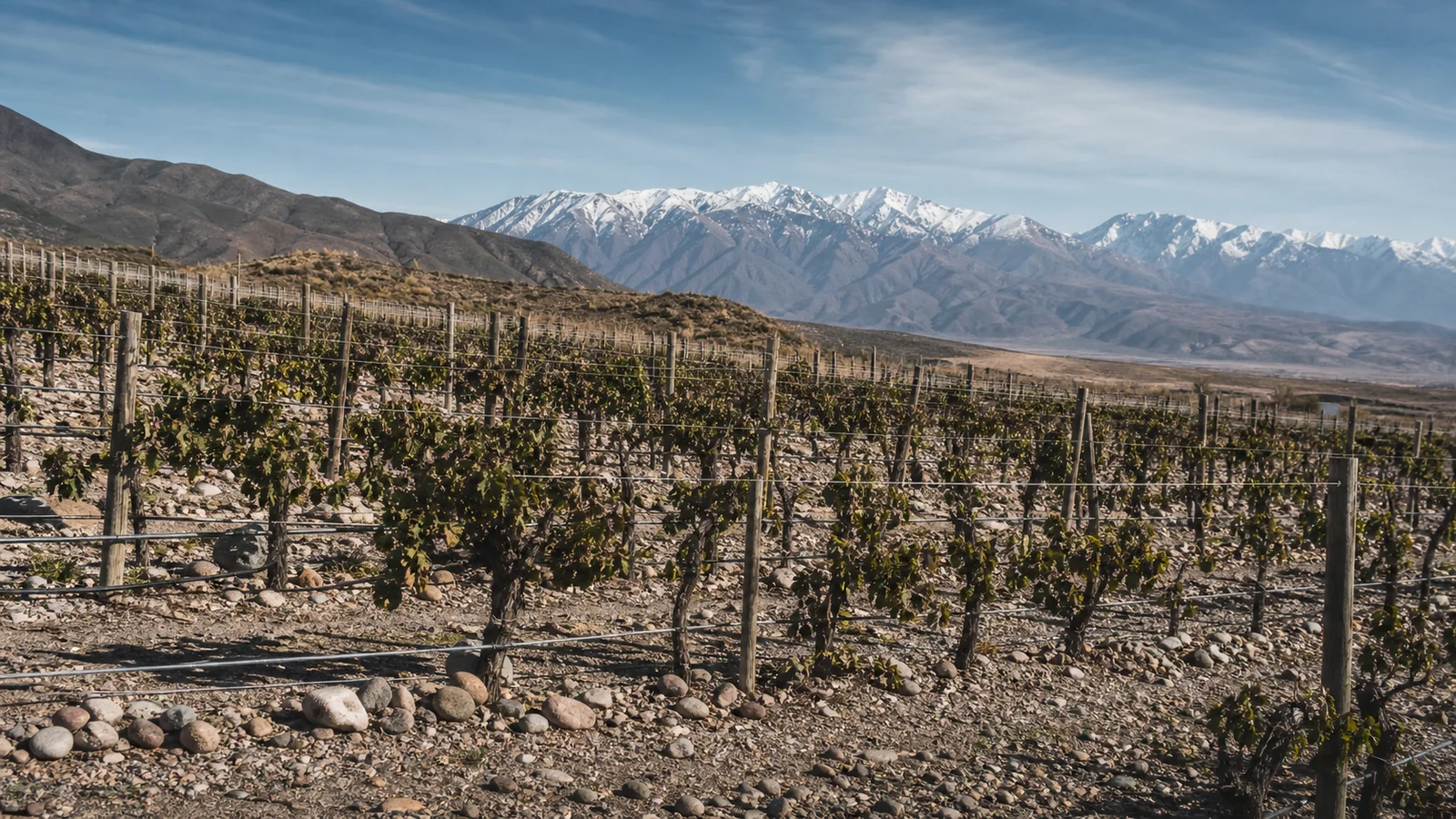
“High altitude” is one of wine’s most persuasive label phrases because it compresses a mountain into two words. The phrase can point to meaningful growing conditions, especially in Mendoza. It can also become a shortcut that skips the work of explaining the vineyard.
This guide unpacks the mechanisms and the limits. It is not a definition of MASL, or metres above sea level. It asks what changes as a vine moves up a landscape, which changes have been tested in Mendoza Malbec, and what a drinker can reasonably infer from the number on a bottle.
Altitude is a bundle of variables, not an ingredient
Elevation does not enter a grape like oak aroma from a barrel. It changes the environment around the vine. Some changes tend to travel together, but not perfectly.
On a phone, swipe the table horizontally to see every column.
| Vineyard factor | What elevation can change | Why the wine result is conditional |
|---|---|---|
| Air temperature | Higher sites are often cooler, especially at night | Latitude, slope, aspect, cold-air drainage, cloud, and season alter the pattern |
| Day-night range | Some elevated desert sites experience warm days and cool nights | A wide diurnal range is not guaranteed by elevation alone |
| Ultraviolet radiation | UV exposure generally increases with elevation and atmospheric conditions | Canopy shading, row direction, berry exposure, and cloud change the dose |
| Water and aridity | Cooler air may reduce some heat load, while wind and exposed soils can raise demand | Irrigation supply, soil depth, roots, salinity, and timing determine vine stress |
| Seasonal timing | Cooler conditions can slow sugar accumulation or shift harvest | Frost windows, cultivar, crop load, heat events, and grower decisions intervene |
| Berry skins and phenolics | UV and moderate stress can stimulate protective compounds | Excess stress can reduce photosynthesis, damage berries, and impair ripening |
| Acidity | Cooler conditions can help retain acid during ripening | Harvest timing, potassium, pH, crop balance, season, and winemaking still matter |
The scientific question is therefore not “Does altitude improve wine?” It is “Which environmental variables changed at this site, how did the vine respond, and what else was held constant?”
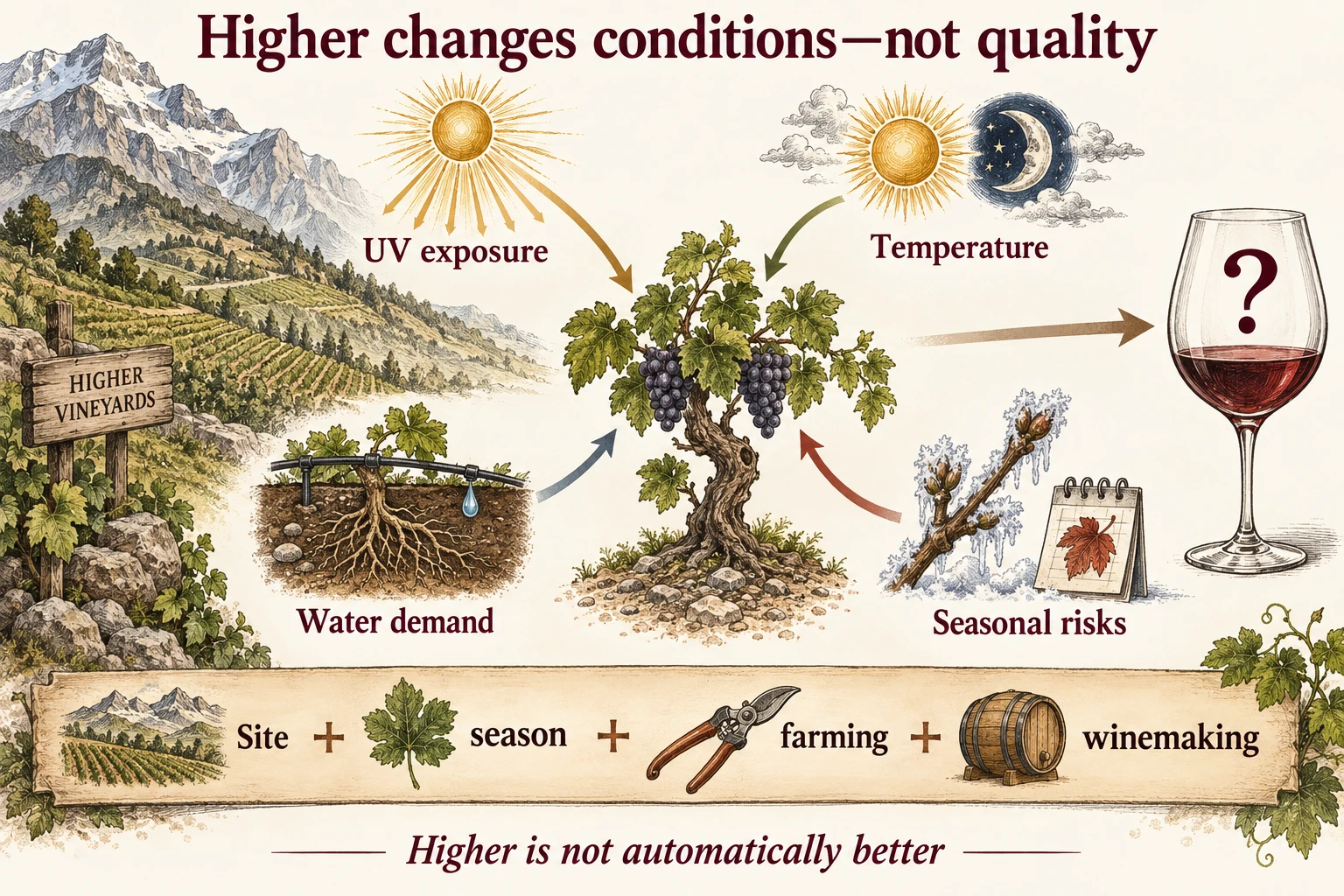
Read the illustration
A mountain vineyard links elevation to temperature, UV exposure, water demand, and seasonal risks. These conditions interact with farming; greater height does not guarantee better wine.
Temperature and the pace of ripening
Air generally cools as elevation rises, but vineyards do not experience an abstract standard atmosphere. Sun-facing slopes warm differently from shaded ones. Cold air can drain downslope and pool. A windy exposed parcel and a protected parcel at the same height may accumulate heat differently.
In favorable cases, warm sunlight allows grapes to build flavor and sugar while cooler nights slow respiration and help preserve acidity. That balance can extend development without forcing a rapid harvest. The careful words are can and in favorable cases. A heat wave, frost, hail, water shortage, or heavily exposed canopy can change the outcome.
This is also why diurnal range deserves its own measurement. Two vineyards at the same elevation can have different day-night swings. A producer who gives actual temperature context tells you more than one who treats metres as a flavor scale.
Acidity is not an automatic altitude stamp
Wine acidity reflects several acids, grape chemistry, harvest timing, pH, potassium, fermentation, and possible cellar adjustments. Cooler ripening often supports greater acid retention, yet a very ripe high-elevation fruit lot can still make a broad wine. An earlier-picked lower site may taste brighter than a later-picked higher one.
When a label promises “high-altitude freshness,” treat that as a hypothesis to test in the glass. Look for lift, salivation, and balance, but do not confuse sharpness with proof of elevation.
UV exposure, berry skins, and color
Grape skins protect the berry and contain anthocyanins and other phenolic compounds important to red-wine color, bitterness, astringency, and development. UV exposure can stimulate protective responses in the vine. Mendoza offers unusually useful field evidence because researchers have tested Malbec across elevations and manipulated UV-B exposure.
A 2008 trial grew Malbec at 500, 1,000, and 1,500 metres and compared ambient UV-B with filtered treatments. At 1,500 metres, berries under ambient UV-B had the highest total polyphenols, anthocyanins, and resveratrol relative to the filtered treatment at that elevation. This supports a UV response. It does not prove that any vineyard at 1,500 metres makes darker or better wine than every vineyard below it.
Three limits matter:
- The comparison involved specific sites, seasons, vines, and experimental treatments.
- Phenolic concentration is not a complete sensory quality score.
- Growers can alter berry exposure through canopy management, and excessive sun can burn fruit.
A dark glass of Malbec may reflect skin chemistry and extraction, but also berry size, maceration, temperature, enzymes, pressing, oxygen, pH, blending, and bottle age. Color cannot tell you the vineyard elevation by itself.
Water, aridity, and the irrigation question
Mendoza’s vineyards occupy dry oases where river water and irrigation make farming possible. The Andes supply snowmelt, but “mountain water” does not remove the need for careful scheduling, infrastructure, and soil knowledge.
Elevation can modify evaporative demand through temperature, wind, radiation, and exposure. Soil then determines how much water is stored and where roots can reach it. A deep, fine-textured profile behaves differently from a shallow, stony one even when the vines receive the same irrigation program.
Moderate water limitation can reduce excessive shoot growth and alter berry composition. Severe stress is not a quality technique. It can close stomata, reduce photosynthesis, expose clusters, stop ripening, or damage the plant. The useful target is vine balance for that parcel and season, not maximum hardship.
The soil-depth study that complicates the mountain story
A 2022 study in Gualtallary examined Malbec within one vineyard at 1,450 metres. Researchers compared shallow and deep soils under the same broad management and irrigation context. Soil depth changed root distribution, vegetative growth, yield, vine water status, and berry phenolics.
The shallow-soil vines had lower vigor and yield. Under some conditions, moderate stress aligned with higher phenolic measures. But the paper also warns that severe water restriction combined with high temperature and UV exposure can cause physiological harm.
That result is valuable because elevation was not the moving headline. The vines were neighbors at the same high site, yet vertical soil variation changed their behavior. “High-altitude vineyard” still contained multiple growing environments.
The practical lesson: ask about rooting depth, stones and fine earth, irrigation, canopy exposure, and vine balance. A precise elevation can locate the parcel, but it cannot summarize what happened below or around the roots.
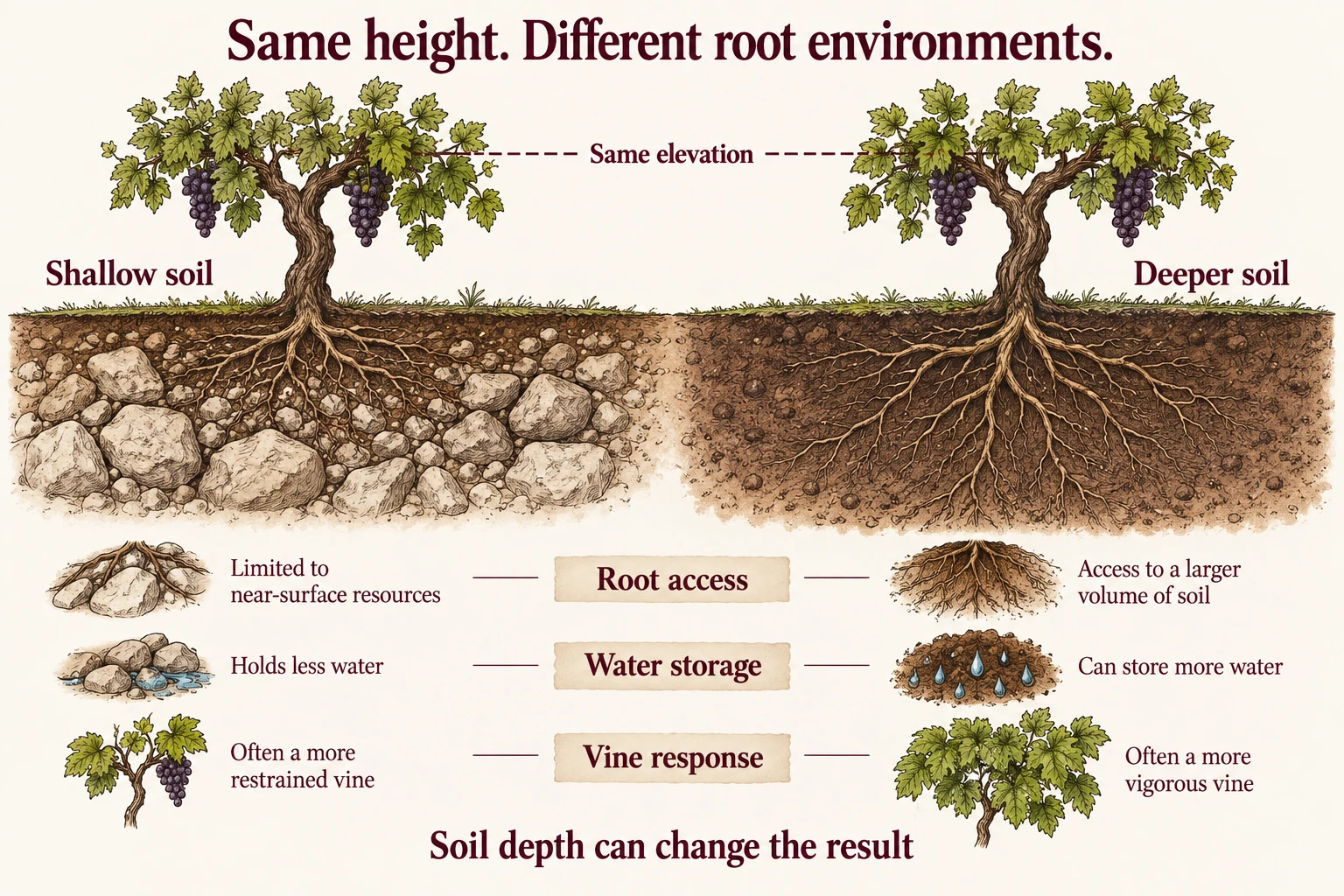
Read the illustration
Two neighboring vines at the same elevation show a shallow stony soil and a deeper soil profile. Root access, stored water, and vine response can differ without any change in altitude.
What standardized Malbec trials found across Mendoza
A 2018 peer-reviewed study sampled 27 Malbec parcels in 13 subregions across six Mendoza departments. The elevation gradient ran from roughly 500 to 1,600 metres. Researchers used standardized small-scale winemaking to reduce cellar variation and better observe geographic signals.
Origin and environment influenced phenolic composition and sensory profiles. Chemical differences were often clearer than simple sensory categories, and not every tasting measure separated sites neatly. The data support regional and vineyard influence, not a single altitude ladder.
This is an important distinction for wine language. A statistically detectable difference is not the same as a universal tasting note. “Higher tastes more floral” or “lower tastes jammy” may fit one dataset or producer lineup and fail in another vintage.
Three Mendoza contexts, not one altitude hierarchy
Mendoza’s five official winegrowing zones span different latitudes, elevations, rivers, soils, and settlement histories. The Mendoza wine regions guide provides the full map. For altitude, three contexts are especially useful.
Center Mendoza and Luján de Cuyo
The INV describes Center Mendoza’s established alluvial and irrigated setting, including piedmont vineyards in Luján de Cuyo above roughly 850 metres. That is elevated viticulture, but the number should be read alongside gravel and other coarse materials, low organic matter in broad regional descriptions, Mendoza River irrigation, and a long history of named districts.
The Center proves that high-altitude wine is not only a Uco Valley story. It also shows why a regional minimum or average cannot stand in for a vineyard profile.
Uco Valley
An INV regional overview gives a broad progression from about 900 metres near Tunuyán city to around 1,250 metres near Tupungato. Individual vineyards extend higher, including the 1,450-metre site in the soil-depth study. Uco’s alluvial fans and proximity to the Andes create strong site contrasts over relatively short distances.
The valley has become internationally associated with altitude, but “Uco” is not one exposure, soil, or wine style. Department, district, geographic indication, vineyard, and producer practice all refine the claim.
San Rafael and the southern oasis
San Rafael belongs to Mendoza’s South zone, not the Uco Valley. Its established vineyards are linked to the Atuel and Diamante river oasis. The legal San Rafael denomination boundary includes a reference point at 692 metres, which gives useful scale but does not define every vineyard’s elevation.
San Rafael should not be marketed as extreme-elevation Uco. Its interest comes from its own combination of southern latitude, river-fed agriculture, alluvial soils, districts, and vineyard decisions. Elevation remains relevant, but it is one coordinate in a different regional system.
For Familia Morgan, that difference is the point. Staying close to San Rafael fruit means understanding what each parcel needs rather than borrowing a mountain claim from somewhere else.
Five altitude myths worth retiring
| Myth | Better reading |
|---|---|
| Higher is better | Higher changes conditions and risks. Quality depends on whether the site and farming are in balance. |
| Altitude always means cool climate | Elevation often cools air, but latitude, exposure, heat events, and air drainage can dominate parts of the season. |
| Cool nights guarantee high acidity | They can support acid retention. Harvest timing, vine chemistry, and winemaking still shape the result. |
| More UV makes thicker skins and better wine | UV can alter protective phenolics. Excess exposure can burn fruit, and phenolic concentration is not a total quality measure. |
| One elevation number predicts taste | Two parcels at the same height can differ in soil depth, water, aspect, canopy, crop, and season. |
How to read a high-altitude wine claim
- Check the unit. Argentina commonly uses metres above sea level. Convert only if you need to compare with feet; do not confuse elevation with vineyard area.
- Look for a named origin. A vineyard, district, or geographic indication gives the number context.
- Ask what the producer observed. Useful details include harvest timing, temperature pattern, soil depth, irrigation, frost, wind, and canopy decisions.
- Separate vineyard facts from tasting claims. “1,200 m” can be measured. “More elegant because of altitude” is an interpretation.
- Compare within a producer or controlled tasting. Similar grape, vintage, élevage, and serving conditions make place easier to evaluate.
What you may notice in the glass
Depending on the site and choices, a high-elevation Mendoza Malbec may show vivid color, floral aroma, fresh acidity, defined tannin, and ripe fruit without feeling heavy. Another may be powerful, warm, and oak-led. A lower-elevation example may be bright and restrained. None of those outcomes invalidates the vineyard’s elevation.
Taste in this order: temperature, fruit ripeness, acidity, tannin, alcohol, then oak. Revisit the wine with food. If you want to understand the grape before isolating altitude, use the Malbec wine guide. When you are ready to compare bottles by value and disclosed style, continue to the affordable Malbec buying guide.
Let the vineyard claim earn its place
When you explore Familia Morgan wines, read the origin and cellar details together. Elevation matters most when it is part of a specific, honest site story.
Sources and methodology
The central evidence comes from experiments and standardized Malbec studies, not promotional summaries. Findings are kept within the conditions tested, and official regional reports are used for orientation rather than a quality ranking.
- Berli et al., field trial of UV-B effects on Malbec at 500, 1,000, and 1,500 metres, Journal of Agricultural and Food Chemistry (2008).
- Ubeda et al., standardized study of Malbec origin across Mendoza, Food Chemistry (2018), 27 parcels across a roughly 500–1,600 metre gradient.
- Dayer et al., soil depth, vine performance, and berry composition in a 1,450-metre Malbec vineyard, OENO One (2022).
- INV, official Mendoza regional reports index, for Center, Uco, and South zone context.
- INV Resolution C.31/2007, for the San Rafael denomination boundary reference.