Georgian Wine: Qvevri, History, and Modern Challenges
Overview
Georgia is often called one of the birthplaces of wine. The country sits in the South Caucasus, a region where archaeological evidence points to some of the earliest grape domestication and winemaking practices. Georgian wine culture is built on two pillars: ancient methods, especially qvevri fermentation, and a remarkable range of native grape varieties.
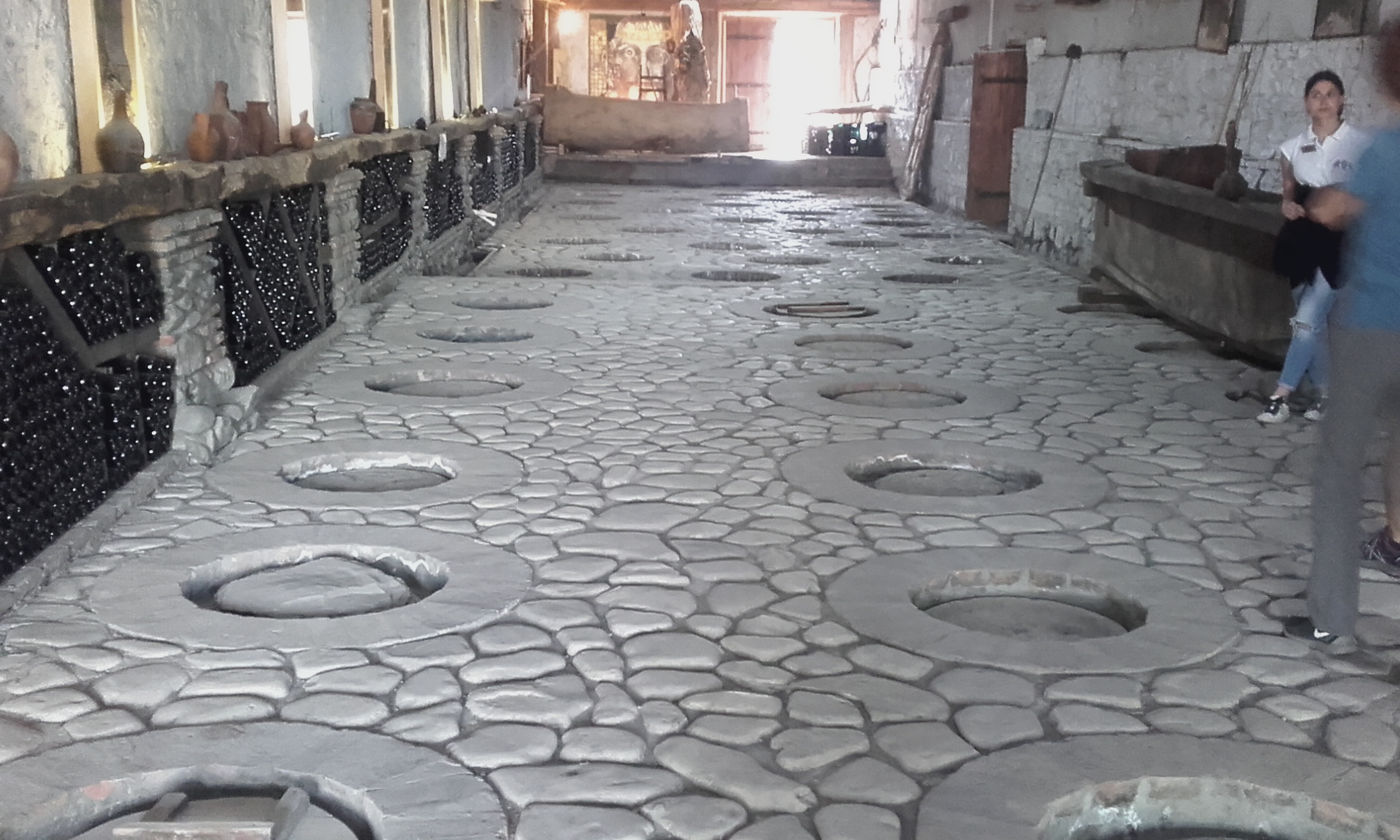
While the tradition is ancient, the modern market has been shaped by Soviet-era industrial production, a 2006 Russian embargo, and recent efforts to rebuild quality and global recognition. The result is a wine culture that balances deep heritage with urgent modernization.
Ancient Origins and Early References
The word wine is rooted in the Latin vinum, but the practice itself is far older. Archaeological research in the Caucasus suggests grape domestication and early fermentation occurred between the sixth and fourth millennium BC. Studies associated with the Shulaveri-Shomu culture in the central Transcaucasus region provide some of the earliest grape seeds and fermentation evidence.
Classical literature reinforces the idea of a wine-rich Caucasus. Apollonius of Rhodes wrote about the Argonauts encountering wine in Colchis (western Georgia), and Homer referenced the fragrant wines of Colchis in the Odyssey. These stories are not scientific proof, but they align with archaeological findings and show how long the region has been associated with vine culture.
Evidence for grape wine and viniculture from the Georgian sites of Gadachrili Gora and Shulaveris Gora dates to approximately 6000–5800 BC—roughly 8,000 years ago—supporting Georgia’s exceptionally ancient winemaking history.
Native Grape Varieties
Georgia is home to dozens of indigenous varieties. Some are known internationally, while many remain local and are rarely seen outside the country.
Notable red grapes include:
- Saperavi
- Vanis chkhaveri
- Otskhanuri sapere
- Dzelshavi
Key white grapes include:
- Rkatsiteli
- Tsitska
- Tsolikouri
- Krakhuna
- Mtsvane kakhuri
- Mtsvane khikhvi
This diversity allows Georgia to produce a wide range of styles, from robust reds to amber whites and aromatic, delicate whites. The mix of varieties is a major part of the country’s identity.
Kakhetian and Imeretian Methods

Read the illustration
Two conceptual white-grape winemaking paths contrast extended contact with grape solids against less contact. Skin contact can add amber color and tannic texture; the vessel alone does not fix the final wine style.
Two traditional methods dominate Georgian winemaking: the Kakhetian and Imeretian approaches, named after their regional origins.
The Kakhetian method for white wine involves fermenting the must with skins, stems, and seeds. This extended maceration can last up to six months, producing amber wines with tannic structure and alcohol levels around 13 to 14 percent. These wines often feel more like reds in texture, with a deep golden color and pronounced grip.
The Imeretian method uses far less skin and stem material, often 5 to 10 percent. This produces a lighter wine with higher perceived acidity and lower alcohol, often around 11 to 12 percent. The profile is fresher, with less tannin and more immediate drinkability.
The contrast between these two methods shows how technique defines style. Georgian wine is not just about grape varieties; it is about how the grapes are treated during fermentation and aging.
Qvevri Craft and the Marani Cellar
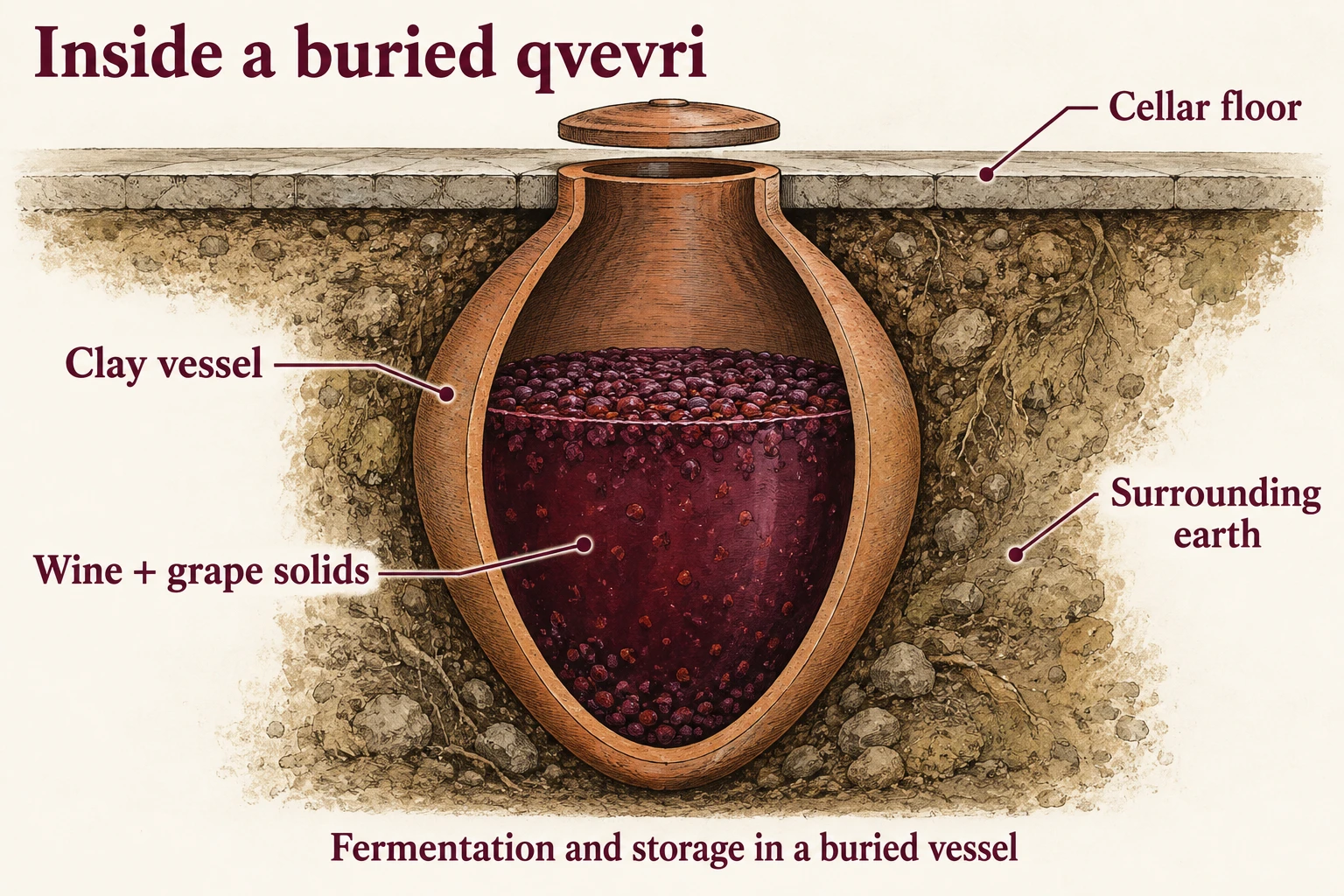
Read the illustration
A clay, egg-shaped qvevri is buried to its neck in the cellar floor. The cutaway shows wine and grape solids inside, with the surrounding earth providing insulation. It is used for fermentation and storage; this is a conceptual diagram, not an operating specification.
The qvevri is a large clay vessel used for fermentation and aging. It is buried in the ground, which keeps the temperature stable around 13 to 14 degrees C. This natural insulation allows fermentation to proceed without mechanical temperature control.
Qvevri are handmade by specialized potters, and each vessel is shaped by hand rather than on a wheel. The craft is demanding, and the number of artisans has declined as fewer young people enter the trade. This creates a preservation challenge for traditional winemaking: without skilled potters, the method itself becomes harder to sustain.
Historical accounts note that similar clay vessels were used in ancient Egypt and Assyria, but Georgian practice differs in its full burial of the vessel, which creates a stable thermal environment. That constant temperature is one of the reasons traditional wines can ferment and mature without modern temperature management.
Most Georgian households with a winemaking tradition have a marani, a dedicated cellar space where qvevri are buried. In Kakheti, marani are often stone structures. In Imereti, qvevri may be buried under outdoor canopies rather than in enclosed cellars. These regional differences are part of the tradition and reflect local practice.
A cultural ritual often cited is the filling of a qvevri at the birth of a child, to be opened at a wedding. Whether practiced widely or symbolically, it underscores how wine is woven into Georgian life events.
Soviet Legacy and the Embargo Era
The Soviet era transformed Georgian wine into an industrial commodity. Large cooperatives prioritized volume, using high-yield varieties and standardized methods. After the collapse of the Soviet Union, many of these structures remained, and modern technology began replacing traditional methods in some wineries.
Imported stainless steel equipment made production more predictable, but it also pulled some producers away from qvevri traditions. This tension between efficiency and heritage has been one of the defining questions for the modern industry.
A major turning point came in 2006, when Russia imposed an embargo on Georgian wine and mineral water. Russia had been Georgia’s dominant market, and the ban forced producers to seek new buyers and to improve quality for international competition. The embargo had mixed effects: some wineries closed, while others were forced to modernize, improve hygiene, and focus on quality. The parallel history of Russian wine helps explain the market and consumer preferences on the other side of that relationship.
The Russian ban also encouraged the formation of quality-focused organizations. Slow Food established a presidium for Georgian wines made in qvevri, initially focusing on Kakheti and Imereti. Later, Kartli joined the effort. The goal was to help producers improve facilities, adopt sustainable practices, and create marketable wines without abandoning traditional methods.
The presidium model emphasized basic improvements: cleaner cellars, better storage, and training in fermentation control while still relying on buried clay vessels. It also encouraged small producers to join together for marketing and education, giving traditional winemakers more visibility in export markets.
Exports and Market Shifts
During the embargo years, exports shifted toward Ukraine, Kazakhstan, Belarus, and other post-Soviet markets. Georgia also built presence in the United States, China, the Baltic countries, and Azerbaijan. These markets required different styles and higher quality standards, pushing producers to raise their game.
Industry figures suggested that Georgian wines had previously held around 10 percent of the Russian market. When the embargo hit, that share was filled by wines from South America and elsewhere, making it difficult for Georgian producers to regain their position even after trade discussions resumed.
Some producers responded by diversifying revenue. The production of chacha, a grape-based spirit distilled from skins and seeds, became more prominent as a way to use byproducts and build additional market presence.
By the early 2010s, Georgian officials began talks with Russian regulators about resuming exports. Even as those discussions progressed, Russia signaled that it would continue to restrict imports of wine material (must and semi-finished wine), a policy that put Georgia at a disadvantage compared with countries that export bulk wine. This added another layer of complexity to the recovery of the Russian market.
Where Georgian Wine Stands Today
Georgia today is a country balancing heritage and modernization. Traditional qvevri wines have gained international interest, while modern wineries experiment with stainless steel and international varieties. The tension between tradition and innovation is not a weakness; it is part of the country’s identity.
The long-term future depends on sustained quality improvement, consistent regulation, and access to stable export markets. Georgian wine is still rebuilding its global position, but the combination of ancient tradition, unique native varieties, and modern ambition gives it a compelling foundation.
For drinkers, Georgian wine offers something rare: a living tradition that is still evolving, rooted in one of the oldest wine cultures on earth but actively adapting to the modern world.
FAQ: Georgian Wine
What is Georgian wine known for?
Georgian wine is known for ancient South Caucasus winemaking, buried qvevri fermentation, amber wines made with skin contact, and native grapes such as Saperavi and Rkatsiteli.
What is a qvevri in Georgian wine?
A qvevri is a large clay vessel buried in the ground and used to ferment and age wine. Burial stabilizes temperature, while extended contact with skins, seeds, and sometimes stems gives many traditional Georgian wines their color, texture, and savory complexity.