In the cellar · vessel field guide no. 01
Wine Barrel and Cask Sizes
A vessel name is a clue, not a conversion table. Read the place, the producer, and the actual liters.
Research note: Capacities are tied to named regional, regulatory, and producer sources. Technical interpretation is bounded by primary research on oxygen transfer and oak extraction.
The working rule
How big is a wine barrel?
There is no single answer. A Bordeaux barrique is conventionally 225 liters, while the traditional Bourgogne pièce is usually 228 liters. But names such as hogshead, puncheon, pipe, butt, Fuder, foudre, and tun have moved across places and centuries.
These are working names, not universal standards. Capacity can shift with region, era, cooper, and producer, so the actual stated capacity in liters wins. Use the name to ask a better question—not to end the calculation.
Compare the reference capacities
01 · Language before liters
Barrel, cask, and vat are not a clean size ladder
In ordinary cellar English, cask can be an umbrella term for a coopered wooden vessel, while barrel often suggests a smaller cask that can be moved and stacked. The boundary is usage, not a worldwide capacity rule. A 225-liter barrique is a barrel and a cask; a very large foudre is usually called a cask or vat rather than a barrel.
Vat is broader still. A vat may be wood, concrete, or steel, open or closed, small or enormous. The French term cuve likewise names a vat or tank without giving you a material or volume by itself. Shape matters, too: a vertical vat and a bilge-shaped barrel can hold the same liters while presenting different geometry and handling.
The glossary owns the concise definitions; this guide owns the comparison. Where a term already has a glossary entry, its link stays with the definition. Here, the question is how the names relate—and what those relationships do and do not let us infer in the cellar.
02 · A contextual scale
Reference capacities, from barrique to foudre
The plot below places evidence-backed examples on one axis. It deliberately shows bands where a name varies and a point where an official source gives a single regional convention. The foudre remains open-ended because large-format cooperage is made in many capacities.
Cellar ledger · liters
Named capacity references
200 L 3,000+ L
- BarriqueBordeaux · 225 L
- PièceBourgogne · 228 LPouilly-Fuissé · 212 L
- Hogshead238–300 L
- Puncheon500–600 L
- PipePort · 550 L average
- Demi-muidBourgogne · 600 L
- Butt / botaJerez · 500–600 L named types
- FuderGermany · 900–1,500 L regional examples
- Tun252 gallons historically954–1,145 L only after choosing a gallon system
- FoudreCustom; commonly thousands of liters
03 · The comparison ledger
What each vessel name tells you—and what it does not
| Name | Evidence context | Capacity reference | Do not assume |
|---|---|---|---|
| Barrique | Bordeaux; also used more broadly as a small wine barrel name | 225 L in the Bordeaux source | That every vessel called barrique is the same wood, toast, origin, or even capacity. |
| Pièce | Bourgogne, with a documented local exception | 228 L generally; 212 L in Pouilly-Fuissé | That a French regional name crosses appellation boundaries unchanged. |
| Hogshead | Historical English wine measure versus current Australian logistics | About 238 L after one historical wine-gallon conversion; 300 L in AWRI’s current table | That the historical measure and a modern cooper’s vessel are interchangeable. |
| Puncheon | Current Australian wine logistics | 500 or 600 L in AWRI’s table | A universal puncheon volume. U.S. wine rules require capacity markings rather than defining one. |
| Demi-muid | Bourgogne’s published vessel list | 600 L; the same source lists a muid at 1,200 L | That muid and demi-muid have never varied outside this regional context. |
| Foudre | French large-format wooden cooperage | Custom; commonly thousands of liters | A fixed capacity, one shape, or one sensory result. Modern coopers publish wide custom ranges. |
| Fuder | German regional examples | 900 L Franken; 960 L Mosel; 1,000 L Rheinpfalz; 1,500 L Baden | That the similar-looking words Fuder and foudre are a direct translation or conversion. |
| Pipe | Port aging, from the IVDP | 550 L average | That a pipe in every fortified-wine tradition is 550 L—or used for the same aging path. |
| Butt / bota | Jerez’s own named cask types | 500 L export butt; 516 L receipt cask; 566 L bodega cask; 600 L bota jerezana | That nominal vessel capacity equals fill volume: a 600 L bota may be filled to about five-sixths for biological aging. |
| Tun | Historical wine measure, often an accounting quantity | 252 gallons; roughly 954 L with today’s U.S. wine gallon or 1,145 L with today’s imperial gallon | That “252 gallons” has one liter answer without naming the gallon system—or that a modern cellar owns a physical tun. |
| Barrel / cask / vat | Generic cellar language | No capacity encoded by the words alone | Wood, size, shape, closure, or use. Ask for the specification. |
04 · The useful geometry
Why vessel size matters—under a strict condition
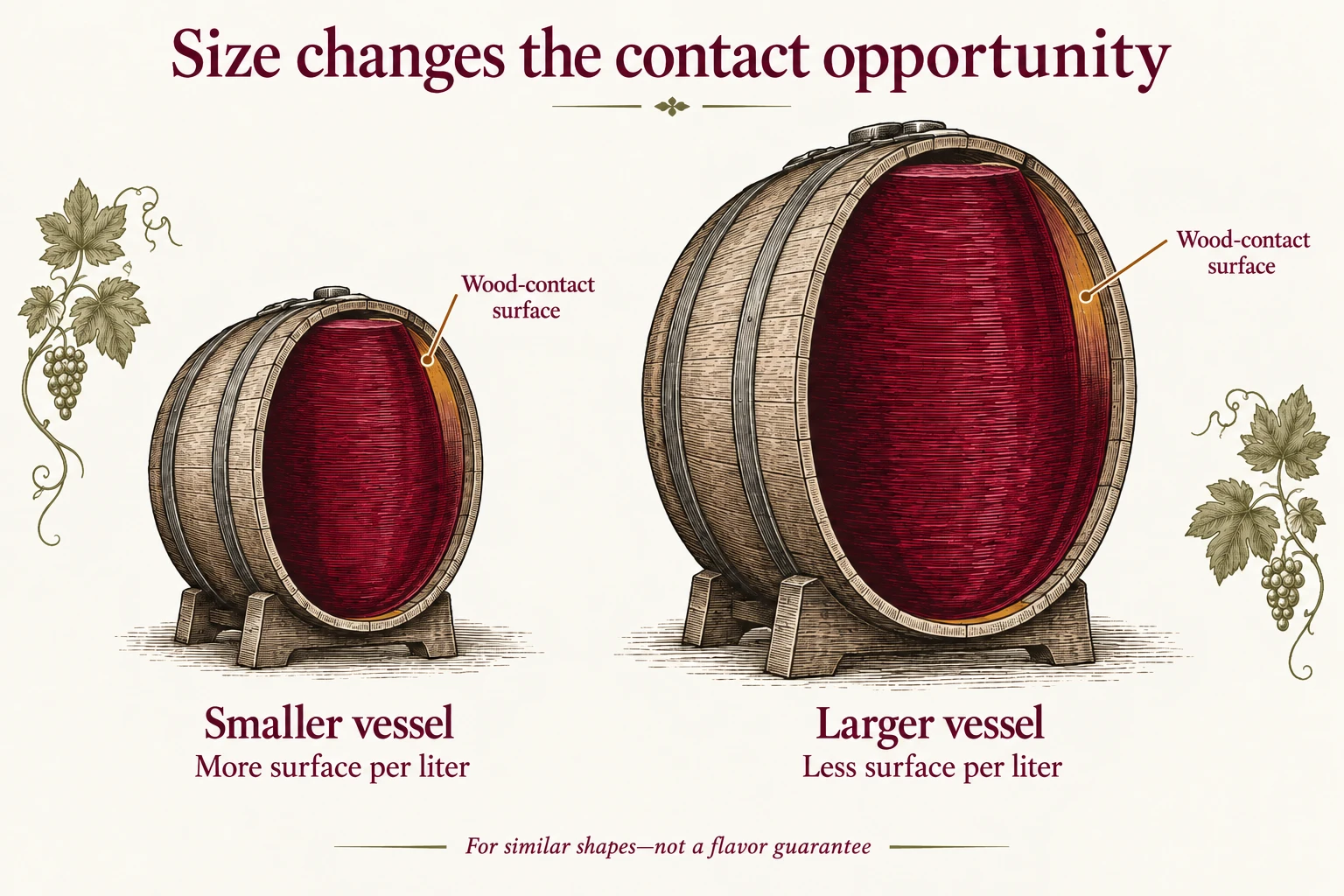
Read the illustration
For vessels with the same proportions, a larger vessel has less interior surface per liter. This changes the opportunity for wood contact, not a guaranteed flavor result. Real barrel shapes and construction vary.
For geometrically similar vessels, volume grows faster than surface area. That means a larger vessel has a lower surface-area-to-volume ratio: less interior surface is available per liter of wine. It is a useful first-principles explanation for why format can change the opportunity for wood contact.
1× linear size
1× surface area 1× volumeReference surface / volume
2× linear size
4× surface area 8× volume½ the surface / volume
The condition matters
Real barrels are not scaled copies. Bilge, head area, stave thickness, grain, construction, fill level, and orientation can change the relationship. Surface-area-to-volume geometry also says nothing by itself about which compounds are available, how quickly they move, or how oxygen enters.
Size changes opportunity for contact; it does not determine the result.
05 · From geometry to wine
The cellar consequences are multivariable
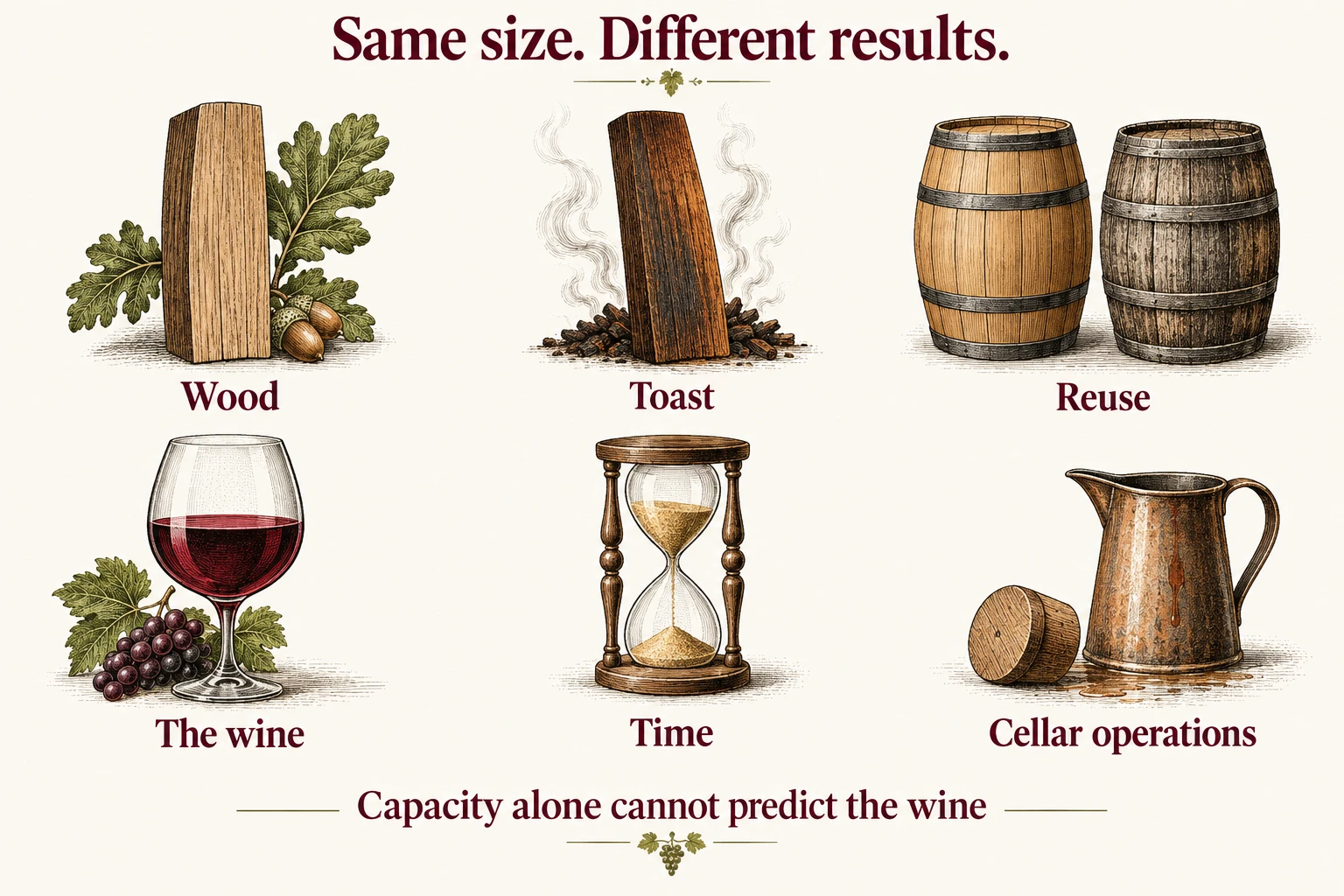
Read the illustration
Wood specification, toast, reuse, the wine itself, time and cellar operations all affect what happens in a vessel. Neither barrel size nor months in oak predicts the result alone.
Capacity belongs in the conversation, but never alone. Two 225-liter barrels can behave differently, and the same barrel can yield different measured compounds when it holds a different wine or remains filled for a different time.
A · Oxygen
A barrel does not “breathe” at one rate
Oxygen can be associated with the bung, stave joints, wood, and cellar operations. A 2014 study of 12 barrel types measured a dissolved-oxygen gradient with more near the bung and found that wetting wood reduced diffusion and oxygen-transfer rate. Whole-barrel work likewise highlights moisture as important. The rate is dynamic, not a fixed breathing rate stamped on a capacity.
The ullage, topping, racking, bung seal, humidity, temperature, and handling all matter. And microoxygenation means deliberate oxygen dosing; it is not simply another name for aging in wood.
To place vessel choice inside the complete cellar sequence, follow how wine is made from harvested grapes through fermentation, maturation, blending, and bottling.
B · Wood
Capacity does not specify the oak
A vessel name does not disclose oak species (see the oak glossary entry), geographic origin, grain, stave thickness, or seasoning. Those variables change the pool and movement of extractable compounds. “Barrique” is a capacity-and-form clue—not a synonym for French oak.
That is why a technical sheet that names the cooper, forest or origin, species, and grain tells you more than a bare vessel name.
C · Toast
Toast is chemistry, not a volume knob
Heat changes wood compounds, but different compounds form, peak, transform, or decline at different conditions. A published toast level is useful context; it is not a simple more-toast-equals-more-flavor dial. Sensory impact also depends on concentration, thresholds, wine composition, and time.
Use the definition of barrel toast and the related wood-lactone vocabulary as starting points, not tasting guarantees.
D · Reuse
New and used are different questions
Whether a vessel is new or reused affects the extractable pool. Research comparing new and once-used barrels found large short-term differences for many oak-derived compounds, while longer aging involved compound-specific evolution. Reuse can reduce many extractives; it does not make the vessel chemically blank or oxygen-proof.
“Percent new oak” is therefore only one input. Ask the age and fill history of the balance, too.
E · Wine + time
The wine participates in extraction
Alcohol, pH, and the broader wine matrix affect extraction and subsequent reactions. Grape variety and wine composition have produced different oak-volatile patterns in controlled studies. Residence time matters, but concentration is not guaranteed to rise in a straight line because extraction and transformation proceed together.
That makes “12 months in barrel” incomplete unless the vessel, wood, age, and wine are also described.
F · Operations
Fill volume is not nominal capacity
A 600-liter vessel does not necessarily contain 600 liters during every process. Jerez provides a vivid example: a 600 L bota may be held at about five-sixths for flor. Elsewhere, evaporation and topping change headspace. Fermentation, aging, storage, and transport can place different demands on the same nominal size.
Read “capacity” as a vessel specification, not an automatic statement of working fill or sensory exposure.
06 · A label-reading protocol
How to read a barrel note or technical sheet
Start with the least romantic detail—the actual capacity—and then add the variables that turn a vessel into a cellar choice.
- 01 Find the liters.
If only a traditional name appears, treat capacity as unresolved rather than filling in a memorized number.
- 02 Locate the usage.
Country, region, appellation, era, and producer can explain which local convention is intended.
- 03 Separate vessel from material.
Wood, concrete, stainless steel, and clay do not become equivalent because all are called vats.
- 04 Read the wood specification.
Species, geographic origin, grain, seasoning, cooper, and stave construction can all be relevant.
- 05 Read age and heat.
New-oak percentage, prior fills, and toast level are separate variables—not a single “oakiness” score.
- 06 Read the process.
Fermentation versus aging, time, fill level, lees contact, stirring, racking, topping, and cellar conditions complete the picture.
07 · Why a producer chooses one
The vessel has to work before it can make a style
A producer is not selecting surface-area-to-volume ratio in isolation. Vessel choice has to fit the wine, the cellar, and a sequence of decisions that ends in a finished blend.
Can one vineyard parcel or press fraction fill the vessel without awkward headspace?
Does the opening, shape, thermal behavior, and access fit fermentation or only élevage?
Can the team top, sample, rack, move, and monitor it with the available equipment?
How do humidity, temperature control, evaporation, and oxygen management interact?
What do access, cleaning, maintenance, repair, and replacement require?
How does the vessel serve the blending plan, timing, inventory, and desired sensory range?
The answer can favor small barrels for one lot, a puncheon or demi-muid for another, a large foudre for a larger volume, or a neutral vat when wood is not the point. None is inherently “better.” It is better only when its measured behavior and practical role match the producer’s intent.
08 · Sources and limits
Methodology and limits
This guide prioritizes official regional bodies, current regulations, historical legislation, cooper specifications, and primary scientific papers. The chart combines unlike evidence types only to show scale and variability; every value remains labeled by context. We did not average traditions into a synthetic “standard.” Historical gallon conversions use current U.S. wine-gallon and imperial-gallon definitions as explanatory endpoints, not as claims that every historical document used the same gallon.
The technical discussion distinguishes geometry from measured outcomes. Surface-area-to-volume reasoning applies to similar shapes; oxygen transfer and extraction claims come from cited experiments and are not predictions for an unnamed producer’s wine.
- Capacities · current logistics Australian Wine Research Institute, packaging options
Lists 225 L Bordeaux and 228 L Burgundy barriques, a 300 L hogshead, and 500/600 L puncheons for Australian logistics.
- Capacity · Bordeaux Conseil Interprofessionnel du Vin de Bordeaux, wine aging
Names 225 L barriques alongside demi-muids and large foudres.
- Capacities · Bourgogne Bourgogne Wine Board, the secrets of a well-aged wine
Gives the 228 L pièce, 212 L Pouilly-Fuissé exception, 600 L demi-muid, and 1,200 L muid.
- Capacities · Germany Weinland Mosel, German wine glossary (PDF), “Fuder”
Documents historical regional variation and modern examples from 900 to 1,500 L.
- Capacity · Port Instituto dos Vinhos do Douro e Porto, vinification and aging
Describes Port pipes as averaging 550 L within a specific aging context.
- Capacities · Jerez Consejo Regulador de Jerez, types of Sherry casks
Lists the 600 L bota jerezana, 500 L export butt, 516 L receipt cask, and 566 L bodega cask, plus working-fill context.
- Regulation · actual capacity 27 CFR § 24.168, identification of tanks
Requires capacity markings for barrels, puncheons, and similar bulk containers without assigning those names a universal volume.
- History · tun UK Customs Consolidation Act 1853 (PDF)
Uses a 252-gallon tun as a wine duty quantity. It is historical evidence, not a modern cooper specification.
- Historical transcription · named measures U.S. Congressional Record (1972), reproducing an English 1692 measures table (PDF)
Records the historical relationship of a 63-gallon wine hogshead, 84-gallon puncheon, 126-gallon pipe or butt, and 252-gallon tun. It does not establish current vessel standards.
- Unit definitions · conversion limits 27 CFR § 27.11, U.S. wine-gallon definition
Defines the current U.S. wine gallon as 231 cubic inches; used only to explain the lower endpoint of the historical-liter band.
- Unit definitions · conversion limits UK Weights and Measures Act 1985, Schedule 1
Defines the imperial gallon as 4.54609 cubic decimetres; used only to explain the upper endpoint, not to relabel earlier sources.
- Large formats · current cooperage Tonnellerie Rousseau, foudres and vats
Shows large wooden vessels as configurable cooperage rather than one fixed foudre size.
- Large formats · current cooperage Garbellotto, wooden vats
Publishes broad and custom capacity ranges, supporting the open-ended treatment of “vat.”
- Primary research · oxygen del Alamo-Sanza & Nevares (2014), Journal of Agricultural and Food Chemistry
Measures oxygen distribution and transfer across 12 barrel types, including the bung gradient and effect of wood wetting.
- Primary research · whole barrels Liger-Belair et al. (2021), OENO One
Measures gas transfer through complete oak barrels and highlights the role of wood moisture.
- Primary research · wood processing Fernández de Simón et al. (2010), Analytica Chimica Acta
Tests wood-piece size, seasoning, and toast effects on volatile composition and wine.
- Primary research · reuse and time Garde-Cerdán & Ancín-Azpilicueta (2006), LWT
Compares new and once-used barrels across aging time and finds compound-specific extraction and evolution.