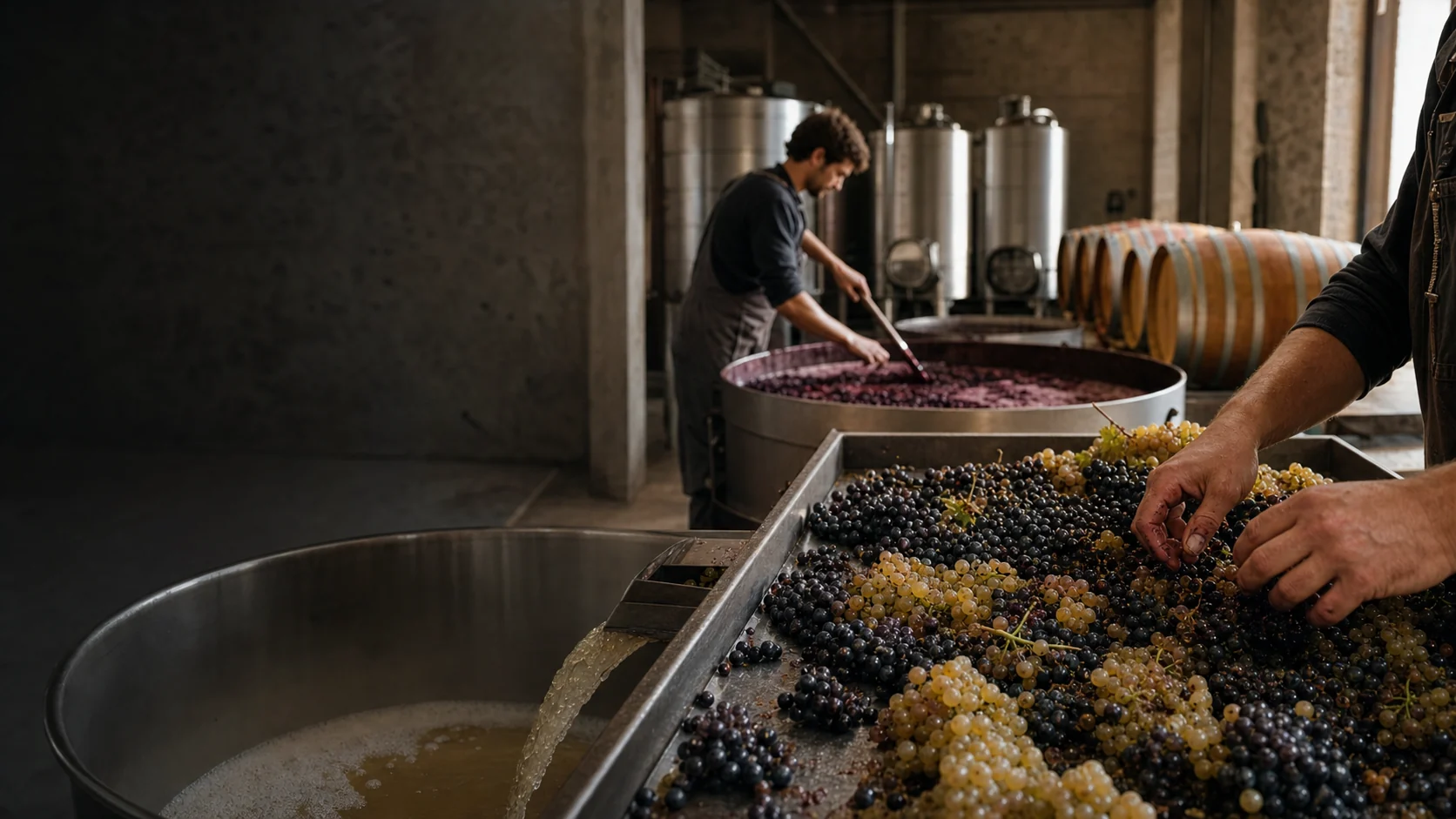
From harvest to bottle · process field guide no. 01
How Wine Is Made: The Process from Grape to Bottle
Wine is not made on one universal assembly line. The useful map begins with a shared fruit and then follows the choices that create red, white, rosé, skin-contact, sweet, and sparkling styles.
Research note: The process map distinguishes common operations from mandatory ones. Definitions follow the OIV; U.S. treatment context follows current federal rules; cellar practice is qualified by wine style, producer, law, and lot.
The short answer
How is wine made?
Wine begins when fresh grapes or grape must undergo partial or complete alcoholic fermentation. In practical cellar terms, grapes are received and evaluated, then may be sorted, destemmed, crushed, pressed, or kept whole. Yeast transforms grape sugars into alcohol, carbon dioxide, and many secondary products. The producer then decides how to manage skins, press fractions, malolactic conversion, maturation, clarification, blending, stabilization, filtration, and packaging.
The order changes with the intended wine. Most white wine is pressed before alcoholic fermentation; most red wine ferments with skins and is pressed later; rosé usually leaves the skins earlier. Those are useful pathways, not fixed recipes. There is no single mandatory sequence, and not every wine uses every operation shown below.
Open the branching process mapThe wine making process is a decision map
Search diagrams often place grapes on a single conveyor belt: harvest, crush, ferment, age, bottle. That shortcut hides the most important difference. Pressing moves to a different side of fermentation depending on whether skins are part of the ferment. It also implies that every producer uses every treatment, when whole-cluster fermentation, direct pressing, native fermentation, unfiltered bottling, and many other choices can remove, add, or reorder steps.
White wine
Press before fermentation
- Whole-cluster or crushed-grape pressing
- Settle or clarify juice when desired
- Ferment mainly away from skins
Rosé wine
Short skin contact or direct press
- Press red grapes directly, or macerate briefly
- Separate juice from skins
- Ferment the pink juice
Red wine
Ferment with skins
- Ferment crushed berries or whole clusters
- Manage the cap and extraction
- Drain free-run wine and press the solids
Skin-contact white
White grapes ferment with skins
- Macerate or ferment with white-grape solids
- Choose extraction and contact time
- Drain and press when the producer decides
How to read this map: the lanes show common still-wine routes, not legal definitions or mandatory recipes. Individual producers may move, omit, repeat, or subdivide operations. Sweetness and bubbles add separate branches described later.
01 · Before the color branches
Harvest and receive: the process starts with a lot, not a machine
Harvest timing is a style and farming decision made from more than sugar. Producers may evaluate taste, seed and skin maturity, acidity, pH, disease, weather, water status, yield, and the needs of a particular wine. Fruit can arrive as hand-picked clusters in small containers or as machine-harvested berries; neither phrase alone tells you the quality of the finished wine.
At reception, a winery identifies and weighs the lot, checks its condition, and may sample temperature and chemistry. Sound hygiene begins here. The OIV’s wine-industry hazard guide treats reception, crushing, pressing, fermentation, storage, and bottling as parts of one food-safety system—not just sensory opportunities.
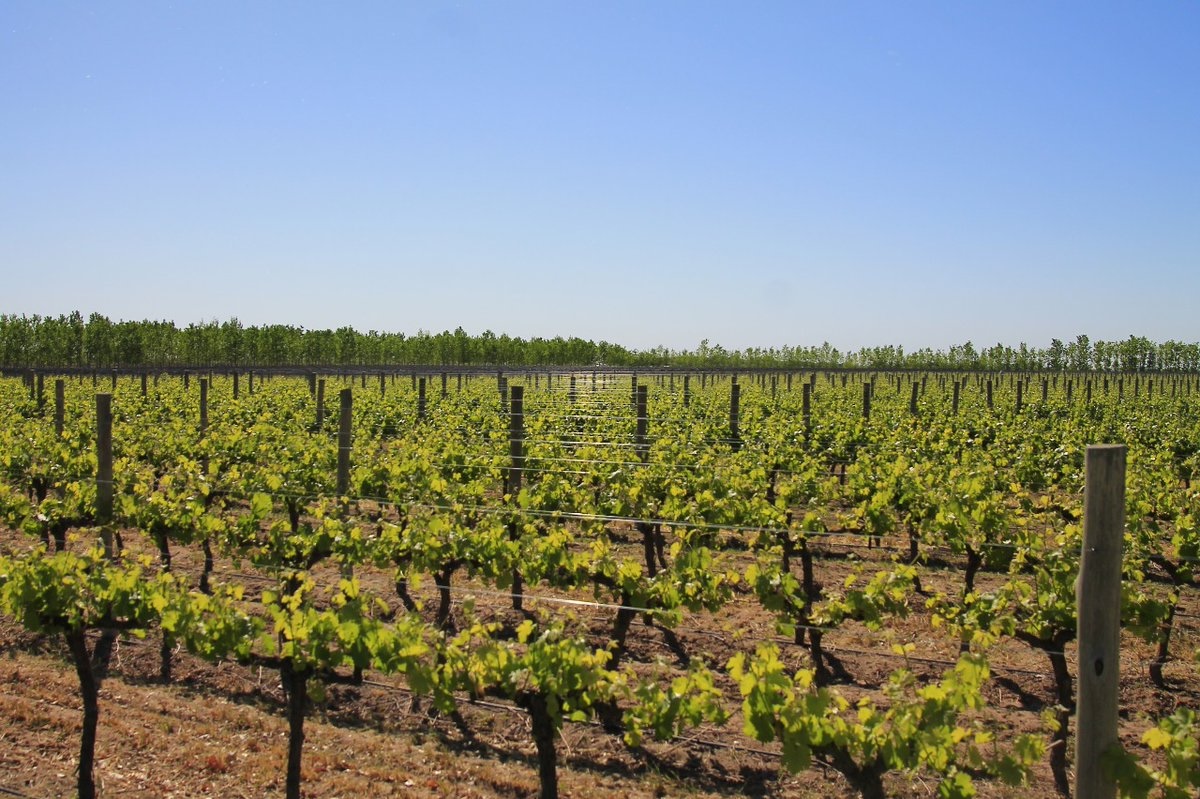
“Many winemakers love the process that happens inside the lab, but what makes a great winemaker is staying connected to what happens with the fruit. The best winemakers spend time with the vines.”
— Barry Morgan, Familia Morgan
Sort, destem, crush—or do less
Sorting can remove leaves, damaged fruit, or other material when needed. A destemmer separates berries from stems; a crusher breaks berries enough to release juice. But crushing is not obligatory, and it is not pulverizing seeds. Whole clusters can go directly to a press for white juice or into a fermentation vessel for a red-wine strategy. Some machine-harvested fruit arrives largely destemmed already.
Stems stay with berries for pressing or fermentation when the producer intends it.
Berries are separated from most stems before crushing, fermentation, or pressing.
Berry skins are opened to release juice; seed breakage is not the objective.
Whole clusters and destemmed berries can share a vessel in a designed proportion.
02 · The pivotal branch
Pressing changes position
The OIV defines pressing as extracting the liquid part from harvested grapes or marc. It explicitly covers two positions: extracting must for fermentation away from solids, and separating press wine from marc after fermentation on skins. That single distinction explains much of the red-versus-white process map.
Before fermentation
White and many rosé pathways
Pressing separates juice from skins, seeds, pulp, and possibly stems. A producer can keep free-run juice and press fractions separate because their composition and sensory contribution may differ.
After skin fermentation or maceration
Red and skin-contact pathways
Wine is drained from the solids, then the remaining marc is pressed. Press fractions can be matured separately and blended later—or excluded.
Color is not locked to grape-skin color alone. Many red grapes have pale juice. White wine can be produced from dark-skinned grapes when juice is separated from skins; skin-contact white wine comes from white grapes kept with their skins. Rosé is chiefly a skin-contact and separation decision, though laws and traditions define particular categories.
03 · The defining transformation
Alcoholic fermentation changes must into wine
The OIV defines alcoholic fermentation as the transformation of grape sugars into ethanol, carbon dioxide, and secondary products. It can begin spontaneously or after inoculation with selected yeast. Those are microbiological starting strategies, not simple synonyms for quality, complexity, safety, or terroir.
The cellar monitors the course rather than trusting a calendar. Sugar or density, temperature, aroma, microbial health, and tasting can reveal a ferment that is progressing, slowing, or developing problems. Nutrients, temperature control, aeration, yeast choice, solids, vessel, and the must’s own composition can influence fermentation. A fixed number of days or one universal temperature would be false precision.
Juice fermentation
Common for white and rosé wine. The juice may be settled or clarified first, then fermented in tank, concrete, wood, or another suitable vessel. Turbidity is managed rather than assumed to be either good or bad.
Maceration and fermentation
Common for red wine and intentional skin-contact white wine. Alcohol, time, temperature, mixing, grape condition, and solids influence extraction; skin contact alone does not promise a particular color or tannin level.
Intracellular and mixed processes
Carbonic or semi-carbonic approaches can begin inside intact berries and coexist with ordinary yeast fermentation as berries break. These are distinct tools, not the default process for all fresh, fruit-led wine.
Cap management is a red and skin-contact decision
During a skin fermentation, carbon dioxide can lift skins and other solids into a cap. Punch-downs, pump-overs, rack-and-return, submerged caps, rotary fermenters, or minimal disturbance change contact, temperature, aeration, and extraction. Maceration can begin before fermentation, continue with it, or extend afterward. “More extraction” is not automatically “more quality.”
04 · After alcoholic fermentation
The wine is made—but it is not necessarily finished
When alcoholic fermentation has reached the producer’s intended endpoint, different lots may still contain skins, gross lees, fine lees, dissolved carbon dioxide, malic acid, unstable tartrates, suspended particles, or oxygen-sensitive compounds. The next operations are selected for the specific wine.
05 · Acid pathway
Malolactic conversion is optional
Lactic acid bacteria can transform malic acid into lactic acid and carbon dioxide. Despite the traditional name “malolactic fermentation,” it is not a second alcoholic fermentation. It is common in many reds, optional in whites and sparkling base wines, and may be encouraged, allowed, limited, or prevented by lot.
06 · Solids pathway
Rack, clarify, stabilize, or filter as needed
Racking transfers wine while leaving selected deposits behind. Clarification, settling, flotation, fining, centrifugation, and filtration solve different problems. None is automatically required; none is evidence of low quality by itself.
07 · Time pathway
Mature, blend, and prepare to bottle
Wine may mature on or off lees in stainless steel, concrete, wood, clay, or bottle. The barrel and cask guide explains why vessel name and size are only part of that decision. Blending can assemble varieties, sites, press fractions, vessels, or lots. To apply that evidence to a bottle choice, the unoaked Chardonnay guide separates oak contact from malolactic conversion, lees work, and texture instead of inferring a whole style from one word.
08 · Package pathway
Package with oxygen and hygiene under control
Before bottling, the producer confirms composition, stability, sensory condition, legal specifications, package, and closure. Dissolved oxygen, fill height, sanitation, closure application, and package integrity matter. “Unfiltered” does not mean untouched, and filtration is not the only way to manage microbial risk.
A useful restraint
Do only what the wine and its route require
The OIV’s general principles say oenological practices should serve a technological need, protect safety and stability, preserve essential wine characteristics, and avoid misleading consumers. That is more accurate than dividing every possible cellar operation into “natural” or “industrial” by name alone.
05 · Branches beyond still dry wine
Bubbles and sweetness add new decisions
Make the base, then choose the bubble method
A base wine follows a white, rosé, or sometimes red route with specifications suited to the intended sparkling wine. A later fermentation in bottle or closed tank may create endogenous carbon dioxide; ancestral approaches retain or resume the original fermentation. The maintained sparkling wine methods guide owns that comparison.
Sugar can remain or become concentrated in different ways
Sweetness can come from interrupted fermentation, high initial sugar through late harvest, raisining, botrytis or freezing, or legally permitted sweetening and blending practices. A sweet wine is not simply a dry-wine ferment that “failed.” The wine sweetness chart separates measured sugar from perceived sweetness and keeps still-wine terms apart from sparkling dosage language.
06 · Process shortcuts to retire
Six claims the real process does not support
“White wine comes only from white grapes.”
Pale juice can be separated quickly from dark skins. Blanc de noirs is the clearest familiar example.
“Rosé is just red and white wine mixed.”
Many rosés are made by direct pressing or short red-grape skin contact. Specific regions and categories have their own rules.
“Yeast must always be added.”
OIV recognizes spontaneous fermentation and inoculation with selected yeast. Either requires monitoring and appropriate cellar control.
“Malolactic is a second yeast fermentation.”
It is a bacterial conversion of malic acid, not another conversion of grape sugar into ethanol.
“Filtering strips every wine.”
Filter type, pore or retention goal, wine condition, and timing matter. Filtration can serve clarity, stability, or packaging safety.
“Natural wine means one documented process.”
The phrase does not disclose a universal legal method in the U.S. Ask about farming, additions, fermentation, sulfur, clarification, filtration, and packaging separately.
Continue by decision
Open the part of the process you want to inspect
07 · Evidence ledger
Methodology and limits
This guide starts with OIV definitions and accepted-practice categories, then uses U.S. federal rules and current technical resources to show why operations are conditional. It is a conceptual route map, not a production protocol. Exact temperatures, additions, analyses, equipment, time, and legal limits depend on the wine, facility, jurisdiction, vintage, and producer; law and cellar practice vary by country.
The ImageGen hero is a clearly captioned editorial composite. The numbered process map is deterministic HTML/CSS so labels, ordering, and branch relationships remain exact and accessible. The San Rafael field image and attributed note are first-party material; no AI-generated machinery, chart, or number is used as evidence.
- OIV, Wines—basic definition — wine as partial or complete alcoholic fermentation of fresh grapes or grape must, with jurisdictional qualifications.
- OIV, Grape must — liquid derived from fresh grapes by crushing, destemming, draining, pressing, or spontaneous release.
- OIV, Pressing — press-before-fermentation and press-after-skin-fermentation purposes and cautious operation.
- OIV, Alcoholic fermentation — sugar conversion, spontaneous and inoculated routes, and factors used to influence progress.
- OIV, Lactic acid bacteria — malic-to-lactic conversion and carbon dioxide production.
- OIV, Racking — transfer, deposit separation, optional aeration, and inert transfer context.
- OIV, wine-industry hazard and critical-control guide — reception through bottling as a food-safety system.
- Australian Wine Research Institute, wine fermentation resources — yeast and must preparation, monitoring, stuck fermentation, and malolactic management.
- AWRI, aeration of ferments — oxygen as a managed fermentation input rather than a blanket enemy or requirement.
- 27 CFR § 24.246, materials authorized for treatment of wine and juice — current U.S. treatment purposes and limitations; not a global recipe.
- 27 CFR Part 24, Subpart F — U.S. production operations including amelioration, sweetening, blending, and cellar treatment context.
- OIV, Sparkling wines — bottle and closed-tank secondary-fermentation categories and endogenous carbon dioxide definition.