Read the producer, not the prestige
Wine Estate Terms: Bodega, Domaine, Château, Tenuta & More
Bodega, domaine, château, tenuta, and quinta are not five costumes for the same idea. Each word carries its own language, place, and label rules.
Research note: Language meanings come from RAE, Treccani, CNRTL, and Priberam. Label claims are separated into the current OIV, EU, U.S., and Argentine frameworks; rules can differ by jurisdiction, wine category, and exact phrase.
The short answer: These words are not interchangeable. Depending on the language and label, a term may point to a place, facility, business, farm, or holding. A familiar estate word does not, by itself, guarantee quality, prove that the producer owns every vineyard, mean the wine is estate-bottled, or certify that the farming is organic. Translate the word first. Then read the origin, producer, and bottling statement.
A wine label can make a simple building sound like a title. Château may suggest towers. Tenuta may sound more important than “farm.” Bodega may be translated as both cellar and winery. None of that tells you, on its own, who grew the grapes or where the bottle was filled.
This page is the map between those words. The glossary owns each concise definition; this guide owns the comparison. Open the linked term when you need one meaning. Stay here when you need to decide whether two terms are actually equivalent.
The comparison: what each wine estate term can tell you
The closest English translation is only a starting point. Country, wine category, the rest of the producer name, and nearby bottling language control the useful reading.
On a phone, swipe the table horizontally to see every column.
| Term | Language and common context | Closest useful reading | What it usually points to | Do not infer |
|---|---|---|---|---|
| Bodega | Spanish; especially visible in Spain and Argentina | Wine cellar, wine storehouse, or wine-producing establishment | A production or storage place, and often the business operating it | Vineyard ownership, estate-grown fruit, a quality tier, or bottling on site |
| Cantina | Italian wine; also a different everyday word in Spanish | Cellar or the rooms used to make, handle, store, and package wine | The cellar facility, winery, or producer; cantina sociale is a cooperative | That the producer owns vineyards. In Spanish, the word can instead mean a bar, tavern, or cafeteria |
| Domaine | French; common in Burgundy, the Loire, the Rhône, and beyond | Domain, landed property, or winegrowing holding | An estate identity tied to vineyard operations | A castle, classified status, organic farming, outright ownership of every parcel, or bottling on the property |
| Château | French; strongly associated with Bordeaux wine | Castle or substantial country house; in Bordeaux usage, a winegrowing holding and its wine | The producer or holding name | A literal castle, a classified growth, superior quality, or the same meaning in every country |
| Tenuta | Italian | Estate, agricultural holding, or landed property | The rural property or producer identity | That every wine is made only from owned vines, bottled there, or better than a wine labeled cantina |
| Azienda agricola | Italian business and agricultural language | Agricultural enterprise or farm business | The farming operation, which may include grapes and other crops | That the phrase alone describes the sourcing and bottling history of every wine |
| Azienda vinicola | Italian wine-business language | Wine-producing business or wine company | The enterprise engaged in making or handling wine | Vineyard ownership or a universal rule that it must buy fruit. Read the producer and bottler details |
| Quinta | Portuguese; especially familiar in the Douro | Rural property, farm, country house, or estate | A named agricultural holding, often associated with vineyards | A winery building, a single vineyard, bottling on the property, or a quality rank |
| Winery | English; broad international use | A place or business where wine is made | The production facility or company | Owned vineyards, estate fruit, an attached tasting room, or a small scale |
| Wine estate | English description; usage varies across markets | A winegrowing property or producer associated with land | The holding and its identity | That an unqualified use of estate is the same claim as the defined U.S. words Estate Bottled |
The common error is to line up the rows and read them as direct translations. A bodega and a winery can both name production facilities. A domaine and a quinta can both name holdings. That similarity does not erase national rules or prove identical grape sourcing.
Four word families, not one prestige ladder
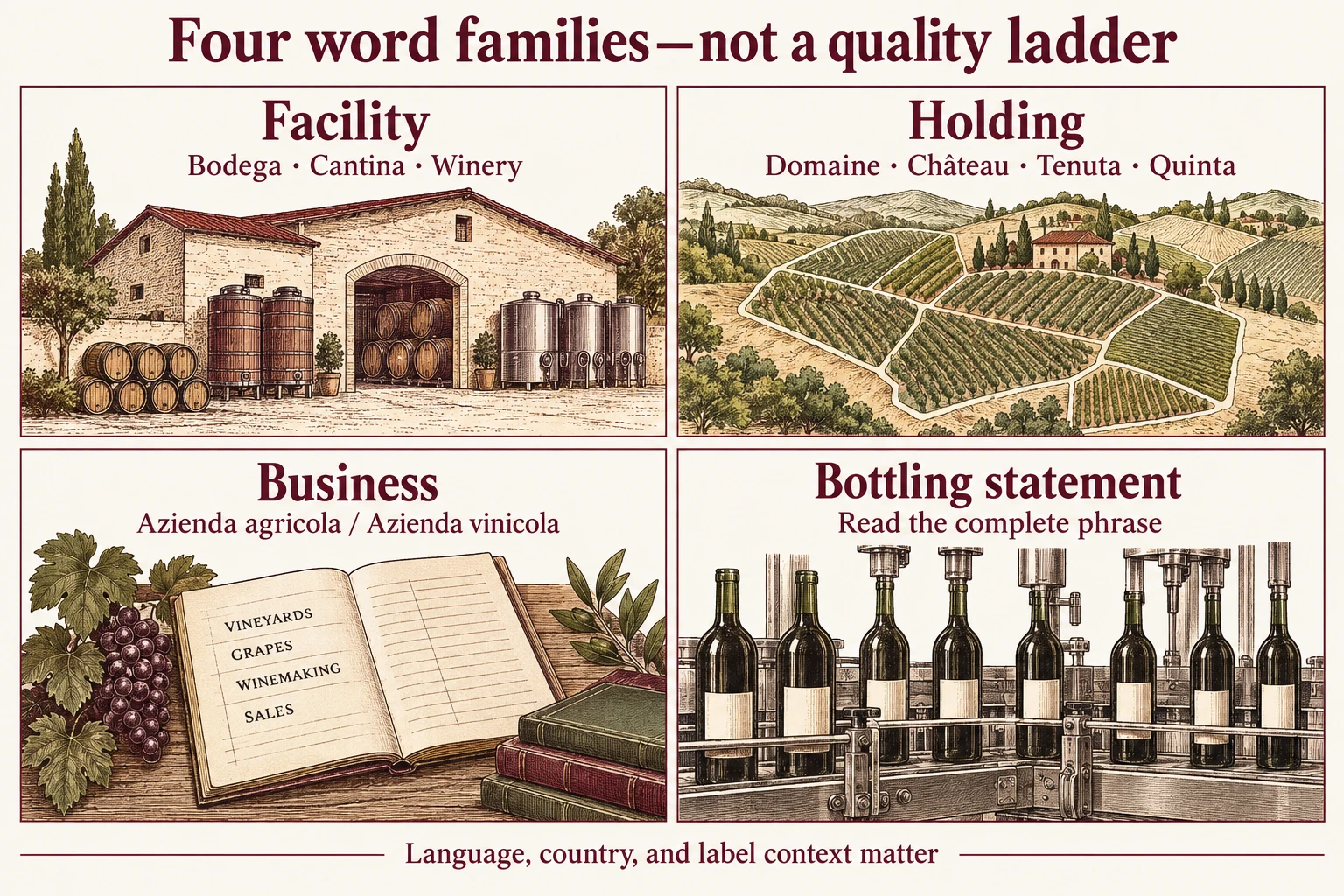
Read the illustration
Facility words include bodega, Italian cantina, and winery. Holding words include domaine, château, tenuta, and quinta. Business words include azienda agricola and azienda vinicola. Bottling statements are a separate category. None forms a universal quality ranking.
Facility words
Bodega, cantina, and winery can all point toward the place where wine is made, matured, stored, or packaged. The land and the cellar may be in different places.
Holding words
Domaine, château, tenuta, and quinta lean toward property or holding. They still need the country and the complete label to tell you how the fruit and winemaking relate to that holding.
Business-activity words
Azienda agricola puts farming in view. Azienda vinicola puts the wine business in view. Neither phrase should be turned into a universal own-grapes-versus-purchased-grapes switch without checking the applicable rules and producer.
Bottling statements
Estate Bottled and French phrases beginning mis en bouteille answer a more specific question. They describe defined growing, production, bottling, identity, or location conditions under the law that governs the wine.
Bodega is not the Spanish word for estate
The RAE gives bodega several wine meanings: a place where wine is kept and matured, a wine warehouse or shop, and an industrial establishment for making wine. Argentina’s Instituto Nacional de Vitivinicultura also treats bodega as one category in its register of wine-producing establishments.
That makes winery or wine cellar a sensible translation in Argentina. It does not make every bodega an estate in the landholding sense. If land control matters, look for the vineyard origin and producer statement instead of asking the one word to carry the whole chain.
Our Argentine wine guide explains the region and label layers that sit beside a bodega name. The Mendoza wine regions guide helps place a producer within Mendoza rather than treating the province as one vineyard.
Cantina changes meaning when the language changes
Treccani defines an Italian wine-industry cantina as the complex of rooms used for vinification, processing, conservation, and packaging. It also defines cantina sociale as a cooperative formed by agricultural producers to process and sell their grapes together.
Spanish does not transfer that full Italian trade meaning automatically. The RAE entries center a public refreshment place, a household wine cellar, and regional uses such as tavern. Context decides whether the right English word is winery, cellar, cooperative, bar, or canteen.
Domaine and château are not Burgundy-versus-Bordeaux quality grades
French usage makes domaine a broad landed property or agricultural holding. Château literally names a castle or substantial residence; in Bordeaux usage it also names a winegrowing property and, by extension, its wine. A Bordeaux château does not need storybook towers, and a domaine does not become lesser because it lacks the word.
For certain EU labels, these are more than loose translations. Article 54 of the current EU wine-labelling regulation reserves listed holding terms for PDO or PGI wines. Its Annex VI includes Château and Domaine for France and Quinta for Portugal. Where that rule applies, the wine must come from grapes harvested in vineyards exploited by that holding, with winemaking carried out entirely on that holding. Member states regulate their listed terms.
That is a real condition, but it is not permission to flatten the whole table into one rule. The binding meaning still depends on jurisdiction, wine category, and exact phrase. Brand history, trademarks, national provisions, and a wine’s appellation can add another layer.
Tenuta, azienda agricola, and azienda vinicola answer different questions
Treccani’s ordinary Italian meaning of tenuta is a landed agricultural property, often with buildings. Azienda is the organized economic enterprise. The modifiers then change the emphasis: agricola points to agriculture, while vinicola points to wine production or the wine trade.
That gives a useful reading order:
- Tenuta: What property or holding is named?
- Azienda agricola: What farming enterprise is named?
- Azienda vinicola: What wine enterprise is named?
It does not create a universal sourcing rule. Italian and EU label provisions can restrict agricultural descriptions in particular settings, but the words should not be used as shortcuts for “all estate fruit” or “all purchased fruit.”
Quinta names a Portuguese property, not a bottle style
Priberam defines a quinta as cultivated land with a garden or trees, generally enclosed and usually with a house, and also as a country house. In wine, that rural-property meaning fits the named estates seen across Portugal, especially in the Douro.
Under the EU framework noted above, Quinta is one of Portugal’s listed holding terms for PDO or PGI wine. It remains a property word, not a grape variety, Port style, vineyard classification, or promise that bottling happened at the estate.
Bottling language that adds specific information
A producer name answers identity. A bottling phrase answers a different question. This is where exact wording matters most.
United States: “Estate Bottled” is a defined claim
Under 27 CFR 4.26 and the TTB’s current guidance, Estate Bottled may be used only when all of these conditions are met:
- 100 percent of the wine comes from grapes grown on land owned or controlled by the bottling winery;
- the winery and those vineyards are within the same labeled viticultural area;
- that winery crushes and ferments the grapes, then finishes, ages, processes, and bottles the wine in a continuous process on its premises; and
- the wine never leaves those premises during that process.
The regulation defines controlled land through a qualifying lease or similar agreement, so “controlled” does not always mean owned. It also has a cooperative rule. This is much more specific than simply seeing estate inside a brand or producer name.
France and the EU: translate the full bottling phrase
The verb and preposition matter as much as the estate noun.
- Mis en bouteille au château
- Literally, bottled at the château.
- Mis en bouteille au domaine
- Literally, bottled at the domaine.
- Mis en bouteille à la propriété
- Literally, bottled at the property.
- Mis en bouteille par
- Bottled by the named person or company. This identifies who carried out or takes responsibility for bottling; it does not say "at the estate."
- Mis en bouteille pour
- Bottled for the named party. Read the remaining label for the actual bottler and origin.
EU Article 46 lets member states define bottling terms for PDO or PGI wines when bottling occurs on a producer’s holding, at a producer group’s premises, or at an eligible enterprise within or immediately near the delimited area. France then applies its own permitted wording and conditions. The literal phrases are useful, but they are not a one-for-one translation of the U.S. claim. The U.S. definition combines grape control, place, continuous production, and bottling in one specific term.
For a concise translation, use the glossary entry for mis en bouteille au château. For a purchasing or compliance decision, check the current rule governing the bottle in front of you.
What estate language does not promise
No estate word is a tasting note. It cannot tell you whether the wine is balanced, delicious, expensive, age-worthy, or suitable for your table.
It also does not universally prove:
- ownership: a holding may exploit or control leased vineyards under applicable rules;
- one vineyard: an estate can farm multiple parcels and appellations;
- one building: grapes, winemaking, maturation, and bottling may occur at different authorized sites;
- organic practice: look for the relevant organic certification and scope;
- family ownership: a historic name can belong to a company, group, or successor;
- bottling location: read the bottling phrase and bottler identity;
- quality rank: classification terms, when they exist, belong to a separate system.
Estate control can give one team continuity across vineyard and cellar decisions. It can also concentrate every mistake. A skilled merchant, cooperative, or producer working with growers can make excellent wine. The operating model is evidence, not a score.
A four-question method for reading the label
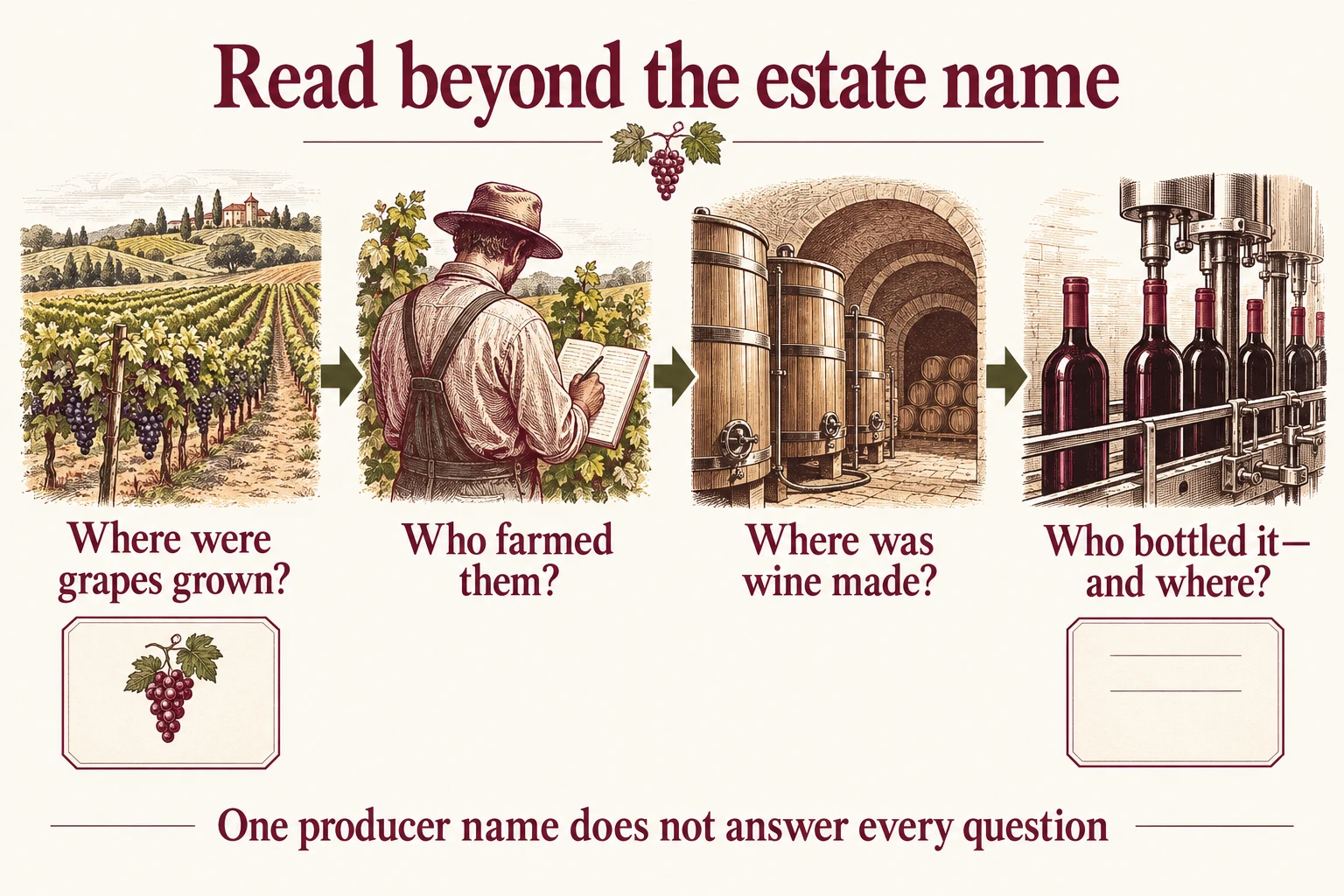
Read the illustration
Read a wine label by asking where the grapes grew, who farmed or controlled them, where the wine was made, and who bottled it and where. A producer name alone does not answer all four questions.
-
Where were the grapes grown?
Find the appellation, geographical indication, country, region, village, or vineyard. A producer address is not necessarily the grape origin.
-
Who farmed or controlled them?
A holding term may help under a specific framework. A technical sheet or producer statement may supply the missing detail.
-
Where was the wine made?
Bodega, cantina, or winery may identify a facility. That location can differ from the vineyard and from the business's mailing address.
-
Who bottled it, and where?
Read every word around "bottled," mis en bouteille, imbottigliato, or embotellado. Prepositions such as "at," "by," and "for" change the claim.
If the front label gives only a romantic estate name, turn the bottle around. The producer, bottler, importer, origin, lot code, and certification marks often do more factual work than the largest word on the front.
Vigneron, winemaker, and sommelier are people, not estate types
These role words often appear beside producer stories, but they belong to a different comparison. The titles can overlap, especially in a small family operation.
Vineyard
Vigneron
A French vine grower or winegrower. In current trade use it can describe a grower-producer, but the word alone does not prove that one person performs every cellar task.
Cellar
Winemaker
The person responsible for turning grapes or must into wine and directing cellar choices. A winemaker may work closely in the vineyard without owning or personally farming it. The regulated title oenologist has its own training definitions in many countries.
Table
Sommelier
A hospitality and beverage-service professional who may build lists, recommend pairings, serve wine, train staff, and manage a cellar. A sommelier evaluates and presents wine; that does not make the role a synonym for winemaker.
The OIV’s in-force oenologist definition spans vineyard participation, grape processing, production control, analysis, and parts of marketing. The Court of Master Sommeliers describes service, selection, pairing, education, and cellar management. Real careers cross borders, but the center of responsibility still differs.
Useful reading rule: property terms tell you how a producer presents a place. Role terms tell you where a person's work is centered. Neither should be stretched into a complete biography.
Sources and methodology
Sources were checked 11 July 2026. We used national-language dictionaries for ordinary meaning, regulator text for binding label conditions, and professional organizations for roles. The OIV standard supplies an international reference: its Resolution OIV-ECO 700-2023 says a wine presented with a viticultural-holding name such as château, quinta, finca, tenuta, Weingut, manor, or estate should come solely from grapes harvested and vinified in that holding, follow the country’s customs, avoid consumer confusion, and carry a recognized geographical indication or appellation. That standard does not replace national law.
- RAE, bodega and RAE, cantina, for Spanish meanings and regional context.
- Treccani, cantina, tenuta, and azienda, for Italian facility, property, and enterprise meanings.
- CNRTL, domaine, château, and vigneron, for French meanings and Bordeaux usage.
- Priberam, quinta, for the Portuguese rural-property meaning.
- OIV Resolution OIV-ECO 700-2023, for the international standard on names of viticultural holdings.
- EU Delegated Regulation 2019/33, consolidated 18 January 2025, especially Articles 46 and 54 and Annex VI, for bottler and listed holding-term conditions.
- TTB wine appellation guidance and 27 CFR 4.26, for the U.S. Estate Bottled definition.
- INV register of wine-producing establishments, for bodega within Argentina’s establishment categories.
- OIV Resolution OIV-ECO 492-2013, for the in-force definition and functions of an oenologist.
- Court of Master Sommeliers Americas, what a sommelier does, for the modern service-role comparison.