At the table · tasting field guide no. 04
Wine Tasting Flight Guide: Plan, Pour, and Compare
A useful flight does not ask which bottle wins. It changes one question at a time, keeps the obvious conditions steady, and lets each taster record the evidence before the reveal.
Research note: This guide combines transparent bottle and alcohol math, an embedded printable planner, and guardrails drawn from NIST, NIAAA, CDC, OIV, ISO, INV, and sensory research.
The short answer
A good wine flight asks one question at a time
A wine tasting flight is a set of small pours chosen to compare something specific. Start with three or four wines, write the question in one sentence, measure equal samples, use comparable glasses and temperatures, record impressions before discussion, and reveal the labels only after the first pass.
The most useful themes hold at least one variable steady: grape, region, vintage, producer, cellar treatment, or price band. A flight can be educational without being formal, competitive, or alcohol-centered.
Choose a flight design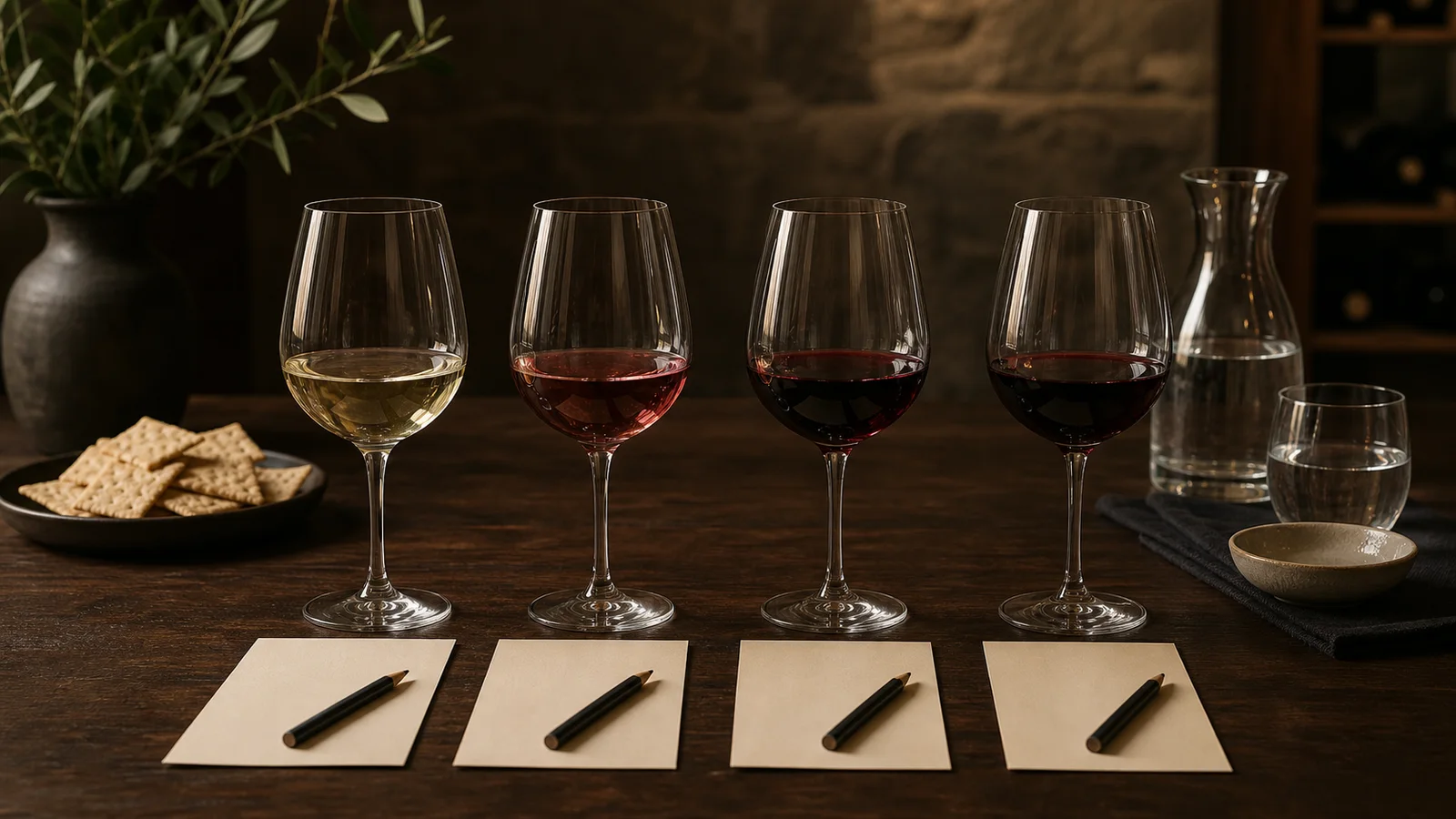
Need the term in one paragraph? The tasting-flight glossary entry owns the concise definition. This hub owns the practical work of planning and hosting: the comparison question, bottle math, setup, order, note sheet, reveal, and responsible service.
Choose the question before the bottles
A themed lineup is not automatically a controlled comparison. Four Malbecs from four countries may also differ in vintage, varietal percentage, price, ripeness, oak, age, and producer ambition. That does not make the flight useless. It changes the honest conclusion from “region caused this” to “these four bottles differed, and region was one visible part of the design.”
Write this on the first line
What do we want to notice?
- HoldWhat can stay reasonably similar?
Grape, vintage, origin, oak regime, price band, ABV, temperature, glass, or pour.
- ChangeWhat is the main visible variable?
Place, release year, producer, vessel, price, label information, or one documented cellar choice.
- AdmitWhat still moves underneath?
Site, farming, harvest date, blend, bottle age, storage, closures, and individual perception.
The house rule: describe what you observed before explaining why you think it happened.
Seven flight designs that teach different things
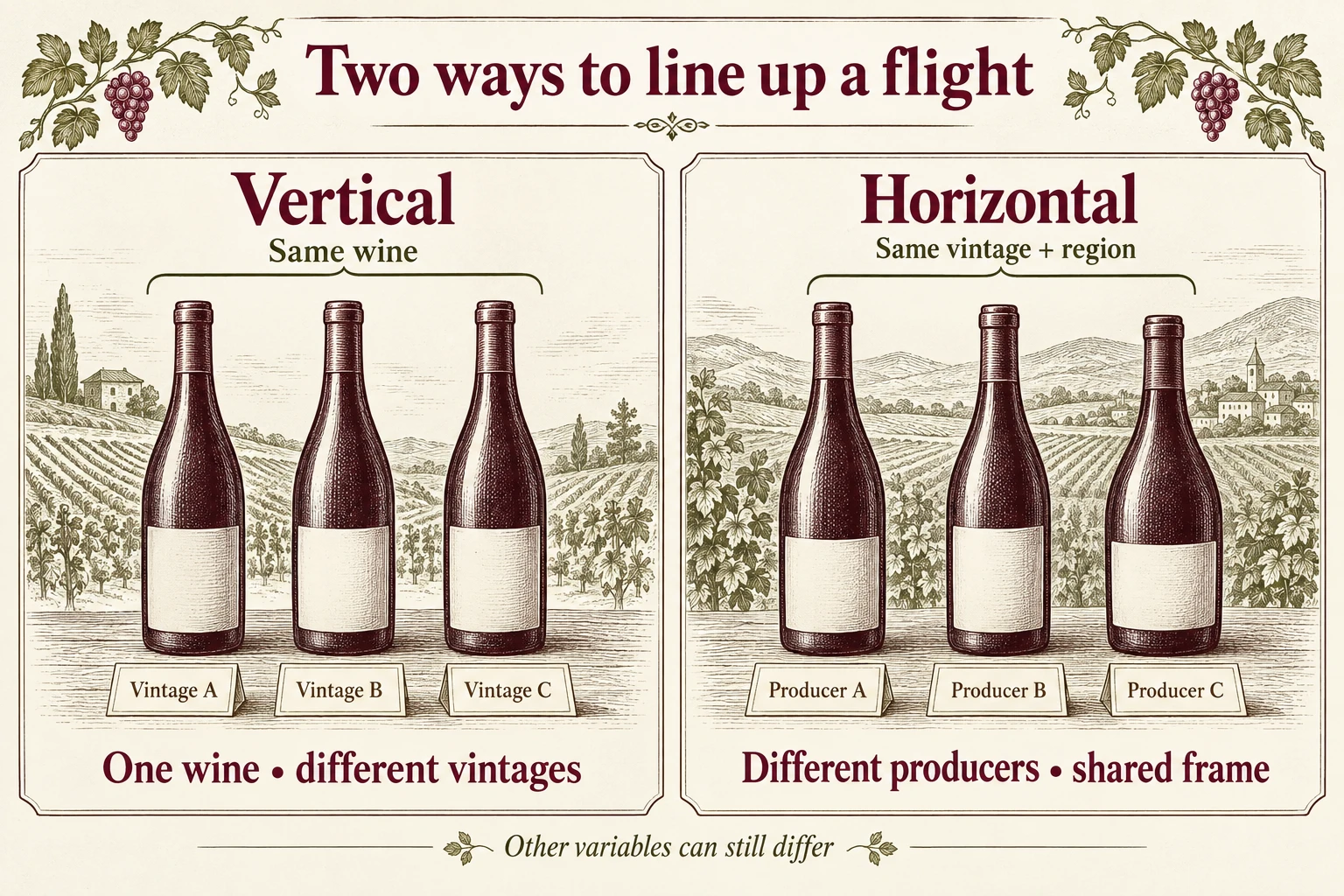
Read the illustration
A vertical flight compares the same named wine from one producer across vintages. A horizontal flight compares producers within the same vintage and defined region, matching grape or style. Other variables can still differ.
Use the cards as experiment briefs. “Hold steady” means match as closely as the market allows, not that every hidden variable has disappeared. Three to four wines are often enough to make a contrast visible while leaving time to revisit the glasses.
Place · broad comparison
Same grape, different region
Choose one named variety from several regions. Match vintage, varietal percentage, price band, ABV, and cellar treatment where possible.
- Ask
- How do these bottles labeled from different places compare?
- Hold steady
- Grape first; then narrow the obvious commercial and cellar variables.
- Watch
- Origin does not act alone. Producer, site, harvest, and winemaking still move.
Time · one label
Vertical flight
A strict vertical compares the same named wine or cuvée across multiple vintages from one producer.
- Ask
- What changed across releases, and what may be bottle development?
- Hold steady
- Producer and exact wine or cuvée name.
- Watch
- Blend, sourcing, cellar practice, ownership, storage, and bottle condition may have changed too.
Producer · one year
Horizontal flight
Use the same vintage and defined region or appellation across producers, with the same grape or legally comparable style.
- Ask
- How do producers interpret a shared place and season?
- Hold steady
- Vintage, origin, grape or appellation style, and a sensible price band.
- Watch
- Individual vineyards and élevage can remain major variables.
Cellar · paired method
Oaked versus unoaked
Prefer the same producer, grape, vintage, and region, then verify the producer technical sheet for vessel, wood age, toast, time, and percentage of new oak.
- Ask
- What aroma or texture differences do we observe between documented treatments?
- Hold steady
- Everything practical except the treatment under study.
- Watch
- Butter does not prove oak; malolactic fermentation and lees work are different variables.
Value · preference test
Price ladder
Buy a similar grape, place, vintage, and style at several prices. Record the price paid, then hide it until preference and descriptive notes are complete.
- Ask
- Which wine do I prefer, and what differences can I describe?
- Hold steady
- Category, serving conditions, pour, and label visibility.
- Watch
- Price reflects scarcity, packaging, age, distribution, brand, and demand—not a single quality meter.
Method · coded reveal
Blind comparison
Blindness is a method layered onto another flight. Have someone code identical-looking covers, hide bottle shape and price, then reveal only after independent notes.
- Ask
- What do I notice without label, reputation, origin, or price information?
- Hold steady
- Glass, temperature, sample volume, timing, and information.
- Watch
- Blind service reduces some expectation effects; it does not remove order, color, physiology, or group influence.
Argentina · controlled place
Familia Morgan / Argentine Malbec
Anchor the flight with a currently available Familia Morgan Malbec only when its live label and product facts fit the comparison. Add documented Argentine contrasts without pre-writing what anyone should taste.
- Ask
- How do these Argentine Malbecs compare when the obvious label facts are reasonably aligned?
- Hold steady
- Vintage, varietal percentage, oak regime, price band, ABV, and sample size where possible.
- Watch
- San Rafael, Uco Valley, Luján de Cuyo, Salta, and Patagonia are not single uniform styles.
Build the Familia Morgan / Argentine Malbec flight from live facts
This guide does not publish a fixed lineup. Vintages change, prices move, products sell through, and technical sheets differ. On the day you buy, verify current vintage, price, availability, and technical details on the producer page, label, or merchant listing. Do not copy tasting notes onto the worksheet before anyone tastes.
San Rafael
If a Familia Morgan Malbec is currently offered, record its stated origin, vintage, varietal composition, ABV, and cellar treatment. It earns the first slot by documented facts, not by a promised flavor.
Another Argentine origin
Choose a Malbec from a clearly stated different region or Mendoza subregion. Match vintage, percentage, oak, price band, and ABV as closely as possible.
Repeat or contrast
Add a third Argentine origin, or keep the origin closer and change one verified cellar treatment. Do not claim a regional comparison when the main designed change is oak.
Before the reveal
- Code the wines with neutral numbers.
- Pour equal samples at the same temperature.
- Write fruit direction, non-fruit observations, acidity, tannin, body, warmth, texture, and finish length in your own words.
- Reveal origin and technical facts only after the first notes.
- Use regional studies as post-reveal context, never as an answer key.
The Malbec guide explains Argentina, Cahors, origin, oak, serving, and label terms. The Malbec comparison guide owns the broad red-wine chooser. This flight page owns the comparative setup.
Two kinds of math belong on separate lines
Competing guides often say a bottle contains “five glasses” and then use that number for a tasting. That confuses a familiar standard-drink example with the number of small samples a bottle can physically supply.
01 · bottle yield
How many equal samples?
750 mL ÷ 29.573 mL per U.S. fluid ounce = about 25.36 U.S. fluid ounces.
Use the exact labeled bottle volume when it differs. For full, equal samples, round the sample count down; for bottles to buy, round the requirement up.
| Sample | Planning amount | Full samples |
|---|---|---|
| About 1 oz | 30 mL | 25 one-ounce samples |
| About 1.5 oz | 44–45 mL | 16 one-and-a-half-ounce samples |
| About 2 oz | 59–60 mL | 12 two-ounce samples |
02 · alcohol-content reference
How much pure alcohol?
NIAAA defines one U.S. standard drink as 0.6 fluid ounces or 14 grams of pure alcohol. Its familiar wine example is 5 fluid ounces of 12% table wine.
ABV changes the result. Estimate the flight as:
wines × sample ounces × ABV decimal ÷ 0.6
This is an educational content estimate. It cannot predict blood alcohol concentration, impairment, or whether anyone can drive.
The comparative tasting ledger
Size the pours, then print the evidence
Set the number of tasters, wines, sample size, and the highest planned ABV. The planner calculates bottle inventory and a separate U.S. standard-drink reference, then prepares a blank note sheet for the selected flight.
This is an inventory estimate, not a drinking recommendation. The alcohol figure estimates pure-alcohol content from the ABV you enter; it does not predict blood alcohol concentration or individual impairment. No guest needs to drink or finish a sample. Keep water and alcohol-free options visible, provide a discard vessel, and arrange safe rides.
Printable comparative sheet
Record first. Reveal second.
Use your own words. The lines are prompts, not a scoring exam.
The flight planner sizes equal samples of several wines. For a full party or wedding inventory—including exact bottle formats, a visible buffer, bottles already on hand, and alcohol-free drinks—use the wine bottle calculator.
Set the room so the comparison has a chance
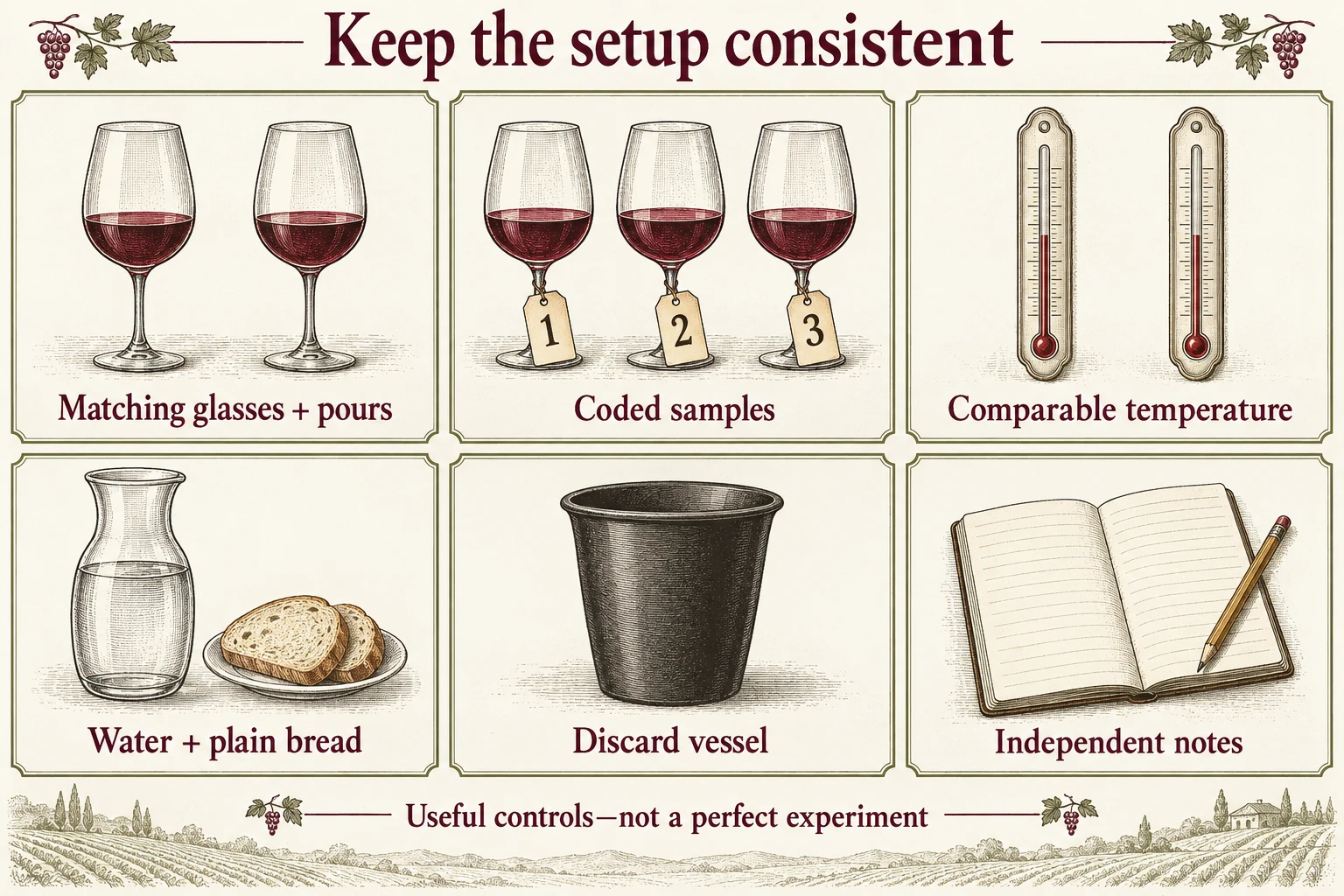
Read the illustration
Use matching glasses and equal pours, numbered samples, comparable temperatures, water and plain bread, a discard vessel, and independent notes. These controls help comparison but do not remove every influence.
Professional competition rules are not mandatory at home, but their controls are useful clues: clean standardized glasses, neutral light, coded samples, water, bread, a discard vessel, breaks, and comparable temperatures. Use what you already own consistently before buying specialist equipment.
Keep the vessel comparable
Use the same glass shape for every sample when possible. Clear, clean, odor-free bowls with a narrower opening than their widest point are useful; grape-specific crystal is not required.
Number before pouring
Place each glass on a numbered card. For a blind flight, have one person code covered bottles and keep the key away from the tasting table.
Provide, but do not promise a reset
Put fresh water and plain bread or neutral crackers at every place. They support comfort and pacing; they do not erase all sensory carryover.
Compare wine first
Serve flavorful food after the first comparison pass. Then taste with the meal and note whether preference changes. Avoid cooking aromas during the initial pass.
Match within the flight
Comparable wines should begin at the same temperature. A region test is weak if one bottle is warm and another has just left the refrigerator.
Make “not finishing” normal
Give each taster a personal cup or shared discard vessel. Write independently before anyone announces a favorite or supplies a tasting descriptor.
Purpose decides the order
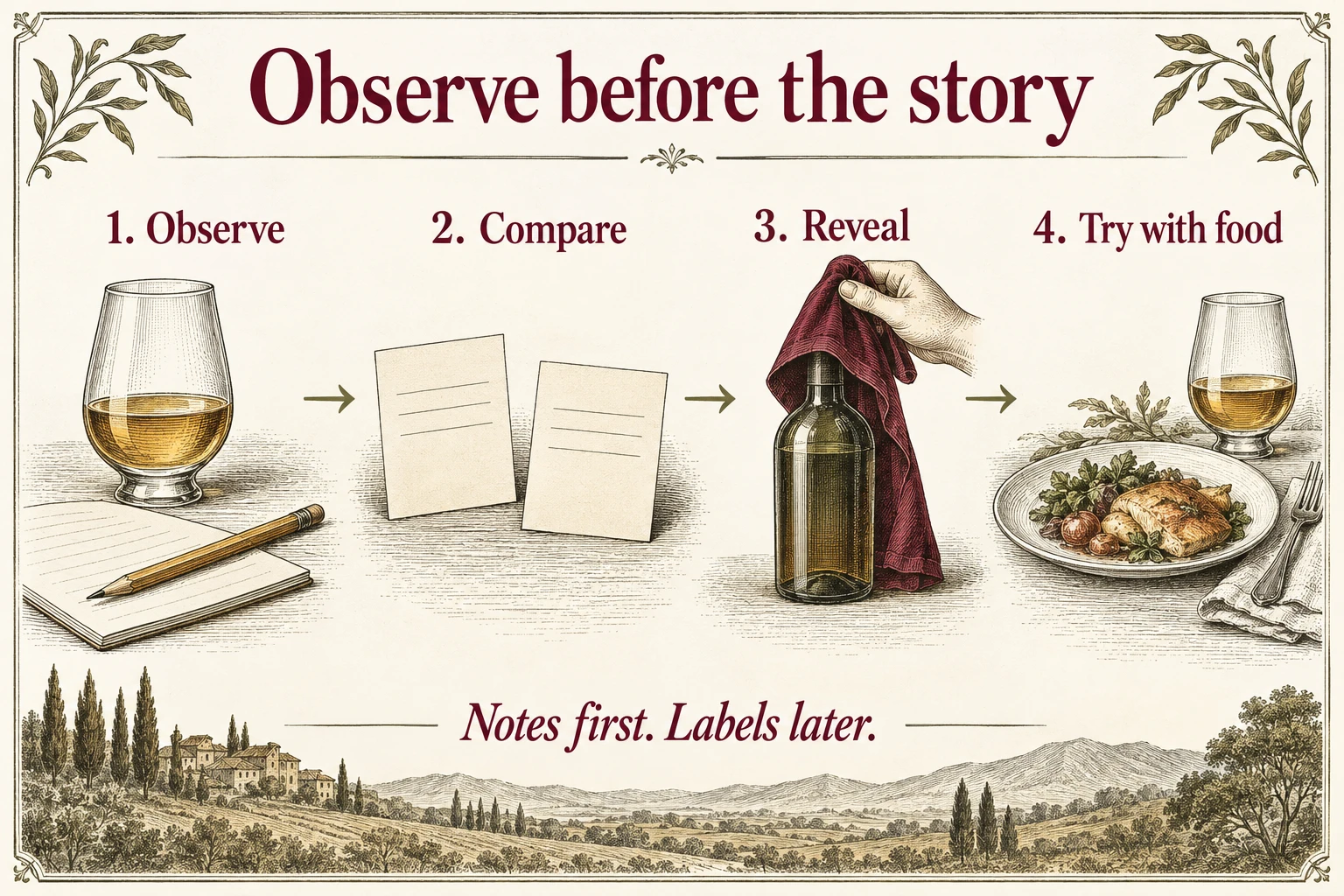
Read the illustration
For a coded comparison, observe independently, compare notes, reveal the bottle facts, then try the wines with food. Write observations before hearing others or seeing labels; food may change preference.
There is no single scientifically optimal home sequence. A practical mixed-style progression and a difference-focused comparison solve different problems. Choose one method, disclose it, and let people return to earlier glasses.
Curated mixed-style flight
Move from less forceful to more forceful
- Delicate, dry still wines
- Fuller or oak-influenced whites
- Lighter reds
- Fuller, more tannic reds
- Sweet or fortified wines
The shortcuts white and rosé before red and dry before sweet are useful, not natural laws. Body, tannin, sweetness, aroma intensity, and alcohol can matter more than color.
Difference-focused or blind flight
Control information and acknowledge order effects
- Code equal samples.
- Use one disclosed order for the group.
- Write before discussion.
- Allow retasting.
- Reveal after notes are complete.
Individual randomized orders would be more rigorous. At home, a single coded order is manageable as long as the host admits that sequence can influence the result.
A vertical has no universally required young-to-old or old-to-young direction. Choose a direction, keep it consistent, and remember that older bottles can differ in provenance and condition as much as in vintage.
Palate fatigue is a design constraint, not a failure
Stop before every glass sounds the same
Small flights preserve the question
Repeated red-wine tasting can produce astringency build-up through polyphenol accumulation and changing oral conditions. Water and crackers do not guarantee a complete reset.
Three to six wines is an editorial home-planning range, not a universal maximum. When the flight grows, use a break between series, smaller measured pours, water, time, and a discard vessel. Split a complex comparison into another session rather than turning the last glasses into endurance.
Run the reveal without rewriting anyone’s notes
Observe
Appearance, aroma, flavor, acidity, tannin, body, alcohol warmth, texture, finish, and personal preference—in language that belongs to the taster.
Compare
Which differences feel large? Which wines seem similar? What would you want to retaste before making a claim?
Reveal
Add producer, wine, vintage, origin, ABV, price paid, and verified cellar facts. Do not delete an observation because it contradicts the label story.
Test with food
Add the meal after the first pass. Preference may move; that is another result, not proof the original note was wrong.
Continue by the comparison you actually want to make
Origin, taste ranges, oak, serving, labels, and pairing without a fixed bottle prescription.
Broad chooserMalbec comparison guideMalbec beside seven red-wine styles, with exact guides kept separate.
The gatheringSobremesa hosting guideInvitation, access, beverage inclusion, pacing, food safety, and a graceful ending.
Four existing two-grape flights
Keep the deeper comparison with its owner
The reference unit is not permission
Plan the alcohol-free path before uncorking
A standard drink is a reference unit, not a target. No guest needs to drink or finish a sample, and someone who does not drink should not start for health reasons. Current NIAAA guidance summarizes the risk direction as the less, the better.
Serve only adults of legal drinking age. Put water, alcohol-free drinks, and a discard vessel at every place. Arrange a sober designated driver, taxi, rideshare, or overnight plan before tasting.
People who are pregnant or trying to become pregnant, taking interacting medications, managing conditions worsened by alcohol, recovering from alcohol use disorder, or unable to control intake should avoid alcohol and follow clinical guidance.
Food, water, coffee, spitting, a calculator result, or waiting a guessed amount of time does not prove someone is sober or safe to drive. ABV math does not predict an individual blood alcohol level.
Sources and methodology
The seven flight templates, three-slot Malbec blueprint, and printable worksheet are editorial planning tools. The claims and calculations below rely on primary government, standards, and research sources. Professional competition controls are translated into optional home practices, not presented as mandatory rules.
- NIST, U.S. fluid-ounce conversion guidance — 1 U.S. fluid ounce is approximately 29.573 mL, used for the transparent 750 mL conversion.
- U.S. Alcohol and Tobacco Tax and Trade Bureau, wine net contents — the 750 mL / 25.4 fl oz label context and the instruction to use the package’s stated volume.
- NIAAA, What Is a Standard Drink? — the U.S. 0.6 fl oz / 14 g pure-alcohol unit and 5 fl oz at about 12% wine example.
- NIAAA, current alcohol-risk guidance — “the less, the better,” advice not to start for health, and circumstances in which alcohol should be avoided.
- CDC, preventing impaired driving — plan alternate transportation or a designated driver who does not drink.
- OIV, Standards for International Wine Competitions — coded samples, neutral setting, water, bread, discard vessels, clean standardized glasses, comparable temperatures, rational categories, and breaks.
- ISO 3591:1977, Wine-tasting glass — the current-confirmed sensory glass standard and narrower opening; cited as consistency evidence, not a purchase requirement.
- Fernandes et al., palate cleansers and wine astringency — evidence of astringency build-up and the limits of assuming one cleanser erases carryover.
- Spence, price and wine evaluation — review of cognitive price effects and why a price ladder should be served blind before price is revealed.
- Instituto Nacional de Vitivinicultura, 2025 Malbec report — current planted-area context for Argentina, Mendoza, San Rafael, and Uco Valley; not used to prescribe tasting notes.
- UC Davis Waterhouse Lab, oak lactones — oak species, toast, and cellar choices as variables behind wood-associated compounds.