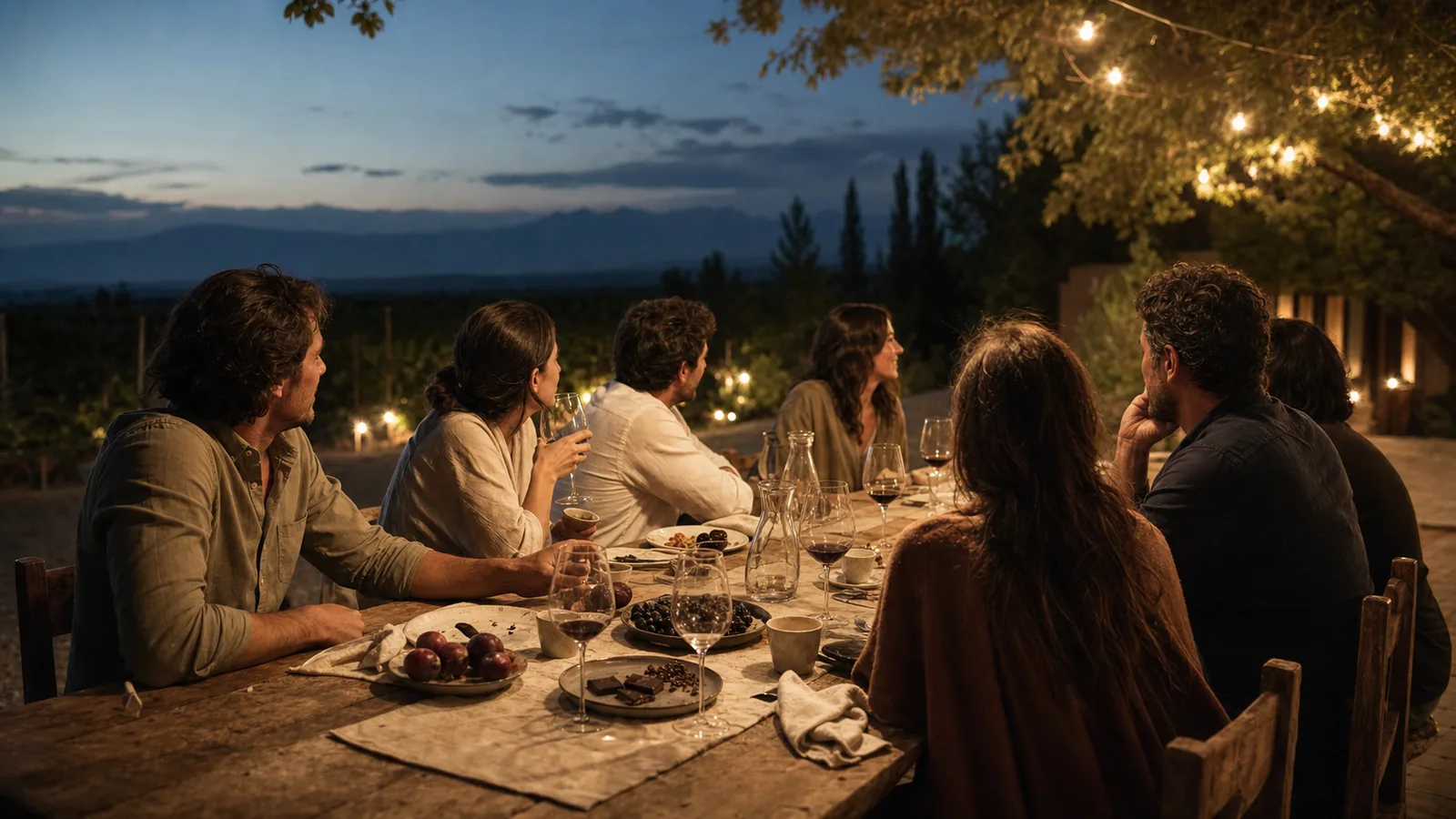
At the table · hosting field guide no. 01
How to Host Sobremesa: A Practical Field Guide
A good sobremesa is not produced on cue. The host creates comfort, time, food safety, and permission to stay—then lets the table become its own.
Research note: This is the maintained practical guide. It separates editorial hosting suggestions from official food-safety and alcohol guidance, and it keeps meaning and cultural history with the existing Art page.
The short answer
Host the conditions for lingering, not a performance
Tell guests the real time window, serve a meal that can slow down, clear perishables, and make the after-meal table comfortable. Keep water and alcohol-free drinks as visible as wine. When plates are cleared, offer coffee, tea, fruit, or a small sweet; use one open question only if the conversation needs it. Close warmly and clearly before fatigue becomes the host.
Think in four phases—before, table, linger, close. It is a sequence, not a stopwatch, and none of the phases requires alcohol.
The Real Academia Española defines sobremesa simply as the time spent at the table after eating. Our Art of Sobremesa page owns the meaning and cultural story. This page has the practical hosting job: invitation, pacing, setup, prompts, food safety, and a respectful end.
The four-phase hosting plan
A host cannot guarantee a profound conversation, and should not try. The useful work is more concrete: remove avoidable friction before guests arrive, serve without making everyone chase a clock, create an unmistakable transition after the meal, and end with enough clarity that staying feels like an invitation rather than an obligation.
Before guests arrive
Share the real time window, ask about dietary and accessibility needs, stage water and serving tools, and finish the work that would keep you away from the table.
At the table
Serve food people can pass, keep the next course simple, and sit down. The host’s attention is more valuable than one additional garnish.
The linger
Clear perishables, leave glasses and water, offer a small optional second act, and allow silence or a new thread to appear without manufacturing intimacy.
The close
Give a warm signal before the promised end, confirm rides, pack safe leftovers, and make departure easy. A clear ending protects the pleasure of staying.
The hosting paradox: plan the practical details closely enough that you can stop managing the room once everyone sits down.
Design backward from the goodbye
Start with the ending window, not a fantasy guest count. “Dinner at 6:30; we will start wrapping around 10” is kinder than an open-ended invitation followed by surprise when someone leaves. Guests may leave before the linger and still have participated fully.
There is no universal guest-count sweet spot. Two close friends can linger; twelve relatives can linger. Choose the number your table, kitchen, seating, sound level, budget, and energy can support. If conversation would fragment naturally, treat several small conversations as success rather than forcing one table-wide performance.
An invitation that tells the truth
A useful template
“Dinner is at [time]. We are planning to stay at the table afterward for coffee, something small, and unhurried conversation. We will begin winding down around [time]. Come for as much of the evening as works for you. Please tell me about food, mobility, sensory, or seating needs by [date].”
That last sentence is not a legal form. It is a signal that access and comfort are part of the plan. Give guests a private way to respond, and never make someone explain a need to the whole group.
Build a menu that can survive attention moving elsewhere
The best hosting menu is not necessarily the most traditional or ambitious. It is the one you can serve safely without disappearing into the kitchen. A flexible structure is enough: one arrival bite, one shared main direction, one bright side or condiment, and a simple finish.
Comfort is part of hospitality
Check the room before styling the table
- Route: can a guest enter, move to a seat, and reach the restroom without negotiating clutter?
- Seat: does anyone need a backed chair, armrests, more space, a lower noise position, or a place away from smoke?
- Light: warm light can feel inviting, but people still need to read the food, steps, faces, and exits.
- Sound: music is optional. If guests lean forward to hear every sentence, it is too loud for this table.
- Food: label unfamiliar fillings and keep serving utensils separate when allergens or dietary restrictions matter.
A printable field card
Plan the conditions; leave the conversation unplanned
Check only what your gathering needs. The card is deliberately flexible: it organizes comfort, food, drinks, and a clear ending without scripting the people at the table.
Plan a beverage table, not a wine requirement
Put chilled water and alcohol-free drinks where guests can serve themselves without asking. Offer them in the same glassware and with the same care as wine. No guest needs to drink for the ritual to work. A cup of coffee, sparkling water, tea, or nothing at all can accompany the linger.
For U.S. alcohol guidance, NIAAA defines a standard drink as 0.6 fluid ounces or 14 grams of pure alcohol. Its familiar wine example is 5 fluid ounces of 12% table wine. That is a reference unit, not a target pour, and customary glasses can hold more. ABV changes the alcohol content, so a 5-ounce pour of a stronger wine can contain more than one standard drink.
Count choices, not assumptions
Ask whether people want wine instead of assigning it to every adult. Keep reserve bottles sealed until there is a clear reason to open one.
Make opting out effortless
Water, tea, coffee, and zero-proof choices should not feel like substitutions hidden at the back of the kitchen.
Resolve the ride home
Designated drivers, taxis, rideshare, guest rooms, or a sober pickup plan belong in the invitation—not in a negotiation at the door.
Wine service: keep bottles away from fire, sun, and overheated rooms. Taste before deciding whether to decant. Some young wines may become more expressive with air; some bottles need none, and older wines may be more about sediment than aeration. A fixed clock is not a guarantee.
Need a transparent quantity plan? After asking who actually wants wine, use the wine bottle calculator to set the pour, exact package volume, visible optional buffer, on-hand bottles, and a separate alcohol-free inventory line. It is a purchase estimate, not a drinking recommendation.
Planning a comparison instead of ordinary dinner pours? Use the wine tasting flight guide for themes, tasting order, equal sample sizes, and a printable note sheet.
Conversation prompts should open a door, not corner a guest
Use a prompt only when the table wants help. Read the room, offer an easy pass, and avoid questions that demand disclosure about grief, money, health, family conflict, or work. One good follow-up—“What made that interesting to you?”—usually does more than a deck of increasingly intimate cards.
What small thing made this week better than expected?
What have you changed your mind about lately?
What meal do you remember because of the people around it?
If tomorrow had one extra free hour, how would you spend it?
What are you enjoying that the rest of us might have missed?
Which dish on this table deserves its own holiday?
A graceful ending is part of a good invitation
Ten or fifteen minutes before the shared end window, lower the uncertainty: “I have loved this. Let us finish these cups and start sending everyone home.” Turn the music off, bring coats closer, confirm rides, and offer safely packed leftovers. Do not open another bottle as an accidental extension signal.
If the conversation is thriving and everyone genuinely wants to continue, the host can extend once with a new clear end. If one person needs to leave, make the departure easy without turning it into a vote. The point is connection, not endurance.
Before the table settles back
Clear the food-safety clock
A long conversation does not pause food-safety limits. USDA advises keeping cold perishable food at 40°F (4.4°C) or below and hot food at 140°F (60°C) or above. Refrigerate perishable leftovers within two hours, shortened to within one hour above 90°F (32.2°C). Divide large amounts into shallow containers so they cool more quickly.
For the meal itself, USDA lists whole beef, pork, lamb, and veal steaks, chops, and roasts at 145°F (62.8°C) with a three-minute rest; ground meat at 160°F (71.1°C); and poultry at 165°F (73.9°C). Use a food thermometer. A preferred texture and a safe minimum are separate decisions.
The original field companion
Keep the PDF for the table; use this page for maintained guidance
The 2025 printable includes a compact philosophy, hosting checklist, asado outline, and founder story. This HTML page is the maintained source for current food-safety distinctions, inclusive beverage planning, decanting caveats, and flexible timing. Where the two differ, follow the current sources linked here.
Open the printable companionContinue by the job you need to solve
Sources and methodology
The four-phase hosting structure, invitation template, prompt deck, and menu architecture are editorial tools. The sources below support the word’s literal meaning, Argentine gathering context, U.S. food-safety minimums, and responsible alcohol language. No source claims there is one ideal guest count, timeline, prompt, or bottle plan.
- Real Academia Española, sobremesa — the literal definition as time spent at the table after eating.
- Visit Argentina, asado gathering guide — official tourism context for shared roles, the staged meal, and the gathering around the fire and table.
- USDA FSIS, Leftovers and Food Safety — safe minimum temperatures, holding temperatures, prompt refrigeration, and shallow-container cooling.
- NIAAA, What Is a Standard Drink? — the U.S. definition, wine example, and warning that customary serving sizes and alcohol percentages vary.
- NIAAA, hosting and summer safety fact sheet — alcohol-free options, food, safe rides, and underage-drinking responsibility for hosts.