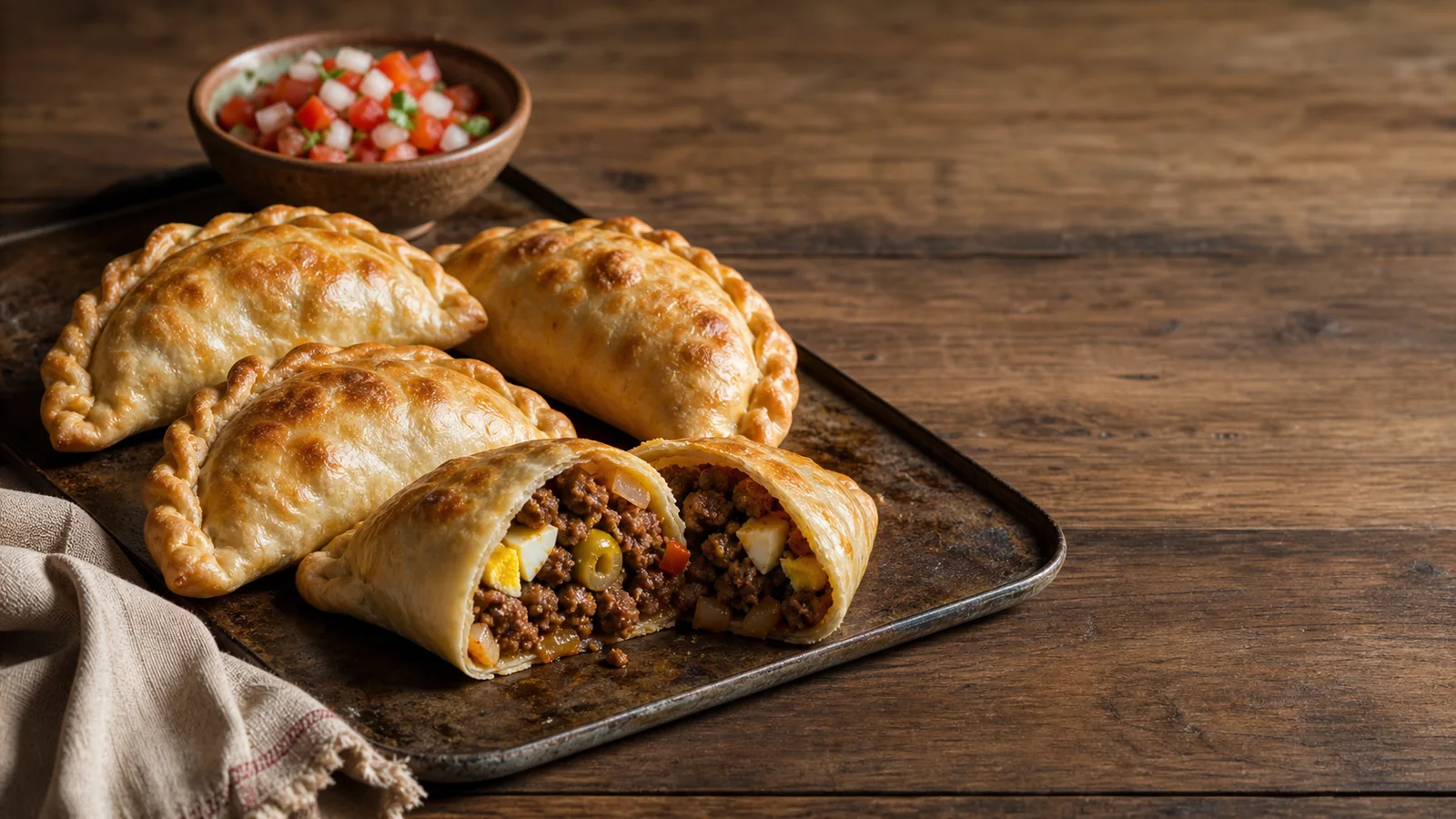
Argentine Beef Empanadas: A Mendoza-Style Baked Recipe
Answer first: these baked Argentine beef empanadas use an onion-rich filling with paprika, cumin, oregano, hard-boiled egg, and green olives. You can make the dough or use refrigerated empanada rounds. Cook the beef to 160°F (71.1°C), cool the filling promptly in a shallow pan, and heat the finished empanadas to 165°F (73.9°C).
Argentina does not have one national beef-empanada formula. Dough, size, meat cut, seasoning, garnish, and cooking method vary by province, town, bakery, and household. The Ministry of Culture lists the empanada as part of Argentina’s food heritage while also emphasizing that food practices are continually renewed and recreated.
This recipe is a Mendoza-style starting point, not a national standard. It takes its regional cue from a Government of Mendoza recipe built around beef, a generous amount of onion, olives, hard-boiled egg, paprika, cumin, oregano, and chile. We reduce the official batch to a home scale and make baking the main method.
The empanada glossary entry keeps the concise definition. This page owns measurements, temperature, folding, baking, frying, and storage.
Why the filling is cooled before assembly
Warm filling softens the fat in the dough, creates steam too early, and makes a clean seal difficult. It also should not spend a long period cooling on the counter. Spreading the cooked mixture in a shallow pan and refrigerating it promptly solves both problems.
The official Mendoza recipe likewise instructs cooks to cool the picadillo in the refrigerator, never at room temperature, and notes that it can be prepared the day before. Our version adds current USDA ground-beef and leftover temperatures for a U.S. home kitchen.
An onion-heavy ratio is intentional. Cook the onions gently until translucent so they become sweet without drying out. The cooled mixture should be moist but not wet. If liquid remains in the pan, let it evaporate before chilling rather than thickening the filling with crumbs.
Dough choice
Ready-made empanada rounds are the practical option and the easier path to a consistent dozen. Buy rounds labeled for baking if possible; frying rounds may have a different fat and thickness.
The homemade dough here is deliberately simple: flour, salt, fat, and warm water. Rendered beef fat or lard gives a more savory, extensible dough. Butter works but tastes different and can make the dough slightly more brittle when cold. Resting relaxes the gluten, which makes each circle easier to roll without springing back.
Keep either dough covered. Dry edges crack during the fold and weaken the seal.
Filling and the repulgue
Two and a half tablespoons is enough for a 5- to 6-inch round. More filling is tempting, but an overloaded empanada is harder to seal and more likely to leak.
The braided edge is called a repulgue. It can identify fillings in shops and displays, although patterns are not universal. At home, its first job is mechanical: reinforce the seam. If the braid is unfamiliar, press the closed edge firmly with a fork. A secure fork seal is better than a beautiful weak fold.
Fried variation
For fried empanadas, do not brush them with egg wash or cut steam vents. Fill a deep, heavy pot with about 2 inches of neutral high-heat oil, leaving ample headroom. Heat it to 350°F (176.7°C). Lower in 2 or 3 chilled empanadas at a time and fry for about 2-3 minutes per side, adjusting the heat to keep the oil between 325°F and 350°F (162.8-176.7°C).
Drain on a rack over a sheet pan, not directly on paper where the bottom can steam. Check a test empanada for a center temperature of 165°F (73.9°C). Never put ice-covered frozen empanadas into hot oil; thaw them safely in the refrigerator first. Keep children and water away from the frying station.
What to serve with beef empanadas
Salsa criolla brings raw onion, pepper, tomato, and vinegar to the browned beef and pastry. It is brighter and chunkier than chimichurri. Serve either on the side so the crust stays crisp.
For a longer asado, one empanada is enough as an opening course. If the meal centers on handheld food, add choripán and a salad, then let the table slow down.
Wine pairing
The filling combines browned beef, sweet onion, spice, egg, and salty olive. A medium-bodied Malbec with dark fruit and moderate tannin can match that savory range. When salsa criolla is prominent, choose a fresher bottle with restrained oak so the condiment’s vinegar does not become sharp beside sweet wood and high alcohol.
The Malbec guide explains how oak, origin, serving temperature, and structure alter the match.
Sources and methodology
The regional ingredient pattern comes from Mendoza’s government food program. Safety temperatures and storage limits follow current U.S. federal guidance. The smaller quantities, dough, and bake/fry timing are recipe-development choices, not claims about every Mendoza kitchen.
- Government of Mendoza, Alimentos mendocinos en comidas patrias, for the regional beef, onion, olive, egg, seasoning, refrigeration, and hot-oven framework.
- Argentina Ministry of Culture, La gastronomía como patrimonio cultural de los argentinos, for the empanada’s national cultural status and the warning that food heritage is diverse and continually recreated.
- USDA FSIS, Safe Minimum Internal Temperature Chart, for 160°F ground-beef guidance.
- USDA FSIS, Leftovers and Food Safety, for shallow-container cooling, refrigeration windows, and 165°F reheating.
Ingredients
- 12 empanada dough rounds, 5 to 6 inches wide, refrigerated, or make the dough below
- 3 cups (375 g) all-purpose flour, only if making dough
- 1 teaspoon fine salt, only if making dough
- 1/2 cup (113 g) rendered beef fat, lard, or unsalted butter, melted and cooled slightly, only if making dough
- 3/4 cup (180 ml) warm water, plus up to 1 tablespoon as needed, only if making dough
- 2 tablespoons rendered beef fat or neutral oil, for the filling
- 1 1/2 pounds (680 g) yellow onions, about 3 medium, cut into 1/4-inch dice
- 1 pound (454 g) ground beef
- 2 teaspoons sweet paprika
- 1 teaspoon ground cumin
- 1 teaspoon dried oregano
- 1 1/2 teaspoons fine salt, plus more only after tasting the cooked filling
- 1/2 teaspoon black pepper
- 1/4 teaspoon crushed red chile or ají molido, optional
- 2 large eggs, hard-boiled, cooled, peeled, and chopped
- 1/2 cup (70 g) pitted green olives, chopped
- 1 large egg plus 1 tablespoon water, beaten together for the baked-method egg wash
- About 2 quarts neutral high-heat oil, only for the fried variation
Directions
- Make the dough, or keep purchased rounds cold. Whisk the flour and 1 teaspoon salt. Mix in the melted fat, then add 3/4 cup warm water until a firm, smooth dough forms, adding the extra tablespoon only if dry. Knead for 2-3 minutes, cover, and rest for 30 minutes. Skip this step when using ready-made rounds.
- Cook the onions. Heat the 2 tablespoons beef fat or oil in a wide skillet over medium-low. Add the diced onions and cook for 12-15 minutes, stirring, until soft and translucent but not deeply browned.
- Cook the beef safely. Add the beef, paprika, cumin, oregano, 1 1/2 teaspoons salt, black pepper, and optional chile. Break the meat into small pieces and cook for 7-10 minutes. Check several places with an instant-read thermometer; the ground beef must reach 160°F (71.1°C).
- Cool promptly. Spread the filling in a clean shallow pan so it cools quickly. Refrigerate it promptly, never on the counter, until it reaches 40°F (4.4°C) or below, at least 30 minutes. Once cold, fold in the chopped hard-boiled eggs and olives.
- Roll and cut homemade dough. Divide the rested dough into 12 equal pieces. Roll each on a lightly floured surface into a 5- to 6-inch circle, about 1/8 inch thick. Keep finished rounds covered. Purchased rounds can go straight to filling.
- Fill without crowding. Put 2 1/2 tablespoons cold filling just below the center of each round. Moisten the rim lightly with water, fold the dough over, press out trapped air, and seal firmly. Do not let the filling touch the sealing edge.
- Make the repulgue. Starting at one corner, fold a small section of sealed edge over itself, then repeat along the curve to make a rope-like border. A firmly pressed fork edge is an equally functional home seal. Refrigerate the shaped empanadas for 15 minutes while the oven heats.
- Baked method. Heat the oven to 425°F (218.3°C). Arrange empanadas on a parchment-lined sheet, brush with egg wash, and cut one small steam vent in each. Bake for 18-22 minutes, rotating once, until deeply golden and the center of a test empanada reaches 165°F (73.9°C).
- Rest and serve. Cool on the pan for 5 minutes before serving. The filling stays very hot, so open one before serving children. Discard the used egg wash and wash any brush or bowl it touched.
Wine Pairing
Malbec's dark fruit can meet browned beef and sweet onion; choose a fresher, less oaky style when salsa criolla is on the plate.
Serving Ideas
Serve 2-3 empanadas per person with salsa criolla and a simple green salad, or offer 1 each before an asado. Keep the salsa on the side so the pastry remains crisp. For a larger Argentine spread, add provoleta or choripán rather than overfilling the empanadas.
Storage
Make the beef-onion filling up to 1 day ahead and keep it at 40°F (4.4°C) or below. Refrigerate cooked empanadas within 2 hours, or within 1 hour above 90°F (32.2°C), and use within 3-4 days. Reheat to 165°F (73.9°C). Freeze unbaked, fully shaped empanadas on a tray until firm, then bag for up to 2 months for best pastry quality; bake from frozen and verify the center reaches 165°F.
The most useful sign of a well-built empanada is not decorative perfection. It is a cold, flavorful filling held inside a firmly sealed pastry that reaches the table crisp. Read the Malbec guide when you are ready to choose the bottle.
Editorial image created for this recipe; the finished pastries illustrate the intended bake and filling rather than a documented family recipe.