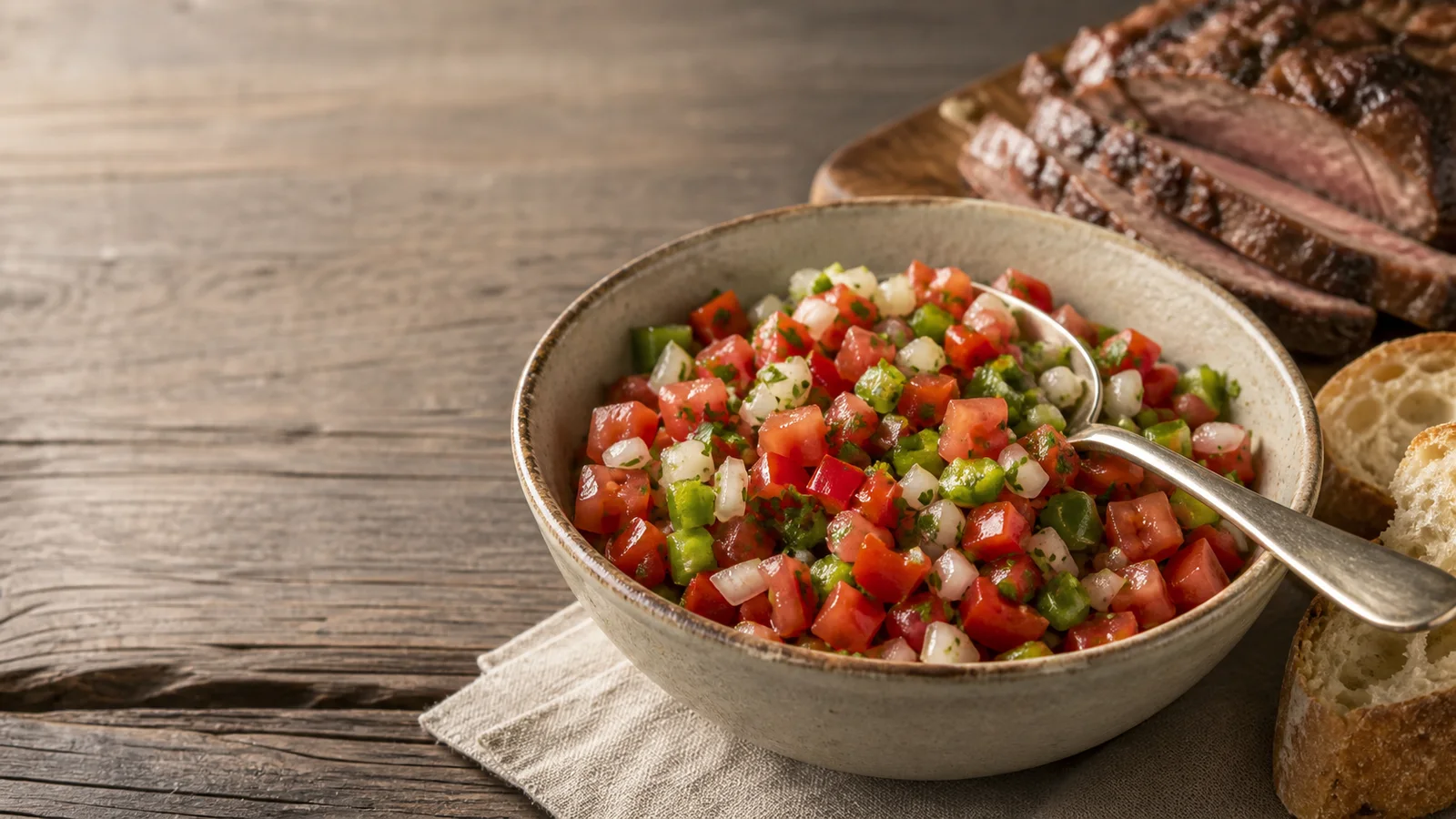
Salsa Criolla: Argentine Onion, Pepper, and Tomato Relish
Answer first: Argentine salsa criolla is a fresh, chopped condiment built from onion, peppers, tomato, vinegar, oil, and seasonings. Rest it for at least 30 minutes and keep it refrigerated. It is a vegetable-led relish, while chimichurri is an herb-led sauce.
Recipes vary. Some families omit tomato, change the pepper colors, add scallion, use more vinegar, or leave out garlic and parsley. The Argentine Food Code gives a useful ingredient family for a packaged product called salsa criolla: onion, tomato, green chile, garlic, parsley, salt, pepper, oil, and vinegar, with possible additional seasoning. That commercial definition is not a universal home formula.
Our version adds red bell pepper for color and sweetness while keeping green pepper, tomato, garlic, and parsley. It is designed for an asado table, not for shelf storage.
The ratio behind the recipe
By approximate volume, the bowl contains about four parts chopped vegetables to one part vinaigrette. The dressing uses three parts oil to a little more than two parts vinegar. That is brighter than a leafy salad dressing, which suits fatty sausage, grilled meat, and pastry.
The 1/4-inch dice is small enough to stay on a forkful or sandwich but large enough for each vegetable to remain distinct. If the tomatoes are very wet, seed them before weighing or measuring. Otherwise their juice can dilute the vinegar and leave the bowl watery.
Salt first dissolves in the vinegar. Oil follows. Resting then takes the raw edge off the onion and lets tomato juice join the dressing. Thirty minutes is useful; overnight is not necessary and softens the vegetables considerably.
Salsa criolla versus chimichurri
Chimichurri usually centers parsley, garlic, oregano, chile, vinegar, and oil. It is loose, herbaceous, and often finely chopped. Salsa criolla centers diced fresh vegetables and eats more like a relish.
They are partners, not interchangeable names. Put both beside choripán: chimichurri supplies herbs and garlic, while salsa criolla supplies crisp onion, pepper, tomato, and a juicy vinegar bite.
What to serve with salsa criolla
- Choripán: drain a spoonful lightly so the bread stays crisp.
- Beef empanadas: serve on the side and dip each bite rather than soaking the pastry.
- Grilled steak: spoon it over sliced beef at the table. Use the steak wine guide for the cut and cooking method.
- Provoleta: a small amount can brighten the browned cheese, though chimichurri is the more familiar route in our existing recipe.
- Grilled vegetables or bread: treat it as a vinaigrette-rich relish, not a marinade left at room temperature.
Wine pairing
Salsa criolla changes a pairing without becoming the whole meal. Vinegar and raw vegetables can make a hot, heavily oaked red feel more severe. A fresh, fruit-led Malbec or red blend is often the easier starting point, especially with grilled beef or chorizo underneath.
For empanadas, let the browned beef and pastry provide the wine’s weight. For a vegetable plate, a dry rosé or crisp white may fit better than red. The Malbec guide helps distinguish freshness from sweetness and oak aroma.
Make-ahead and food safety
Prepare the salsa up to a day ahead for convenience, understanding that the vegetables will soften. Keep it cold rather than trying to preserve the crunch at room temperature.
The vinegar in a home recipe does not make the bowl self-preserving. The Food Code’s pH requirement applies to a packaged, properly processed commercial product. We did not laboratory-test this home batch, so the safe instruction is refrigeration, not canning.
FDA guidance recommends rinsing produce under running water and explicitly advises against soap, detergent, or commercial produce wash. Also keep the board and knife for ready-to-eat vegetables separate from raw meat and its juices.
Sources and methodology
The composition is anchored to Argentina’s official ingredient definition, then scaled and balanced as a fresh home relish. Food-safety instructions use current FDA and FoodSafety.gov guidance; the recipe makes no shelf-stability or measured-pH claim.
- Argentine Food Code, Chapter XVI, Article 1291, for the officially defined salsa-criolla ingredient family and the distinct requirements for packaged products.
- Visit Argentina, Asado: A Guide to Experience the Most Delicious Ritual, for salsa criolla and chimichurri as choripán/asado accompaniments.
- FDA, Selecting and Serving Produce Safely, for running-water washing, no soap, refrigeration, and raw-meat separation.
- FoodSafety.gov, 4 Steps to Food Safety, for 40°F refrigeration and the two-hour/one-hour rule.
Ingredients
- 1/2 medium red onion (about 3 ounces / 85 g), cut into 1/4-inch dice
- 1/2 medium red bell pepper (about 2 1/2 ounces / 70 g), cut into 1/4-inch dice
- 1/2 medium green bell pepper (about 2 1/2 ounces / 70 g), cut into 1/4-inch dice
- 2 Roma tomatoes (about 8 ounces / 225 g), cored, seeded if very juicy, and cut into 1/4-inch dice
- 1 small garlic clove, finely grated or minced
- 2 tablespoons flat-leaf parsley, finely chopped
- 1/4 cup (60 ml) red-wine vinegar
- 1/3 cup (80 ml) extra-virgin olive oil or neutral oil
- 1 teaspoon fine salt, plus more only after resting and tasting
- 1/2 teaspoon black pepper
- 1/4 teaspoon crushed red chile or ají molido, optional
Directions
- Clean before cutting. Wash hands for 20 seconds. Rinse the onion, peppers, tomatoes, and parsley under plain running water and dry with a clean towel. Do not use soap or produce wash. Use a clean board and knife kept separate from raw meat.
- Dice evenly. Cut the onion, red bell pepper, green bell pepper, and tomatoes into roughly 1/4-inch pieces. Even pieces are easier to spoon and soften at a similar pace. Mince the garlic and parsley.
- Build the dressing. Whisk the vinegar, salt, black pepper, and optional chile in a nonreactive bowl until the salt dissolves. Whisk in the oil.
- Combine. Fold the onion, both peppers, tomato, garlic, and parsley through the dressing. Taste only with a clean spoon. The mixture should be bright and loose, not submerged in oil.
- Rest for 30 minutes. Cover and refrigerate for at least 30 minutes, or up to 2 hours, so the onion softens and the juices meet the vinaigrette. Stir and taste again before adding more salt.
- Serve cold or cool. Spoon with a slotted spoon when you want less liquid on bread or pastry. Keep the bowl at 40°F (4.4°C) or below until service, and return it to the refrigerator within 2 hours, or within 1 hour when the air temperature is above 90°F (32.2°C).
Wine Pairing
Salsa criolla's vinegar and raw vegetables favor fresh, fruit-led reds over heavily oaked bottles; use the grilled food or empanada beneath it to make the final wine choice.
Serving Ideas
Spoon salsa criolla over grilled beef, chorizo, or vegetables; serve it beside empanadas; or drain it lightly before adding it to bread. Two tablespoons per person is a useful starting portion. Keep extra dressing in the bowl so guests can decide how juicy they want each serving.
Storage
This fresh home recipe is not shelf-stable and has not been tested for canning or a target pH. Keep it covered at 40°F (4.4°C) or below and use within 3 days for best texture. Follow the 2-hour rule at room temperature, shortened to 1 hour above 90°F (32.2°C). Discard it if it has contacted raw-meat juices or utensils.
Cut the vegetables evenly, give the vinegar time to work, and keep the batch cold. Then let the food under the salsa decide the wine. The Malbec guide is the next step.
Editorial image created for this recipe; it illustrates the fresh condiment rather than a commercially acidified product.