Buyer guide · Value proof
Affordable Malbec Wine: What to Check Before You Spend Under $25
A low shelf price is only the first line of the receipt. Value comes from a bottle whose disclosed facts match the job you need it to do.
Research note: These are Familia Morgan's recommendations about wines Familia Morgan makes. This is not an independent blind tasting, a paid review, or a global ranking. Product facts were verified July 31, 2026.
The direct answer: an affordable Malbec wine is not simply the cheapest bottle on a results page. For this guide, it means a Malbec listed under $25 whose vintage, origin, cellar method, flavor direction, and intended use are clear enough to judge before buying. Check the date behind the price, compare the disclosed style with your meal, and treat shipping and tax as part of the final cost.

In this notebook
- Define affordable
- Build a value proof
- Choose the style job
- What spending more may change
- When this is not your bottle
- Sources
Define affordable before ranking bottles
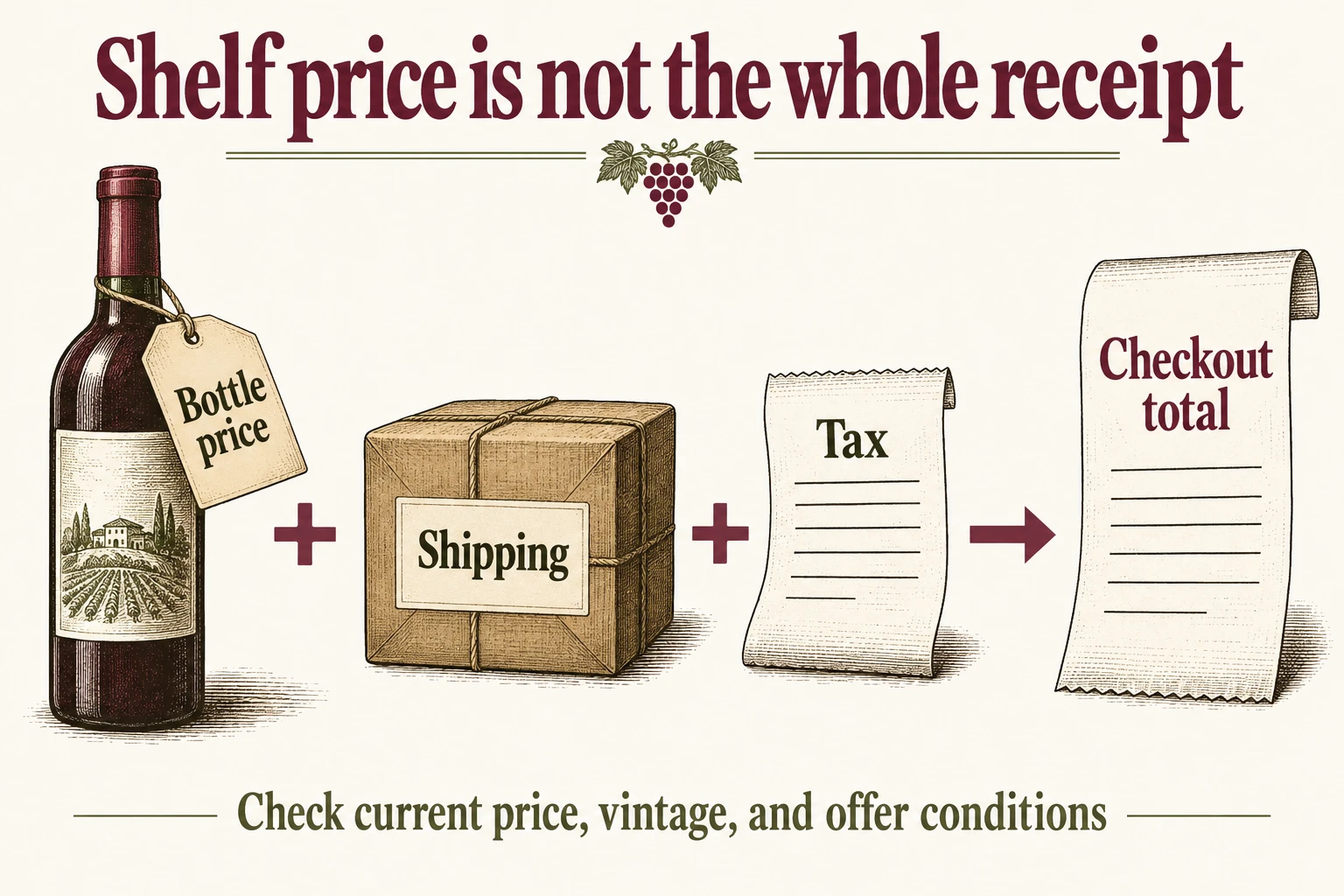
Read the illustration
The bottle price is only part of the purchase: shipping, tax and offer conditions affect the checkout total. Recheck the current price and vintage rather than relying on an old list.
There is no universal dollar line at which Malbec becomes “affordable.” Household budget, state taxes, retailer margin, shipping, bottle size, and occasion all change the answer. We use under $25 as a transparent editorial threshold for this page because it matches the searcher’s practical comparison job. It is a filter, not a claim that $26 is expensive or that every $19 bottle offers value.
The date matters as much as the number. A roundup that once listed a wine under $25 can remain indexed years after that vintage is gone, the link breaks, or the price changes. A local retailer may display a price that applies only in one market. A club discount may require several bottles or a membership. A product grid may omit tax and delivery. Record the exact date, market, bottle, and conditions whenever price is doing argumentative work.
For the producer bottle on this page, the 2024 Nine Queens Malbec was listed at $20 per bottle on July 31, 2026. That is a dated bottle-price snapshot, not a delivered-price promise. It does not include or predict a shipping charge, taxes, destination eligibility, current availability, or the final total. All of those are confirmed at checkout.
Once price clears your threshold, stop ranking by price alone. A cheaper bottle that does not suit dinner—or whose current vintage and style are unclear—can be poor value for your particular job. A slightly more expensive bottle whose origin, method, and intended use are transparent may be the more useful purchase. That is a preference decision, not a mathematical quality score.
For broad varietal background, including how Malbec can vary by site and winemaking, use our complete Malbec guide. This page stays narrower: how to investigate value under a declared ceiling.
Build a value proof, not a fake score
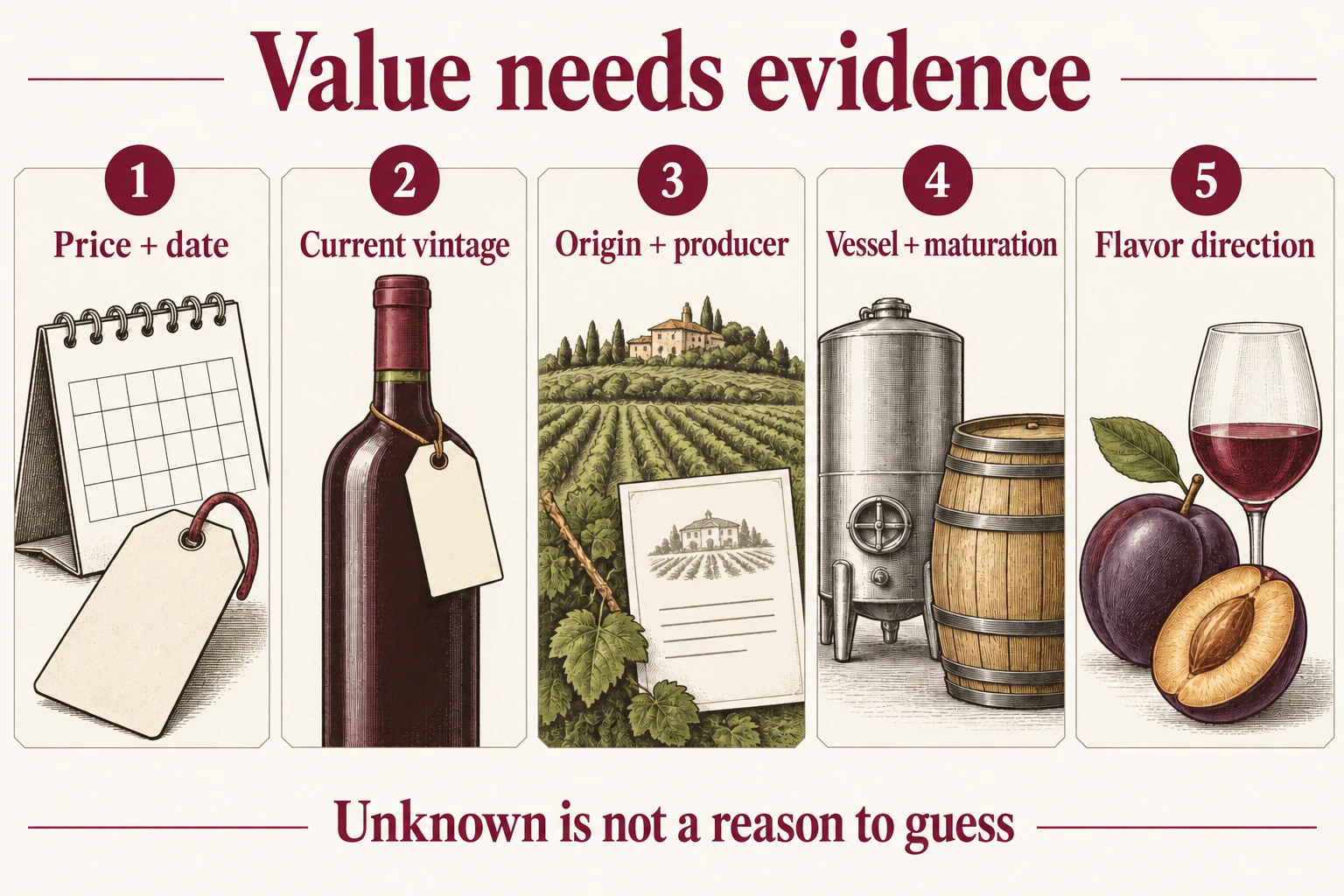
Read the illustration
Record price and date, the current vintage, origin and producer, vessel and maturation, and the stated flavor direction. Missing information remains unknown; no score can replace style fit.
A “92-point value” badge collapses too many judgments into one number. Our value proof keeps each claim visible. Six rows are enough to expose stale listings, missing facts, and mismatched styles without pretending we have calculated objective quality.
| Evidence field | What to record | Why it matters | Status for Nine Queens |
|---|---|---|---|
| Price and date | Bottle price, market, conditions, and check date | Prevents a stale list price from becoming a promise | $20 bottle listing checked July 31, 2026; checkout total not included |
| Vintage | Harvest year on the offered bottle | Lets you compare the product actually for sale | 2024 |
| Origin and producer | Most precise supported place and who stands behind the claim | Makes the recommendation accountable | Argentine Malbec from Familia Morgan; producer recommendation disclosed |
| Vessel and maturation | Stainless, concrete, oak, or a documented combination | Separates fresh and maturation-led buying jobs | Fermented in stainless steel; product page lists Barrel: Unoaked |
| Flavor direction | Current producer notes, not a category stereotype | Helps reject a style you do not want | Fresh red fruit with subtle smoke |
| Unknown checkout items | Availability, destination, shipping, taxes, and final terms | Shows what editorial content cannot guarantee | Confirmed only at checkout |
The blank spaces matter. If a retailer or producer does not tell you how a price is qualified, ask. If a bottle’s vintage is substituted, repeat the style check. If organic certification, residual sugar, or alcohol is central to your decision, verify the current label or official product record instead of assuming the answer from “Malbec,” “Argentina,” “fresh,” or “stainless.”
Origin can help you ask better questions without becoming a quality hierarchy. Mendoza contains distinct zones and sites; our Mendoza wine-regions field guide shows why a province name cannot stand in for the whole vineyard story. The high-altitude Mendoza guide likewise explains a mechanism without claiming that elevation automatically makes a better or more expensive bottle.
Choose the style job before the label
Most affordable-Malbec lists mix at least three jobs. A fresh, unoaked or non-oak-matured wine is often being considered for an informal meal and direct fruit expression. A fruit-led crowd bottle may prioritize familiarity and flexibility. A reserve or dinner bottle may introduce more maturation, age, structure, or detail. Those jobs can overlap, but their price tags should not be compared as though the products were interchangeable.
Fresh, non-oak-matured Malbec
Choose this direction when oak-derived vanilla, toast, or spice is not what you are shopping for and when a direct fruit profile makes sense for the table. Verify the vessel rather than trusting a front-label illustration or a retailer filter. A producer’s explicit Unoaked or equivalent maturation statement supports the absence of oak maturation; stainless-steel fermentation alone does not. Neither fact proves high acidity, light body, dryness, lower alcohol, “natural” production, or lower quality.
This style can make sense with burgers, empanadas, tomato-based dishes, grilled vegetables, or an informal mixed table, depending on the actual wine and seasonings. Pairing remains conditional. Salt, fat, sweetness, umami, chile heat, smoke, and sauce can change perception, and a very hot or sweet dish may be more comfortable with a different wine style.
Fruit-led crowd bottle
This is an occasion job rather than a cellar method. Look for a producer description that tells you which fruit direction it means, then check whether oak, sweetness, or heavy extraction are part of the picture. “Fruity” does not mean sweet. A dry red can smell strongly of red or dark fruit, and a sweet wine can have other dominant aromas. If sweetness matters, seek a direct statement.
For guests with different preferences, a transparent bottle is easier to present honestly: you can say what the producer discloses and invite people to decide. The wine-texture guide helps describe the experience without reducing it to “smooth,” another word that can mean different things to different drinkers.
Reserve or slow-dinner style
Spending more may buy additional vineyard selection, lower yields, longer élevage, oak, bottle age, labor, packaging, distribution, or simply a different market position. It may also buy none of the sensory differences you value. “Reserva” does not carry one universal method or quality promise around the world, so read the producer’s actual specification.
Choose a matured style because its disclosed fruit, spice, vanilla, smoke, texture, or age suits the dinner—not because the higher price proves it is objectively better. If you are comparing varietal Malbec with Cabernet, Merlot, Pinot Noir, or Syrah, the Malbec comparison guide keeps those search jobs together.
What spending more can change
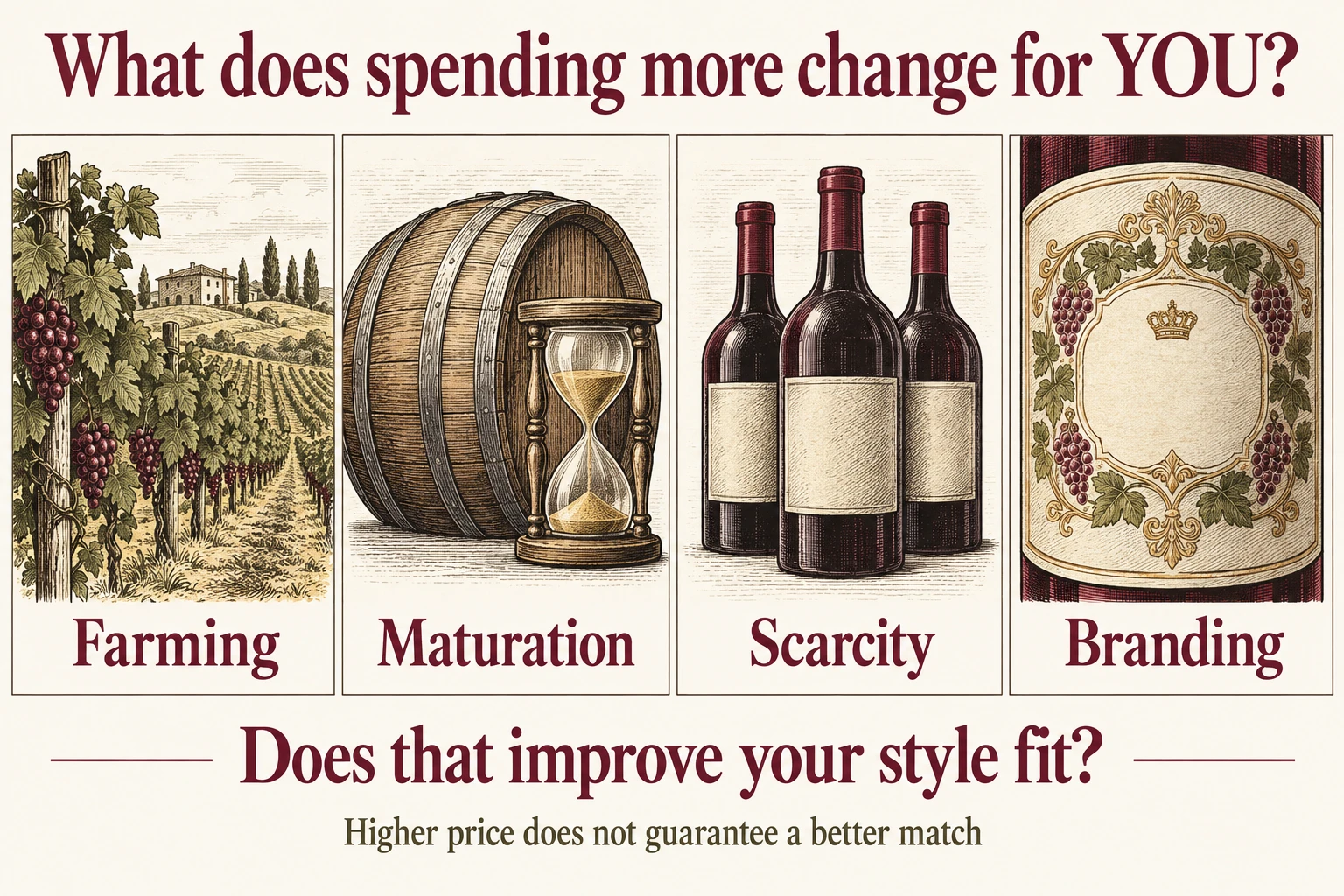
Read the illustration
More money may buy maturation, farming choices, scarcity or branding. It does not guarantee a better fit. If you want direct fruit and dislike oak, a pricier oak-led wine may be the wrong direction.
Price can reflect real cost and intent. Farming a difficult parcel, sorting fruit, using barrels, holding wine before release, importing small volumes, and providing detailed technical information all require resources. But price also reflects branding, scarcity, taxes, freight, channel, and demand. The shelf number does not reveal which factor dominates.
Ask what the extra dollars change for you. If moving from $20 to $35 gives you a documented origin you want to study, a maturation profile you enjoy, or a bottle suited to an anniversary dinner, it may be valuable. If you want fresh fruit for tacos on Tuesday and dislike overt oak notes, spending more on a matured reserve may move in the wrong direction. The honest answer can be to keep the less expensive bottle.
The reverse is also true: an under-$25 ceiling is not a moral test. If no bottle below it discloses the facts you need, do not buy merely to satisfy the category. Change the threshold, choose another grape, or buy from a merchant who can answer the questions. Affordability without suitability is just a lower-cost mistake.
When this affordable Malbec is not your bottle
The 2024 Nine Queens Malbec is not for you if you specifically want oak maturation or a profile led by documented vanilla and toast. It was fermented in stainless steel and is listed as unoaked. It is also not the right choice if you require a certified farming claim, an exact sweetness figure, a specific alcohol range, or guaranteed delivery by a date; this guide does not support those promises.
Choose another wine when the food is delicate enough that red wine will overwhelm it, when substantial chile heat makes alcohol and tannin feel harsher to you, or when you already know you prefer a sweeter style. Choose a matured Malbec when cellar development and oak-related notes are the buying job. Choose a white, rosé, sparkling, or lower-tannin red when the menu points there. Losing a sale is better than turning “affordable” into “works for everyone.”
The verified fit is for a buyer seeking a 2024 Malbec with a fresh red-fruit and subtle-smoke direction, stainless-steel fermentation, an explicit Unoaked product field, and a $20 listing on the check date. A matured or explicitly sweeter style is the honest alternative when those are your priorities. These are Familia Morgan’s recommendations about wines Familia Morgan makes. This is not an independent blind tasting, a paid review, or a global ranking. Price, availability, shipping eligibility, taxes, and final terms are confirmed at checkout.
Questions buyers ask about affordable Malbec
Is every Malbec under $25 a value wine?
No. Under $25 is a price filter, not a quality or suitability result. A useful value bottle still needs to fit your style, food, and occasion. Current vintage, price conditions, and availability also need verification.
Does unoaked mean cheap or simple?
No. Unoaked describes the absence of oak maturation, not the cost, quality, farming, alcohol, body, acidity, or complexity of the wine. Some buyers actively prefer a direct, non-oak-matured expression; others want the flavors and textures associated with a documented maturation program.
Can I assume a red-fruit Malbec is sweet?
No. Fruit aroma and residual sugar are different. “Fresh red fruit” is a producer’s sensory direction here, not a sweetness claim. Look for an explicit dryness or sugar statement when that detail matters.
Why not publish a numerical value score?
A fabricated score would hide subjective weighting. One buyer values oak maturation; another pays to avoid it. One wants a study of a precise vineyard; another wants a flexible weeknight bottle. The value-proof rows let each reader assign weight without borrowing ours.
Sources and methodology
We defined the price ceiling before evaluating bottles, recorded the product and check date, separated verified product statements from general buying principles, and left unknown facts unknown. Prices and availability can change, so the dated product record matters more than an undated value claim.
- Argentina’s Instituto Nacional de Vitivinicultura, 2026 Malbec report, for current official context on Argentine Malbec.
- Argentina’s INV wine-label guidance, for the current regulatory context behind Argentine label information.
- WSET’s food-and-wine matching principles, for the conditional effects of salt, fat, sweetness, and acidity.
- WSET’s takeaway pairing guide, for its treatment of savory or umami-rich food.
- WSET’s guidance on pairing drinks with spice, for how chile heat can heighten perceived alcohol and tannin and how sweetness can soften that heat.
- Familia Morgan’s live 2024 Nine Queens Malbec product record, checked July 31, 2026, for vintage, listed price, vessel, and producer sensory description.
- The Familia Morgan Malbec guide, for broader varietal education intentionally kept outside this price-first page.
This research does not lock a price, reserve stock, calculate a delivered total, or predict your preference. Recheck the offer, read the current bottle, and decide whether the value proof still supports the job you need the wine to do.