At the table · pairing field guide no. 02
The Best Wine With Steak, Cut by Cut
The cut sets the weight. The fire sets the flavor. The sauce gets the last word.
Research note: Pairing recommendations are preference-aware starting points, separated from USDA food-safety guidance and grounded in published work on wine astringency and dietary lipids.
The short answer
What is the best wine with steak?
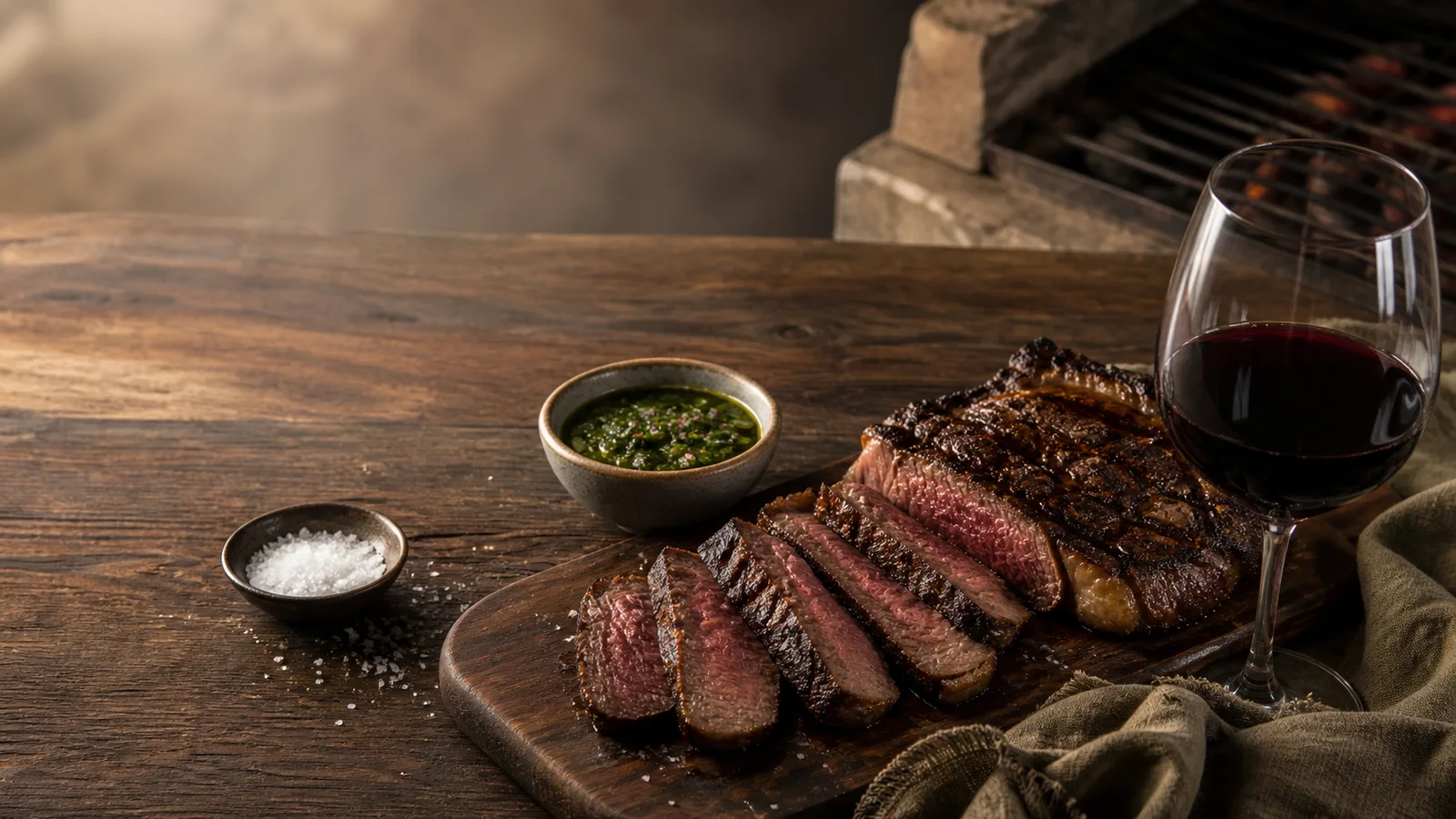
For a simply seasoned grilled steak, start with a dry red whose weight matches the plate: Cabernet Sauvignon for a richly marbled ribeye, Pinot Noir for a gently seared filet, and Malbec for strip, skirt, or flank steak. A red blend is the useful middle path for a porterhouse. Then let the sauce revise the answer.
There is no universal winner. Fat level, surface char, salt, doneness, and sauce change what tastes balanced—and individual sensitivity to tannin changes it again.
See the cut-by-cut matrixChoose the cut before the label
A cut is a starting signal, not a command. Marbling and tenderness influence the plate’s weight, while the pan, grill, seasoning, and sauce may become more important than the name on the butcher’s paper. Use this matrix for a first bottle; use the tool later when the variables begin to stack.
This matrix is for beef steak. For loin, rib, or blade chops from pork, use the wine-pairing guide for pork chops.
| Cut | Fat & texture | Char / preparation | Wine starting point | Sauce pivot | Why |
|---|---|---|---|---|---|
| Ribeye | Rich marbling; broad, juicy texture | Hard grill or cast-iron sear can carry smoke and crust | Cabernet Sauvignon, Syrah, or a structured Malbec | Chimichurri → fresher Malbec; blue cheese → Cabernet-led blend | A concentrated steak usually welcomes comparable fruit, body, and structure. |
| New York strip | Moderate marbling; firmer chew than ribeye | Grilled or pan-seared; enough crust to carry savory wine | Malbec or a Cabernet-led red blend | Peppercorn → Syrah; mushroom → mature red blend | It sits between ribeye’s richness and filet’s delicacy, so balance beats maximum power. |
| Filet mignon | Lean and very tender; mild beef flavor | Gentle sear or pan roast; avoid making char the whole dish | Pinot Noir, Merlot, or a supple Malbec | Mushroom → Pinot Noir; cream sauce → structured Chardonnay | Lower-tannin, less forceful wines leave room for the cut’s subtle flavor. |
| Skirt or flank | Flank is leaner; skirt is often richer. Both have pronounced grain and intense flavor. | Fast, high heat; often marinated and sliced across the grain | Malbec, Syrah, or Cabernet Franc | Chimichurri → bright Malbec or Cabernet Franc | Flavor intensity—not fat alone—supports a vivid, savory red. |
| Porterhouse or T-bone | Two textures: tenderloin plus firmer strip | Grilling adds a shared crust while each side cooks differently | Red blend, Malbec, or Cabernet Sauvignon | Choose for the dominant sauce rather than splitting the difference | A blend can bridge the lean and rich sides without demanding one perfect match. |
| Burger | Ground texture; richness varies with blend and toppings | Griddle lace, grill smoke, cheese, and condiments drive intensity | Juicy Malbec, Côtes du Rhône, or a soft red blend | Sweet barbecue → fruit-forward red; chile → lower alcohol and softer tannin | The toppings often matter more than the patty; freshness keeps the combination lively. |
Four checks, in order
A decision path you can use at the table
- Read the cut. Rich ribeye can take more structure; delicate filet often benefits from restraint.
- Read the fire. Smoke and a dark crust raise flavor intensity even when the cut itself is lean.
- Give the sauce a vote. Herbs, sweetness, chile, cream, mushrooms, and blue cheese can redirect the wine.
- Choose your tolerance. If you dislike mouth-drying tannin, a “classic” Cabernet is not automatically your best bottle.
What the science actually supports
Red-wine astringency is a tactile drying or roughing sensation, not simply a flavor. Research describes wine tannins interacting with salivary proteins, changing oral lubrication; the exact sensation varies with tannin structure, the wine matrix, saliva, and the person tasting. That is why two diners can disagree honestly about the same Cabernet.
Laboratory and sensory work also finds interactions between dietary lipids and grape-tannin polyphenol systems. That evidence helps explain why a fatty bite can change the next sip, but it does not prove that “fat cuts tannin” as a universal rule for every steak and every wine. Protein, lipid, salt, acidity, temperature, and sequence can all affect perception. In this guide, “can” and “often” are doing real work.
Tannin can feel drying because oral lubrication changes; more tannin is not automatically better.
Acid tastes tart and can make a sip feel vivid beside a rich plate; “cleanses” is a sensory metaphor.
Smoke, browning, and bitterness can make a fruitier or more savory wine feel better matched.
Salt can suppress some bitter sensations in controlled studies, but a salted steak plus a complex wine is not a laboratory solution. Taste the seasoned bite and the wine together before deciding the bottle is too tannic, too acidic, or too soft. For a deeper vocabulary, see our guide to wine texture and the glossary entry for tannin.
Pairing is also a preference problem. In a controlled food-and-wine study, the pairings preferred by consumer groups differed even when the broad drivers of appropriateness looked similar. That is stronger support for a decision process than for a single “correct” bottle.
Doneness is not a safety chart
How doneness changes the pairing
As a steak cooks longer, its sensory profile changes with moisture, texture, browned flavors, cut, grade, and method. Controlled beef research has found end-point temperature affects expert descriptors and consumer liking, but no single doneness result can stand in for every steak. The plate may move toward roasted, smoky, or sauce-led flavors and favor a fruit-forward red over the most austere bottle—but doneness alone never dictates a grape.
Important: culinary preference language is not a food-safety minimum. The USDA safe-temperature chart lists whole beef steaks at 145°F (62.8°C) with a three-minute rest, and ground meats such as burgers at 160°F (71.1°C). Use a food thermometer and follow current safety guidance; choose the wine after that decision.
The sauce gets the last word
A filet under blue cheese and the same filet under chimichurri are different pairing problems. Match the loudest element on the finished plate, then return to the cut for scale.
01 · green & sharp
Chimichurri
Fresh herbs, garlic, and vinegar reward a red with lift rather than sheer mass. Malbec and Cabernet Franc are useful starts. Keep the condiment itself with our chimichurri recipe.
02 · pepper & cream
Peppercorn
Black pepper’s piperine is not chile’s capsaicin. With a creamy peppercorn sauce, try Syrah or a ripe Malbec. If chile is added, lower alcohol and softer tannin may feel calmer.
03 · earthy & savory
Mushroom
Pinot Noir, mature Merlot, or an evolved red blend can echo earthy notes without burying a lean filet. Umami is not a one-variable wine rule: mushrooms also bring aroma and texture, while the finished sauce may add salt and fat. This is an aroma bridge, not a chemical guarantee.
04 · sweet & smoky
Barbecue
Sweetness and smoke often make rigid, very dry reds feel harsher. Choose generous fruit, moderate tannin, and enough freshness—young Malbec or a Rhône-style blend can work.
05 · salty & forceful
Blue cheese
Cabernet Sauvignon or a structured red blend can stand beside the salt and intensity. If the cheese becomes the main event, a sweeter fortified style is another direction.
About chile heat: experimental work shows ethanol can potentiate the heat-sensitive receptor activated by Capsaicin. That does not predict every diner’s experience, but it supports the practical move toward lower-alcohol, fruit-forward wine when a sauce is truly hot.
Malbec, Cabernet, blend, or Pinot?
01
Malbec: the versatile default
Dark fruit, savory range, and moderate-to-firm structure make Malbec a natural bridge across strip, skirt, flank, and chimichurri. Styles vary widely, so the producer still matters. Read the broader Malbec guide or orient yourself with our Argentine wine field guide.
02
Cabernet Sauvignon: structure for richness
A firm Cabernet can meet ribeye, strip, char, and blue cheese with equal intensity. If you are choosing between Argentina’s two familiar reds, use the Malbec versus Cabernet Sauvignon comparison.
03
Red blend: the bridge bottle
A blend can combine fruit, acidity, and structure in a way that suits a porterhouse or a table serving several cuts. “Blend” says nothing about quality or weight by itself; check the grapes and producer. The red-blend buying guide explains how to read composition, purpose, and producer evidence before comparing bottles.
04
Pinot Noir: finesse for filet
Pinot Noir is especially useful with lean filet, mushroom, gentle searing, and diners who prefer less tannin. Heavy barbecue or blue cheese can overwhelm its quieter styles.
Can white wine work with steak?
Yes—when the white has enough texture, freshness, or savory development for the whole plate. A structured, oak-aged Chardonnay can meet pan-seared filet with a cream sauce. Mature white Rioja can bring savory, nutty complexity to mushroom-topped steak. A dry sparkling wine can be refreshing with salty steak bites or a lighter preparation.
The exception works best when preparation and sauce support it. A delicate, neutral white is likely to disappear beside heavily charred ribeye; a powerful red is equally capable of overwhelming a subtle filet. Color is shorthand, not a rule.
These are established culinary possibilities, not inventions for an exception box: Wines of Argentina explicitly uses full-bodied, oak-aged Chardonnay with steak to illustrate why body can matter more than color, while the Comité Champagne includes grilled meat in its official pairing guidance. Neither source turns the suggestion into a guarantee.
Serve the wine for the bottle you opened
Temperature
Cool, not cold
For most steak-friendly reds, 60–65°F (16–18°C) is a useful starting range—not a law. A warm room can make alcohol seem more prominent. Textured whites often show well somewhat cooler, then develop in the glass.
Air
Taste before decanting
Pour a small sample first. A compact young red may open with air; an older bottle may be fragile and need only careful service off its sediment. No fixed number of minutes fits every wine.
The useful rule
Pair the plate, not the prestige
A famous region cannot rescue a mismatch you do not enjoy. Start with cut, fire, and sauce; choose the level of tannin you actually like; then notice what changes from bite to sip. The best pairing is repeatable because you understand it, not because someone declared it perfect.
Sources & methodology
The sensory mechanisms below are evidence-based; the cut and sauce recommendations are transparent culinary judgments, not experimentally proven universal rankings. Wine style varies by producer and vintage, and individual perception matters.
- McRae & Kennedy, Wine and Grape Tannin Interactions with Salivary Proteins—review of astringency mechanisms and sources of individual variation.
- Saad et al., New Insights into Wine Taste: Impact of Dietary Lipids on Sensory Perceptions of Grape Tannins—biophysical and sensory work on tannin–lipid interactions.
- UC Davis Robert Mondavi Institute, The Winemaker’s Toolkit—plain-language sensory roles of tannin, acidity, alcohol, and sugar.
- USDA FSIS, Safe Minimum Internal Temperature Chart—current whole-steak, rest-time, and ground-meat guidance.
- Trevisani et al., Ethanol Elicits and Potentiates Nociceptor Responses via the Vanilloid Receptor-1—mechanistic evidence behind the chile/alcohol qualification.
- Breslin & Beauchamp, Suppression of Bitterness by Sodium—controlled evidence that salt can suppress bitterness for some stimuli.
- Kerth et al., Using Untargeted Metabolomics and Volatile Aroma Compounds to Predict Expert Sensory Descriptors and Consumer Liking of Beef Loin Steaks—evidence that grade, aging, and degree of doneness affect steak sensory results.
- Yoo et al., Effects of Searing Cooking on Sensory and Physicochemical Properties of Beef Steak—controlled evidence for searing, browned flavor, Maillard products, and the limits of “sealing in juices.”
- Kustos et al., Intertwined: What Makes Food and Wine Pairings Appropriate?—consumer study supporting preference-aware pairing and segmentation.
- Wines of Argentina, The Perfect Marriage—industry guidance supporting the body-over-color white-wine exception.
- Comité Champagne, Food & Champagne Pairings—official pairing guidance that includes grilled meat.