Buyer guide · Blend ledger
The Best Red Blend Wine Depends on What Is Blended, and Why
A red blend is a winemaking decision, not a flavor category. Read the evidence, decide the occasion, and only then choose the bottle.
Research note: These are Familia Morgan's recommendations about wines Familia Morgan makes. This is not an independent blind tasting, a paid review, or a global ranking. Product facts were verified July 31, 2026.
The direct answer: the best red blend wine is the one whose disclosed grapes or base, maturation, flavor direction, and intended use fit your table. “Red blend” alone does not tell you whether a wine is fresh or mature, soft or structured, dry or sweet. Start with evidence on the label and producer page, then choose for the meal or moment. A universal top-ten ranking cannot make those decisions for you.
In this notebook
- Why “red blend” is only a starting point
- The blend ledger
- Fresh versus matured styles
- Food and occasion
- When these bottles are not the answer
- Sources
Read the blend as a decision, not a category
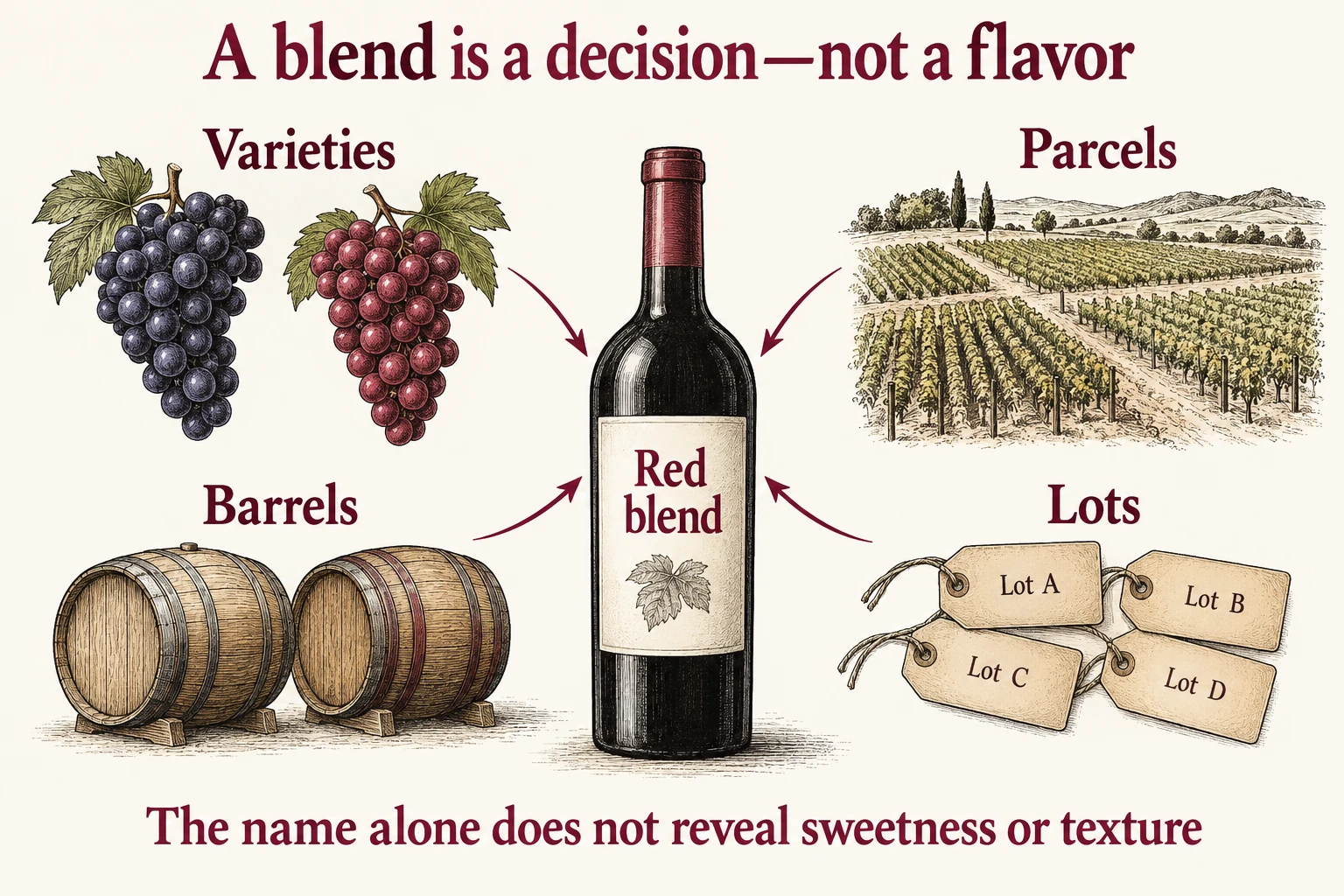
Read the illustration
Winemakers can combine grape varieties, vineyard parcels, barrels, or lots. These inputs converge into one wine, but the word blend alone does not reveal sweetness, texture, or quality.
A blend can bring together grape varieties, vineyard parcels, barrels, lots, regions, or, where rules permit, vintages. The reason for combining them may be consistency, balance, complexity, a specific house style, or simply the best expression of that harvest. None of those purposes is visible in the two words red blend.
That is why the category contains wines that have little in common beyond color and the fact of blending. A Cabernet-led blend may place Cabernet’s character at the center and use other components to adjust aroma, texture, or balance. A blend built around Grenache, Syrah, and Mourvèdre may begin from a different set of materials. Traditional British usage may call a red Bordeaux or Bordeaux-style blend claret. Regional Italian blends can follow still other grapes and traditions. These are useful family names, not reliable tasting notes: site, ripeness, proportions, extraction, fermentation, maturation, and age can move two wines in the same family far apart.
The label is therefore an evidence sheet, not a complete answer. It may disclose grapes, origin, vintage, alcohol, or a regulated term. The producer may add vessel and maturation details. But the front label may not reveal proportions, every component, sweetness, tannin, or how the bottle will feel to you. An omitted fact is an unknown—not permission to fill the gap with a stereotype.
If you want the category terms first, our glossary explains why winemakers blend and what people usually mean by Bordeaux varieties and Bordeaux blends. For a broader side-by-side way to think about red varieties, use the Malbec comparison guide.
Choosing between a blend and a familiar varietal bottle for dinner? Red blend vs Cabernet Sauvignon explains where those labels overlap and how to compare fruit, tannin and oak without assuming the blend is softer or sweeter.
Use the blend ledger
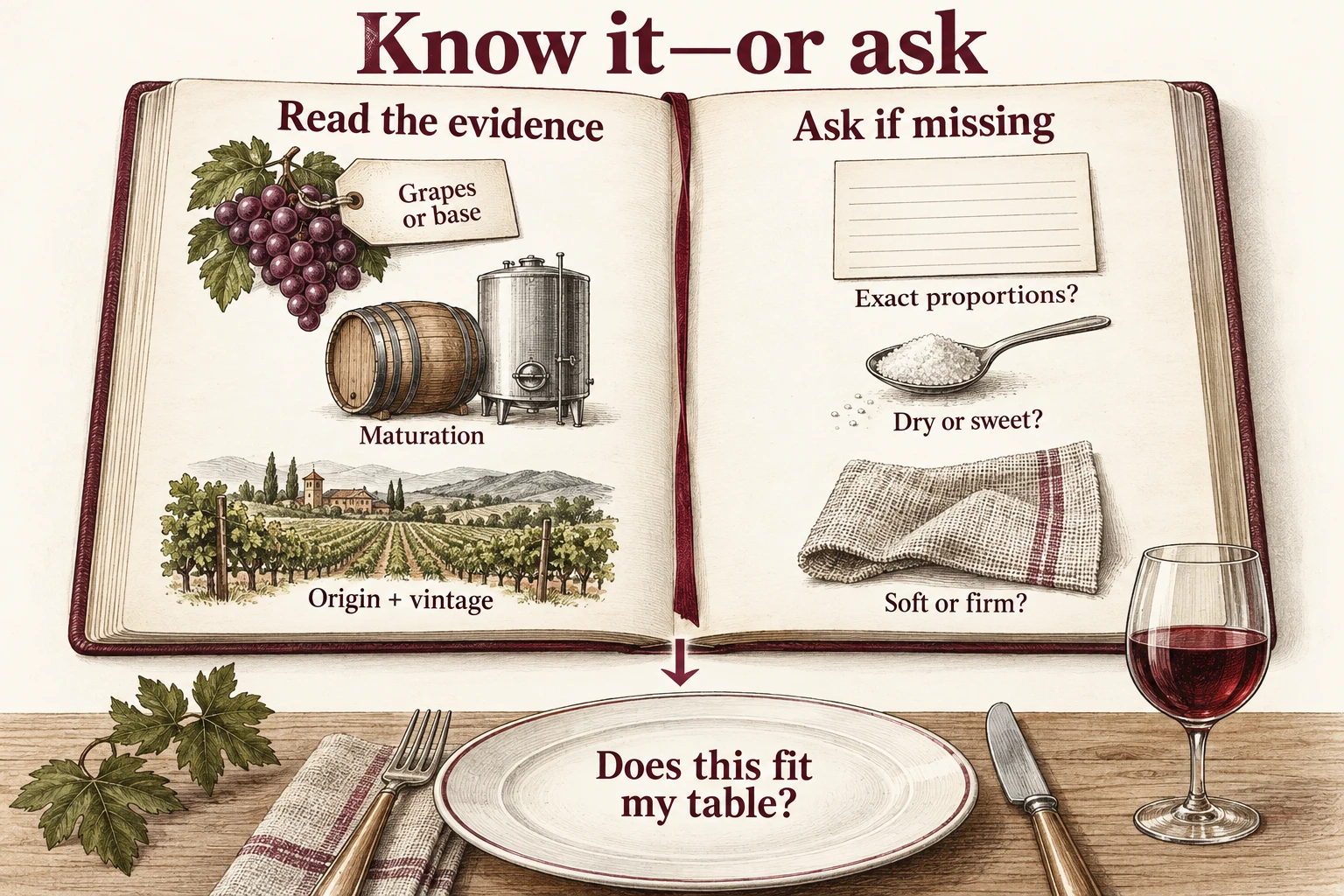
Read the illustration
Read disclosed grapes or base, maturation and origin, then check flavor notes and the meal. Leave undisclosed proportions and sweetness as open questions rather than inferring them from red blend or fruit descriptions.
The most useful buying framework separates what you can verify from what you still need to ask. It also keeps preference distinct from quality. A wine is not defective because it is fresher than you wanted, and it is not superior because it spent time in oak.
| Ledger entry | What to verify | What it helps you decide | What remains unknown |
|---|---|---|---|
| Declared grapes or base | Named varieties, a stated base grape, and origin | Whether the blend family interests you | Exact proportions or sensory result unless disclosed |
| Maturation | Stainless, concrete, neutral wood, new or used oak, and time | Whether fresh fruit or maturation notes are likely to lead | Body, dryness, or quality from vessel alone |
| Flavor direction | Producer notes tied to the current vintage | Whether fruit, spice, vanilla, smoke, or another cue suits the occasion | What your own bottle will taste like |
| Vintage and place | Harvest year and the most precise origin available | A basis for comparing like with like | A guaranteed style for every producer in that place |
| Use case | Food, serving context, and how adventurous the table is | Whether you need freshness, maturity, familiarity, or contrast | One objectively best answer for every guest |
Use the ledger in order. First reject bottles whose disclosed style conflicts with the job. Then compare the remaining evidence. Only after that should price, critic scores, packaging, or popularity break a tie. This reverses the usual retailer grid, where price and star count arrive before you know whether the wine is appropriate.
Decide how much maturation you want
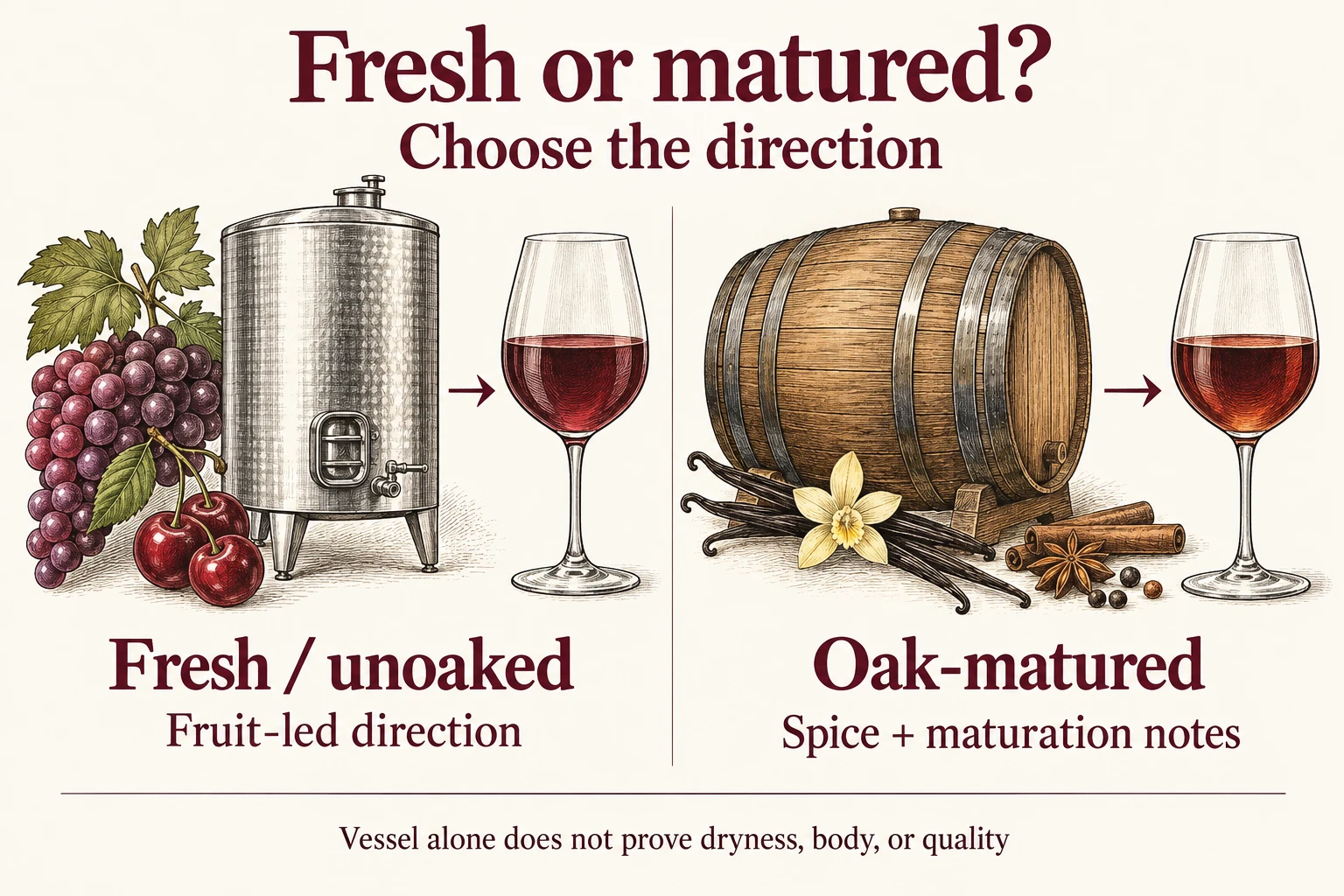
Read the illustration
A documented fresh, unoaked style may emphasize youthful fruit. An oak-matured style may include oak-derived spice, vanilla or smoke. Maturation vessel alone does not determine dryness, body, quality, or preference.
“Fresh” and “matured” describe useful directions here, not a quality ladder. For a wine explicitly listed as unoaked, documented stainless-steel fermentation points away from oak maturation as a driver of its stated profile. Those two facts do not, by themselves, prove dryness, acidity, light body, or a particular tannin level.
An oak-matured blend adds another set of decisions: wood origin, age, toast, vessel size, time, and the proportion of wine that met different barrels. Vanilla, spice, smoke, or texture may become part of the impression, but oak is not a synonym for better wine. It is a tool. If you want a vivid, youthful bottle for an informal table, paying for a longer maturation program may not improve your experience. If you want evolved savory or oak-derived notes around a slow dinner, a stainless-only style may feel too direct.
Bottle age adds another layer. A 2020 and a 2024 wine are not a controlled experiment in cellar method: they also differ in harvest, time, and potentially composition. Compare their disclosed facts, then taste them as two complete wines. Do not attribute every contrast to the vessel.
Our wine texture guide gives you a vocabulary for what happens in the mouth without turning texture into a score. The wine-estate terms guide is useful when origin and production wording on labels becomes confusing.
Choose by table and occasion
Start with the dominant element of the meal, not simply “red meat.” Tomato, chile, smoke, salt, sweetness, herbs, char, mushrooms, and a rich sauce can each change what feels harmonious. Tannin contributes drying sensation; it does not literally cut or break down fat. Food can change how tannin, acidity, alcohol, sweetness, and fruit are perceived, so pairing advice is a starting hypothesis rather than a chemical guarantee.
For a weeknight pizza, grilled vegetables, burgers, or a mixed table, many buyers want a red whose fruit is easy to locate and whose maturation does not dominate the food. A fresher Cabernet-based blend can be a sensible direction. For braised meat, a mushroom dish, or a slow dinner where spice, vanilla, and smoke are welcome, a matured blend may be more aligned. Very sweet barbecue sauce or substantial chile heat may make a lower-alcohol, lower-tannin, or slightly sweeter style more comfortable; those attributes need to be verified on the bottle you choose.
Occasion matters just as much as food. A tasting group may value a blend with unusually detailed composition because there is something concrete to discuss. A large gathering may reward clarity and broad food flexibility. A gift recipient may care more about origin, farming, or cellar detail. “Best” should name the job: best-supported fresh choice, best matured choice for the menu, or best transparent label for a comparative tasting.
If you are deciding between grapes rather than blends, start with Malbec versus Cabernet Sauvignon. To understand where Familia Morgan works, read the five-zone Mendoza field guide.
What changes the answer
The answer changes when a sauce is sweeter or hotter than expected, when the wine is served much warmer than planned, or when a guest strongly prefers low tannin, no obvious oak, or a sweeter profile. It also changes when a producer discloses more precise composition or a new vintage replaces the one you researched.
Do not assume that an expensive blend is more transparent. Do not assume a proprietary name hides weak wine. Do not treat “Reserva” as a universal promise of the same method across countries and producers. Verify what the actual bottle and producer say. If the information is absent, decide whether you are comfortable buying with that uncertainty.
When our two blends are not the right answer
The Nine Queens listing does not disclose percentages, so it is not the right recommendation if a fully quantified recipe is essential. The 2020 Red Blend Reserva listing does disclose 70% Cabernet and 30% Syrah. Choose that bottle only if its oak-matured direction also fits your table; otherwise choose another producer that publishes both the composition and the style you want.
The 2024 Nine Queens Red Blend is also not for you if you specifically want evident oak maturation: it is Cabernet-based, fermented in stainless steel, and listed as unoaked. The 2020 Red Blend Reserva is not for you if vanilla, spice, or smoke are unwelcome; those notes are part of its documented profile after 12 months in mixed French and American oak. A lighter red, rosé, white, sparkling wine, or an off-dry style may also be the better answer for delicate food or pronounced chile heat.
The verified fit is straightforward: Nine Queens is the fresher, Cabernet-based path, documented as fermented in stainless steel and listed as unoaked, with producer-described red fruit and subtle smoke. The Reserva is the disclosed 70% Cabernet and 30% Syrah alternative when you deliberately want a more matured profile, with documented red fruit, spice, vanilla, and smoke. These are Familia Morgan’s recommendations about wines Familia Morgan makes. This is not an independent blind tasting, a paid review, or a global ranking. Price, availability, shipping eligibility, taxes, and final terms are confirmed at checkout.
Questions buyers ask about red blends
Is a red blend automatically sweeter than a varietal wine?
No. “Blend” tells you that multiple components were combined, not the wine’s residual sugar. Fruit aromas can occur in dry wine, and a single-variety wine can also be made in a sweeter style. Look for an explicit sweetness statement or ask the seller.
Does a named base grape tell me how the wine will taste?
It gives you more evidence than “red blend” alone, but it is not a tasting guarantee. Proportion, site, ripeness, extraction, other components, maturation, bottle age, and service all matter. Treat “Cabernet-based” as a useful starting fact, not a complete sensory profile.
Is an oak-matured blend better for aging?
Not necessarily. Oak maturation and the ability to develop in bottle are separate questions. Balance, fruit concentration, structure, closure, storage, and the producer’s intention all matter. Ask for a specific drinking-window recommendation rather than using oak as a shortcut.
Should I serve every red blend at room temperature?
No single service temperature suits every blend or every room. A warm room can make alcohol feel more prominent and fruit less precise. Follow the producer’s guidance where available, cool the bottle modestly if it is too warm, and let your preference decide.
Sources and methodology
This guide distinguishes general blending principles from bottle-specific claims. Product statements are restricted to Familia Morgan’s live product material checked July 31, 2026; undisclosed Nine Queens proportions and unsupported alcohol comparisons are deliberately omitted.
- WSET, “Why do we blend wine?”, for the purposes and forms of blending.
- WSET, “Winter wine and food matching”, for the conditional effects of fat, sweetness, salt, acidity, and intense flavors on a pairing.
- WSET, “How to pair wine with your favourite takeaway meals”, for its treatment of savory or umami-rich food and its meaty-food/red-blend example.
- WSET, “How to pair drinks with spice”, for how chile heat can change the perception of alcohol and tannin and when sweetness may soften that heat.
- Argentina’s Instituto Nacional de Vitivinicultura, current wine-label guidance, for the regulatory context behind Argentine label information.
- Our guide to blending terms, for definitions used on Familia Morgan Learn.
- Familia Morgan’s live 2024 Nine Queens Red Blend and 2020 Red Blend Reserva product records, checked July 31, 2026, for the limited producer facts stated above.
This method cannot tell you what you will prefer, and it cannot freeze a store listing in time. It can make the recommendation auditable: the general principles are identified, the producer facts are narrow, the commercial relationship is visible, and the final buying terms remain at checkout.