In the cellar · process field guide no. 03
Sparkling Wine Methods: A Process Guide
Follow the carbon dioxide. The place where fermentation happens explains the method; it does not decide the wine’s quality, sweetness, or origin.
Research note: The process boundaries follow current OIV definitions, U.S. standards of identity, and official Champagne, Prosecco DOC, Asti DOCG, and Limoux sources. Sensory language is deliberately qualified.
The short answer
What changes from one sparkling wine method to another?
The method tells you where the gas is trapped and how the wine is handled. In the traditional method, a second fermentation takes place in the bottle sold to the customer. In the tank method, the second fermentation happens in a pressure-resistant tank. The transfer method starts with bottle fermentation, then pools and clarifies the wine under pressure. The ancestral family captures carbon dioxide as the original fermentation finishes in bottle. Carbonation introduces carbon dioxide from outside the wine.
Those facts do not settle sweetness, quality, grape, origin, pressure, or flavor. Each of those needs its own evidence from the label, producer, and applicable rulebook.
Trace every route
01 · One question, six routes
The sparkling wine method ledger
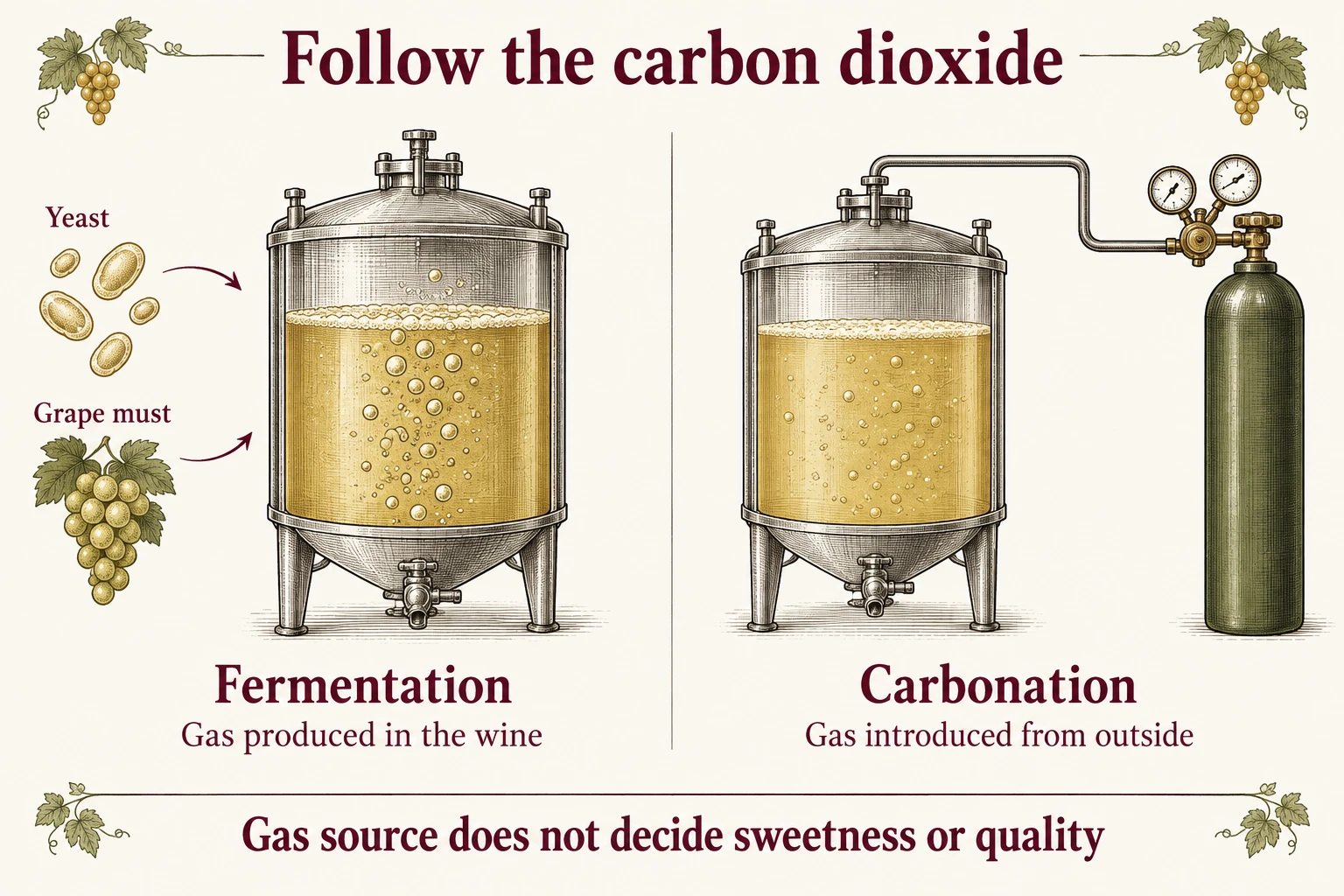
Read the illustration
Fermentation produces carbon dioxide within the wine; carbonation introduces carbon dioxide from an external source. The gas source describes a production distinction, not sweetness, quality or a guaranteed flavor.
Start with the carbon dioxide. OIV separates sparkling wine, whose carbon dioxide is of fermentation origin, from carbonated wine, whose carbon dioxide is partly or wholly exogenous. Within fermentation-made sparkling wine, the useful distinction is the vessel and the sequence.
| Route | Where the bubbles form | How lees are handled | Which bottle is sold | What the method cannot prove |
|---|---|---|---|---|
| Traditional method | Second fermentation in the final sale bottle | Lees collect in that bottle; riddling and disgorgement remove the deposit | The fermentation bottle remains the sale bottle | Origin, grape, age, dosage, price, or sensory quality |
| Tank / Charmat / Martinotti | Second fermentation in a sealed pressure tank | Clarified and usually filtered under pressure | Filled after tank processing under isobaric conditions | That the wine is simple, inexpensive, sweet, or young |
| Transfer method | Second fermentation in bottles | Wine is pooled by isobaric transfer, then clarified or filtered in tank | A different bottle is filled under pressure | That it tastes exactly like either traditional or tank-method wine |
| Ancestral / rural family | The first fermentation begins before bottling and finishes in bottle | May remain on sediment or may be disgorged, depending on the wine and rule | Usually the fermentation bottle, subject to the applicable specification | Cloudiness, sweetness, alcohol, pressure, or a “natural wine” protocol |
| Single-fermentation tank family | Fermentation of must in a pressure tank, stopped at the intended balance | Yeast can be removed by centrifugation or filtration before counterpressure filling | Filled from tank under pressure | One universal “Asti method”; the governing specification controls |
| Carbonation | Exogenous carbon dioxide is dissolved into finished wine | No bubble-making fermentation lees are required | Filled under pressure after carbonation | That the product may use “sparkling wine” as its regulated class name |
02 · A deterministic process map
Trace the vessel, not the reputation
The rails below encode sequence only. They do not encode price, duration, pressure, bubble size, or quality. That restraint matters because the same broad route can contain very different grapes, base wines, yeast cultures, aging periods, and finishing choices.
- 01Traditional
- Base wine
- Tirage
- Second fermentation in bottle
- Lees aging, riddling, disgorgement
- Same bottle, final closure
- 02Tank
- Base wine
- Tirage in pressure tank
- Second fermentation in pressure tank
- Clarify or filter under pressure
- Isobaric bottling
- 03Transfer
- Base wine
- Second fermentation in bottle
- Isobaric transfer
- Pool, clarify, filter
- Rebottled under pressure
- 04Ancestral
- Fermenting must or wine
- Bottle before first fermentation is complete
- Fermentation finishes in bottle
- May be disgorged
- Final closure
- 05Carbonation
- Finished still wine
- Exogenous carbon dioxide
- Gas dissolved under pressure
- Pressure filling
03 · Bottle is the vessel
Traditional method
A still base wine receives tirage, then undergoes a second fermentation in the glass bottle that becomes the final sale bottle. Carbon dioxide from fermentation stays dissolved under pressure. The wine can then remain in contact with lees in that bottle before riddling gathers the deposit in the neck and disgorgement removes it.
In Champagne, the official process states that the wine cannot be transferred from one container to another and is sold in the bottle in which the second fermentation occurred. That is a Champagne rule attached to a protected designation. It is not permission to call every bottle-fermented wine Champagne.
What the process can change
Time on yeast lees creates opportunities for yeast-derived compounds and other chemical changes. It does not prove a flavor profile. Toast, brioche, creaminess, or a particular bubble texture should not be promised from the method name alone. Research finds method effects alongside age, vintage, winery, closure, and other production choices.
The concise term remains in our traditional method glossary entry. The separate méthode champenoise entry explains the Champagne-specific wording boundary.
04 · Tank is the vessel
Tank / Charmat / Martinotti method
Here the base wine and tirage enter a pressure-resistant closed tank. The second fermentation produces endogenous carbon dioxide in that tank. The wine is then clarified and commonly filtered under pressure, with a possible dosage step, before isobaric bottling keeps the dissolved gas in the wine.
Charmat method, Charmat process, Metodo Charmat, Martinotti method, tank method, bulk method, and cuve close can point to this broad route. The names are not a list of separate fermentations. Our Charmat method definition is the single glossary owner for the main English and Italian synonyms.
Prosecco DOC’s official material describes the Martinotti method as natural secondary fermentation in large containers or autoclaves. This is a good appellation example, but the terms are not interchangeable: Prosecco is a protected geographic name, while Martinotti or Charmat names a production route.
No shortcut stereotype
Tank fermentation can support a fresh, grape-led style, and producers can also vary yeast, temperature, pressure, tank residence, lees contact, filtration, and dosage. “Tank method” does not establish price or quality. The method is the vessel choice; the specification is the rest of the wine.
05 · Bottle, then tank
Transfer method
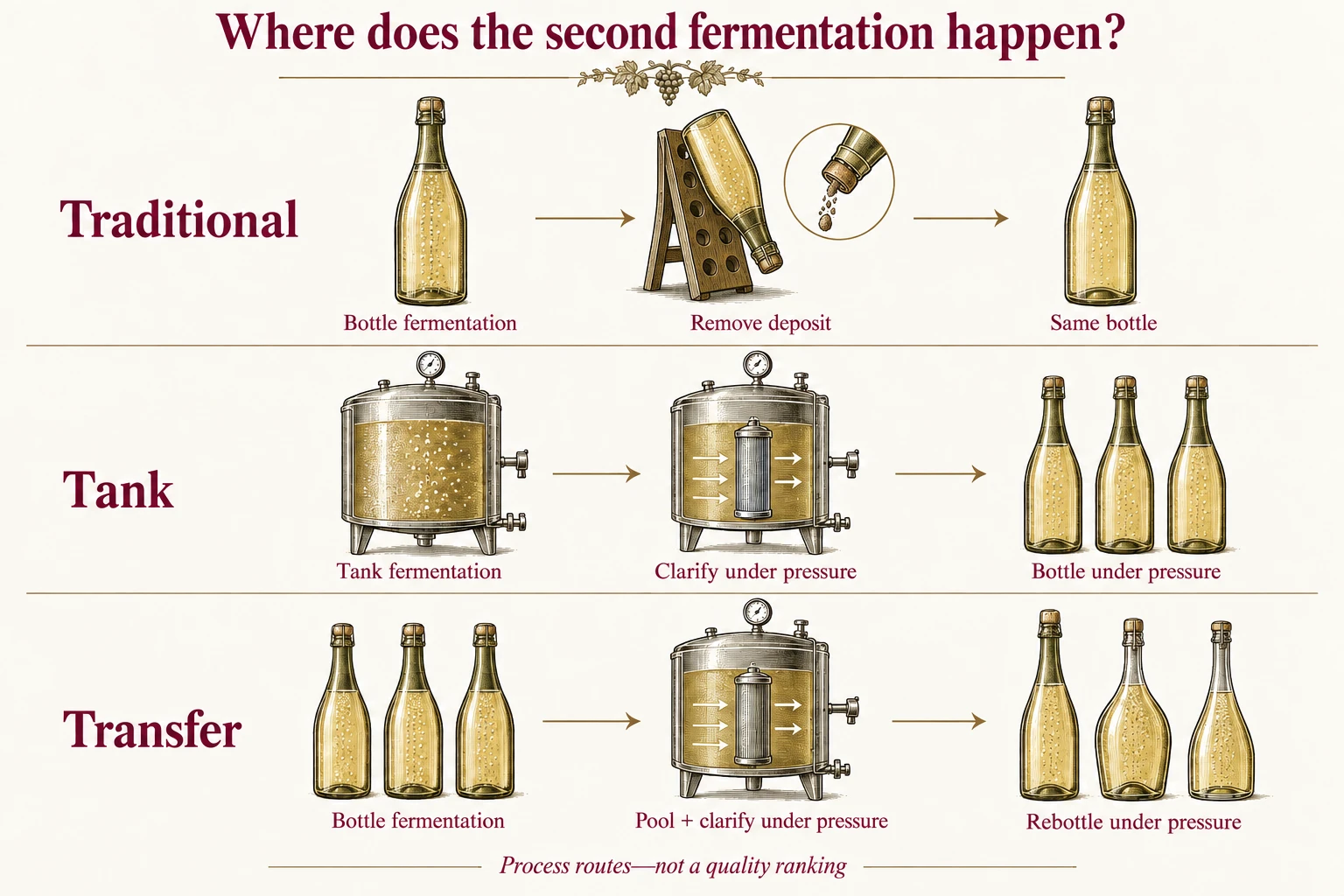
Read the illustration
Traditional method: second fermentation and sediment removal in the same sale bottle. Tank method: second fermentation and clarification in tank, then bottling under pressure. Transfer method: second fermentation in bottles, transfer under pressure to tank for clarification, then different bottles.
The transfer method keeps a bottle-fermentation stage but changes how the deposit is removed. After second fermentation and any chosen lees time in bottle, the wine moves under pressure into a tank. It can be pooled, clarified or filtered, adjusted, and rebottled under pressure. Riddling and disgorging every individual bottle are not the defining sediment-removal steps.
OIV defines transvasage broadly as isobaric transfer of sparkling wine from one wine container to another. Its stated objectives include separating wine from lees or deposits, blending, clarification, stabilization, and isobaric bottling. Local label law can use narrower production-method language, so a transfer claim should be read with its jurisdiction.
The useful distinction
Traditional method: ferment, clarify, and finish the individual sale bottle. Transfer method: ferment in bottles, then pool and rebottle. Tank method: conduct the bubble-making fermentation in tank from the start.
See the transfer method glossary definition for the concise term. This page owns the cross-method comparison.
06 · One fermentation crosses the bottling line
Ancestral / rural family
In the ancestral family, the first fermentation begins before bottling. The wine is bottled while fermentable sugar and active yeast remain, then fermentation finishes in bottle and traps its own carbon dioxide. There is no necessary dry base wine followed by a separately initiated second fermentation.
The official INAO page for Limoux makes the boundary unusually clear: Blanquette de Limoux receives a second fermentation in bottle, while Limoux méthode ancestrale finishes its first fermentation in bottle. That definition belongs to its appellation. Other wines described as ancestral, rural, or pét-nat can follow different detailed specifications.
Cloudy?
Not guaranteed. A wine may keep sediment, or it may be disgorged or otherwise clarified where rules permit.
Sweet?
Not guaranteed. Residual sugar depends on how far fermentation proceeds and the applicable product specification.
Low alcohol?
Not guaranteed. Starting sugar and fermentation completion govern alcohol, not the family name by itself.
“Natural”?
Pét-nat is common market language, but it does not create one worldwide legal protocol for farming or cellar additions.
The bottom line: an ancestral-family wine may be disgorged, and it is not automatically cloudy, sweet, or low in alcohol. Read our corrected méthode rurale definition for the short version.
A related branch: one controlled fermentation in tank
Some aromatic sparkling wines begin with clarified must rather than a finished dry base wine. The must ferments under pressure until the intended alcohol and residual-sugar balance is reached; cooling and filtration stop and stabilize the process before counterpressure bottling. The Asti DOCG consortium describes this must-to-bottle sequence for its pressure-tank production, while its appellation also permits a separate traditional-method type. That is why “Asti” should not be used as a casual synonym for every tank method.
07 · Gas comes from outside
Carbonation
Carbonation dissolves external carbon dioxide into wine under pressure. OIV calls the gas in carbonated wine partially or totally exogenous. Its sparkling-wine definition, by contrast, requires carbon dioxide of exclusively fermentation origin. This is a category boundary, not a judgment about whether someone will enjoy the glass.
U.S. standards draw the same core line. Under 27 CFR § 4.21, sparkling grape wine is made effervescent with carbon dioxide resulting solely from fermentation within a closed container, tank, or bottle. Carbonated grape wine is made effervescent with carbon dioxide that does not result solely from that fermentation route.
Why the label matters
“Bubbles were added” is not enough information for a legal class name. Read the actual product designation in the market where the bottle is sold. A colloquial menu may use “sparkling” more broadly than the regulator does.
08 · Four separate label questions
Method, sweetness, pressure, and place are different fields
A · Process
Where did fermentation happen?
This is the method question: final bottle, pressure tank, bottle then tank, first fermentation across bottling, or externally supplied gas.
B · Sweetness
How much sugar is in the finished wine?
Production method is not sweetness. Brut, Extra Dry, Sec, and other terms belong to a regulated sugar vocabulary. Read the wine sweetness reference rather than guessing from the vessel.
C · Pressure
How much overpressure does the product have?
Pressure is a product specification, not a reliable method detector. Fully sparkling and lightly sparkling categories have jurisdiction-specific thresholds. The same broad route can be used for different pressure styles where rules permit.
D · Place
Which protected name and rulebook apply?
Champagne is a protected designation of origin. Prosecco is a protected geographic name. Cava and Limoux have their own specifications. Method words do not replace the appellation rules.
A common mix-up
Dosage is not the bubble-making method
Dosage is a finishing addition allowed in different sparkling-wine workflows. In the traditional method it may follow disgorgement; OIV also describes dosage in closed tank after fermentation and before bottling. Dosage is a finishing decision, not a synonym for the production method.
09 · Read a bottle in three passes
A practical way to identify the route
- 01 Read the protected name first. Champagne, Prosecco DOC, Cava, Asti DOCG, and Limoux carry rules that a generic method article cannot replace.
- 02 Look for a method declaration. Traditional method, bottle fermented, Charmat, Martinotti, cuve close, transfer, ancestral, and similar words identify a process only when the claim is permitted and used accurately.
- 03 Separate the remaining facts. Read sugar category, vintage, grape, origin, and producer notes independently. If the bottle does not state a method, do not infer one from “Brut,” price, or the shape of the bottle.
For the category definition, continue to sparkling wine. For the chemistry of time on yeast cells, see autolysis. To place the base wine and later bubble-making step inside the wider cellar sequence, follow how wine is made. The useful sensory rule is cautious: production method can shape the opportunity for change, but grape variety, base wine, yeast, lees time, dosage, pressure, and producer choices shape the result together.
10 · Sources and method
Sources checked July 11, 2026
Official definitions control process and label boundaries. Appellation sources support only their own wines. Peer-reviewed research is used to qualify sensory claims, not to turn one study into a universal tasting rule.
- OIV, Sparkling wines — endogenous carbon dioxide, bottle versus closed-tank fermentation, and sparkling sugar categories.
- OIV, Carbonated wines — exogenous carbon-dioxide boundary.
- OIV, Transvasage — isobaric transfer, clarification, blending, stabilization, and bottling objectives.
- OIV, Dosage — finishing use in bottle and closed-tank workflows.
- OIV, Focus on the Global Sparkling Wine Market, Annex A — traditional and closed-tank process sequences.
- Comité Champagne, Bottling and second fermentation — second fermentation and same-bottle requirement in Champagne.
- Comité Champagne, Riddling — sediment movement before disgorgement.
- Comité Champagne, Champagne and its history — protection of the geographic designation.
- Consorzio Tutela Prosecco DOC, Production regulation — Martinotti route and Prosecco DOC specifications.
- Consorzio Asti DOCG, Asti Spumante production — must handling, controlled fermentation, filtration, and counterpressure bottling.
- INAO, Limoux méthode ancestrale — first fermentation completed in bottle versus Blanquette’s second bottle fermentation.
- U.S. Government Publishing Office, 27 CFR § 4.21 — U.S. standards of identity for sparkling and carbonated grape wine.
- Torres et al., Innovations in Sparkling Wine Production (2023) — review of sensory research and multivariable method effects.
- Australian Wine Research Institute, Project 3.3.4 — ongoing work on tank and bottle fermentation, lees aging, chemistry, and sensory vocabulary.