Argentine Flan Recipe: Caramel Custard with Dulce de Leche
Answer first: Argentine-style flan is a firm baked custard of milk, eggs, sugar, and vanilla unmolded over liquid caramel. Bake it covered in a water bath until the center reaches 175-180°F (79.4-82.2°C), refrigerate within two hours, and chill at least six hours before unmolding.
Argentina’s National Food Policy Directorate publishes a home flan built from milk, eggs, sugar, vanilla, caramel, and a baño María. A separate official regional collection from Chaco uses a higher egg ratio, foil over the mold, and about one hour over the water bath. Those examples show a recognizable method, not one immutable national ratio.
This version uses six eggs to three cups of milk for a clean slice that can support its caramel. It is not crème brûlée, which remains in its dish under a hard burnt-sugar top, and it is not a starch-set packaged pudding.
Caramel without guesswork
A wet caramel begins with sugar and water, which gives the sugar time to dissolve evenly before color develops. Once it boils, stirring can encourage crystals; swirl the saucepan instead. A light-colored pan makes the amber stage easier to see.
Remove it when the syrup is a deep honey color. It continues darkening in the hot pan. Pale caramel tastes mostly sweet; very dark caramel can become bitter. Never touch it or lick a spoon. The syrup is far hotter than boiling water and sticks to skin.
Use a metal mold. Pouring very hot caramel into glass can create thermal-shock risk, and not every decorative ceramic dish is rated for direct temperature swings. The hardened layer in the mold is expected; moisture from the custard dissolves much of it during baking and chilling.
A smooth custard
Large bubbles come from forceful mixing and high heat. Whisk gently, temper the eggs with hot milk, and strain before baking. Foil limits surface drying while the surrounding water moderates the oven’s heat.
The water should reach halfway up the mold. Put the nested pans on the oven rack before adding hot water so you do not carry a sloshing bath across the kitchen. When the flan is done, remove only the loaf pan first and let the heavy roasting pan cool in place.
FDA guidance sets 160°F as the safety minimum for egg dishes. Custard at exactly 160°F may still be too loose to unmold cleanly, so this recipe uses a culinary finish range of 175-180°F. The center should wobble as one piece. Residual heat continues setting it as it cools.
Plain flan and flan mixto
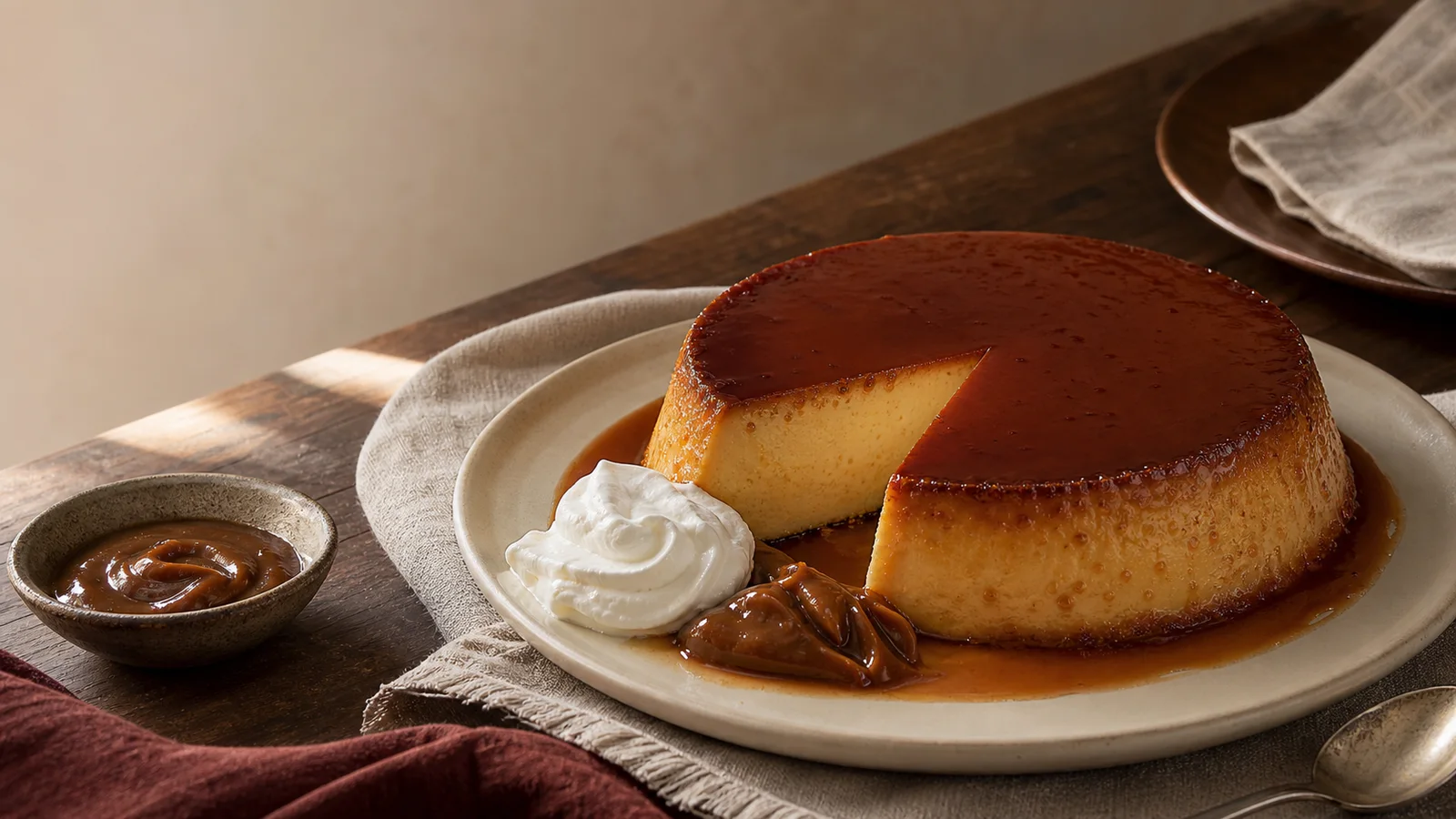
Visit Argentina describes flan mixto as classic flan served with spoonfuls of dulce de leche and cream. That is an optional service style, not a requirement for calling the custard flan. Serve it plain when caramel is enough.
The same distinction matters for sweetness. Dulce de leche and cream make an already sweet dessert richer. Start with modest spoonfuls and let guests ask for more rather than covering the slice before it reaches the table.
If flan closes a longer asado after tira de asado and ensalada rusa, clear and refrigerate the savory leftovers before dessert. The asado wine-pairing guide treats sobremesa as a stage of the gathering, not an obligation to keep opening bottles.
What to drink
Coffee, tea, and water all make sense with caramel custard. A dry Malbec does not become a dessert pairing merely because the meal is Argentine. If wine is wanted, a sweet bottle with enough acidity is the safer sensory direction; the dessert wine glossary entry explains the category. Choose for the dessert instead of forcing a dry red into the pairing.
Make-ahead plan
Flan is a next-day dessert. Bake it the evening before, chill it in its mold overnight, and unmold up to a few hours before serving. Keep the platter covered and cold. Whip cream shortly before the meal or use a stabilized preparation according to its own tested recipe.
Do not unmold a warm flan. Its egg structure is still setting, the caramel is hot, and the custard is more likely to split. Do not leave the chilled mold in warm water while you gather plates; ten to fifteen seconds is enough to loosen the base.
Sources and methodology
The ingredient family and water-bath method come from Argentine government food material. Exact ratios, the temperature finish, chilling schedule, and metal-loaf-pan workflow are our controlled home-recipe choices. U.S. federal guidance supplies the egg-dish minimum and refrigeration limits.
- Argentina’s National Food Policy Directorate, Recetas con leche, yogur y queso, for the official home-flan pattern of milk, eggs, sugar, vanilla, caramel, and water-bath baking.
- Argentina.gob.ar, Recetas del Noreste argentino, for the Chaco flan’s egg-forward ratio, gentle mixing, foil cover, medium-low oven, one-hour water bath, and chilled service.
- Visit Argentina, Nine Must-try Argentinian Sweet Treats, for flan mixto as flan served with dulce de leche and cream.
- FDA, What You Need to Know About Egg Safety, for the 160°F egg-dish minimum, 40°F refrigeration, and three-to-four-day cooked egg-dish window.
- FoodSafety.gov, 4 Steps to Food Safety, for the two-hour/one-hour refrigeration rule and cold holding at 40°F or below.
Ingredients
- 3/4 cup (150 g) granulated sugar, for the caramel
- 1/4 cup (60 ml) water, for the caramel
- 6 large eggs
- 3/4 cup (150 g) granulated sugar, for the custard
- 3 cups (720 ml) pasteurized whole milk
- 2 teaspoons vanilla extract
- 1/4 teaspoon fine salt
- 1/2 cup (160 g) dulce de leche, optional, for serving
- 1 cup (240 ml) softly whipped cream, optional, for serving
Directions
- Prepare the equipment. Heat the oven to 325°F (163°C). Set an ungreased 9-by-5-inch metal loaf pan near the stove. Put a clean kitchen towel in the bottom of a deep roasting pan to steady the loaf pan, and heat a kettle of water for the water bath.
- Cook the caramel carefully. Combine the 3/4 cup sugar and 1/4 cup water in a small light-colored saucepan. Bring to a boil over medium heat without stirring once it bubbles. Swirl the pan as the syrup turns amber, 8-12 minutes. Hot caramel causes severe burns; do not touch or taste it.
- Coat the mold. Wearing dry oven mitts, immediately pour the amber caramel into the metal loaf pan. Tilt the pan away from your face to coat the bottom. Set it on a heatproof surface. The caramel will harden while the custard is mixed.
- Heat the milk. Warm the pasteurized whole milk in a clean saucepan over medium-low heat until steaming and about 165°F (73.9°C); do not boil. Remove from the heat and stir in vanilla.
- Mix without foam. Whisk the 6 eggs, 3/4 cup sugar, and salt gently until combined, not frothy. Slowly whisk in the hot milk. Strain through a fine-mesh sieve into a pitcher, then pour over the hardened caramel. Cover the loaf pan tightly with foil.
- Bake in a water bath. Put the loaf pan in the prepared roasting pan and place it on the oven rack. Carefully pour hot water into the roasting pan until it reaches halfway up the loaf pan. Bake 65-80 minutes. The center should still tremble as one mass, not ripple like liquid.
- Verify the center. Insert a clean instant-read thermometer halfway into the center without touching the bottom. Egg dishes must reach at least 160°F (71.1°C); for this flan's set, remove it at 175-180°F (79.4-82.2°C). Do not bake until the center is rigid.
- Cool and chill safely. With dry mitts, lift the loaf pan out of the water bath and uncover it. Cool on a rack for 30 minutes, then refrigerate it within 2 hours of leaving the oven. Cover once cold and chill for at least 6 hours, preferably overnight.
- Unmold. Run a thin knife around the edge. Dip only the bottom of the metal pan in warm water for 10-15 seconds. Center a rimmed platter over the pan, hold both firmly, and invert in one motion. Let the caramel run around the custard.
- Serve. Cut with a clean thin knife. Serve plain, or add about 1 tablespoon dulce de leche and 2 tablespoons softly whipped cream per slice for optional flan-mixto service. Return the remaining flan to the refrigerator promptly.
Serving Ideas
Serve one chilled slice per person, plain or with dulce de leche and softly whipped cream. A rimmed platter catches the liquid caramel. Coffee, tea, or water keeps the focus on the custard; if you serve wine, choose a genuinely sweet dessert wine rather than assuming a dry red belongs beside the sugar.
Storage
Keep flan covered at 40°F (4.4°C) or below and use within 3-4 days. Refrigerate it within 2 hours, shortened to 1 hour above 90°F (32.2°C). Do not leave the platter at the table throughout a long sobremesa; return extra slices to the refrigerator. Freezing is not recommended because thawing can make the custard weep.
A calm water bath, a thermometer, and a full overnight chill make unmolding less dramatic. Serve the flan plain or as flan mixto, then read the dulce de leche glossary entry for the condiment on the plate.
Editorial image created for this recipe; it illustrates optional flan-mixto service rather than a documented restaurant plate.