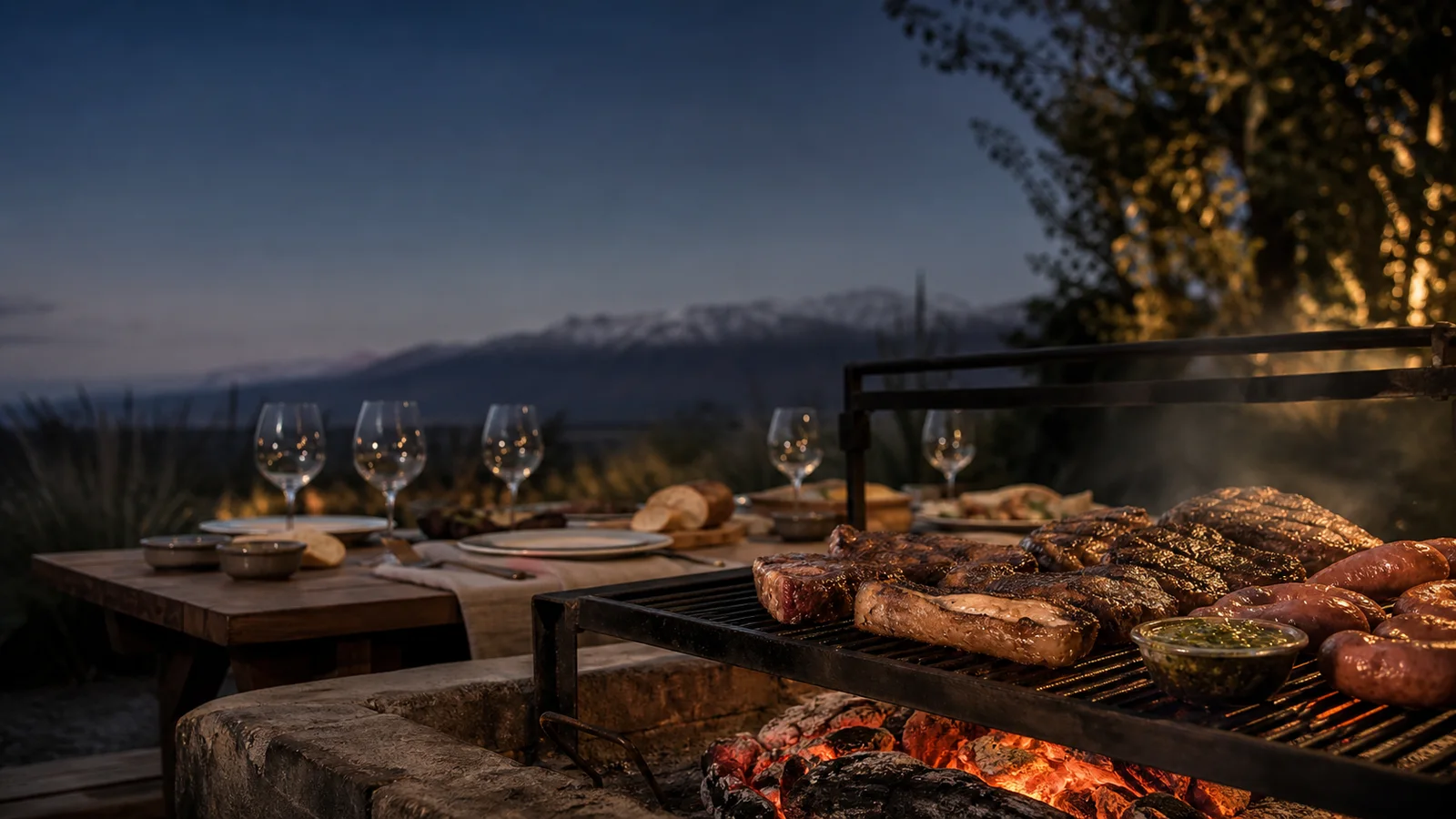
At the table · pairing field guide no. 03
Argentine Asado Wine Pairing: A Course-by-Course Guide
Do not ask one bottle to solve the whole grill. Pair the sequence: bright at the welcome, flexible through the first hot plates, structured when the main cuts arrive.
Research note: This guide separates culinary pairing suggestions from USDA food-safety minimums. Argentine government and tourism sources inform the service sequence; published sensory research informs the cautious pairing language.
The short answer
Pair the order of the meal, not just the largest cut
Begin an Argentine asado with freshness, then add structure. Dry sparkling wine, dry rosé, Torrontés, or bright Bonarda can welcome picada, empanadas, provoleta, and choripán. Save Malbec, Cabernet Sauvignon, Cabernet Franc, or Syrah for the ribs, vacío, and entraña—then let chimichurri, salsa criolla, char, and sides revise the choice.
This is a common sequence, not a national rule. Argentine households, regions, cooks, budgets, and fires differ. The useful idea is progression: the wine should move with the table instead of forcing every plate into one “perfect” match.
Looking for the concise meaning and cultural background? Our asado glossary entry keeps the definition and history. This page has a narrower job: build a wine and service plan for the long meal.
The order is the pairing
Official Argentine travel guides describe asado as a social ritual with food released in stages, not a single steak dropped onto a plate. A picada may occupy the table while the fire settles. Chorizo, morcilla, and other achuras often arrive before larger cuts. Provoleta, vegetables, salads, chimichurri, and salsa criolla move around that order; sobremesa extends the gathering after the grill quiets. The exact menu is the asador’s, but the staggered rhythm changes how wine should be planned.
Welcome
Picada
Olives, cheese, cured bites, bread, and often empanadas while the fire develops.
First heat
Provoleta
Hot cheese, blistered edges, herbs, and enough richness to make freshness valuable.
From the grate
Choripán & achuras
Sausage and, where served, offal cuts with very different textures and intensities.
The long fire
Main cuts
Tira de asado, vacío, entraña, or the household’s chosen cuts with vegetables and salads.
After the grate
Sobremesa
The plates clear; conversation continues. Wine can slow or stop while water stays on the table.
A useful hosting rule: open a bright bottle first, keep the most structured red for the ribs, and leave one fresh bottle in reserve. Cold water belongs on the table before every red is opened.
That first bottle does real work. It meets salty snacks, acid-driven condiments, and people arriving at different times. A dry sparkling wine or dry rosé is more forgiving here than a heavily tannic red. Torrontés can be an aromatic, fresh start with empanadas, salads, and herbs. Bonarda—depending on producer and style—can bridge early plates and the first meat without making the meal feel heavy from minute one.
A course-by-course asado wine matrix
Use the matrix to choose a style, then taste the finished dish. “Fire and weight” describes the plate, not a quality ranking. Producer decisions can make two bottles from the same grape behave very differently, and each sauce can move the answer.
| Plate / course | Fire & weight | Wine starting point | Sauce / side pivot | Why |
|---|---|---|---|---|
| Picada & empanadas | Salty, varied, often pastry-rich; little or no grill smoke yet | Dry sparkling wine, dry rosé, or Torrontés | Salsa criolla → keep the wine bright and dry; chile → favor lower alcohol | Freshness and moderate weight can handle several small bites without deciding the whole meal too early. |
| Provoleta | Melted cheese, browned edge, herbs, rich center | Structured Chardonnay, dry sparkling wine, or rosé | Oregano and chile oil → aromatic white or juicy, low-tannin red | Acidity can make the sip feel vivid beside rich cheese; bubbles add texture without requiring a heavy red. |
| Choripán & achuras | Savory, fatty, crisp-edged; achuras vary sharply by item | Fresh Bonarda, supple Malbec, or dry rosé | Chimichurri → prioritize freshness; morcilla → fruit-forward red; chile → lower alcohol | Juicy fruit and moderate structure can meet sausage without exhausting the palate before the main cuts. |
| Tira de asado / short ribs | Bone, connective tissue, rendered richness, prolonged ember exposure | Malbec, Cabernet Sauvignon, or a structured red blend | Salsa criolla → fresher Malbec; bitter char → generous fruit over austerity | A concentrated plate often welcomes comparable body and fruit, while acidity in the condiment can reward lift. American-style sauced ribs are a different pairing problem; use the BBQ-ribs wine guide when sweetness, smoke, and chile lead the plate. |
| Vacío / abdominal-wall cut | Pronounced grain and beef flavor; richness depends on trimming and the individual cut | Malbec, Cabernet Franc, or Bonarda | Herbal chimichurri → Cabernet Franc or a bright Malbec | Flavor intensity can support a savory red even when the plate is not the fattiest on the parrilla. |
| Entraña / skirt | Intense beef flavor, loose grain, fast char | Syrah, Malbec, or Cabernet Franc | Pepper and smoke → Syrah; tomato-onion salsa → brighter red | Savory aroma and char may matter more than sheer tannin; freshness keeps a quick-cooked cut lively. |
| Vegetables or chicken | Sweet char, herbs, lighter body; chicken preparation varies | Torrontés, Chardonnay, dry rosé, or Pinot Noir | Lemon and herbs → aromatic white; smoky peppers → rosé or light red | A white or rosé can follow aroma and seasoning instead of treating every parrilla dish as a red-wine problem. |
A translation caution: Argentine and U.S. cutting systems do not divide the carcass identically, so vacío is not a one-to-one synonym for a U.S. flank steak. Use the Spanish name when ordering and compare the actual shape, grain, and fat. The IPCVA Argentine Beef cut guide is a useful visual reference.
Three decisions before the label
Read the plate in this order
- 01 Course. A welcome wine should keep the appetite awake; the main-cut wine can carry more body and structure.
- 02 Finished intensity. Char, rendered richness, smoke, salt, and cut size matter more than a reflexive “meat equals red” rule.
- 03 Condiment. Vinegar, tomato, herbs, garlic, chile, and onion can become louder than the meat. Let the sauce cast the final vote.
The asador’s field card
Build a service clock around the first shared plate
Choose when the first hot plate should reach the table. The clock works backward from that moment and estimates bottle inventory for the wine-drinking adults you enter.
This is an inventory estimate, not a drinking recommendation. A 750 mL bottle holds about five 5 oz pours, but ABV determines alcohol content: NIAAA notes that a 12% bottle contains about five U.S. standard drinks, while a 14% bottle contains nearly six. Keep water and alcohol-free drinks visible, plan safe rides, serve only adults of legal drinking age, and let guests opt out freely.
Your service clock
First shared plate: 7:00 PM
- Build the fire and prep the table
Set out separate raw and serving tools; make sauces, salads, water, and alcohol-free drinks ready before guests arrive.
- Start the long-cooking part of your menu
Work from the actual cut, thickness, fire, and recipe—not this clock. Put sturdy vegetables on only when your cooking plan calls for them.
- Welcome guests with picada
Cool the first wine, open water, and keep the most structured red closed until the main cuts are near service.
- Tend chorizo and achuras, if serving
Treat each item as its own food-safety question. Use verified cut-specific guidance and a thermometer, not the color of the fire or meat.
- Ready provoleta, clean platters, and thermometer
Give hot food a clean destination. Taste sauces now so their acid, salt, herbs, and chile can inform the next bottle.
- Send the first hot plates
Serve provoleta, choripán, or the early course you planned. Think of this as the shared-plate anchor, not a deadline.
- Bring the main cuts and sides
Slice only what is ready, keep salads and vegetables moving, and pour the more structured red only if the plate asks for it.
- Clear perishables; settle into sobremesa
Refrigerate food within the USDA time window. Leave water on the table and let conversation—not another bottle—set the pace.
Important: this is a hosting sequence, not a cooking-doneness timer. Fuel, weather, grill geometry, cut, thickness, and starting temperature all change cooking time. Verify doneness with current cut-specific safety guidance and a food thermometer.
This asado planner sequences styles across the meal; it does not total the packages for a guest list. When the menu and wine roles are set, use the wine bottle calculator for exact bottle volume, planned pours, a visible optional buffer, on-hand bottles, and alcohol-free inventory.
An asado does not require an all-red flight
Red wine has an obvious place at an asado, but “obvious” is not the same as “exclusive.” The first hour may contain cheese, pastry, vegetables, herbs, onion, tomato, and sausage before a large beef cut appears. Those plates create credible work for whites, rosé, and sparkling wine.
Bright / opening
Dry sparkling wine
Use with picada, fried or baked empanadas, and provoleta. Keep it dry; sweetness can feel conspicuous beside salty starters unless chile is prominent.
Aromatic / herbal
Torrontés
Useful with herbs, salsa criolla, lighter empanadas, salads, and grilled vegetables. Its perfume is a bridge, not a promise that it will carry the richest ribs.
Textural / cheese
Chardonnay
A structured, not aggressively sweet-fruited Chardonnay can meet browned cheese and charred vegetables. It may also work with chicken when seasoning leads the plate.
Flexible / first grate
Dry rosé
Chill it for choripán, sausage, tomato-onion salsa, and the gap between welcome snacks and red wine. Choose enough fruit to survive smoke.
Why these pairings are phrased as possibilities
Wine astringency is a tactile drying or roughing sensation. Research describes wine tannins interacting with salivary proteins and changing oral lubrication; tannin structure, the wine matrix, saliva, and the individual all affect the sensation. Research on dietary lipids and grape-tannin polyphenols also shows that food can change what happens in the mouth. That evidence does not prove a universal slogan such as “fat cuts tannin” for every glass and every cut.
The honest language is can and often. A richer cut can make a structured red feel more integrated to one diner and still feel drying to another. A tart condiment can make the next sip feel brighter, but “cleansing” is a sensory metaphor. Controlled food-and-wine work has also found different consumer preference groups favor different pairings. There is no loss of expertise in preferring a supple Bonarda to a powerful Cabernet.
Taste twice
First: taste the wine alone. Second: taste it after the seasoned bite. If the wine becomes hard, hot, flat, or bitter, change the serving temperature, condiment, or bottle. A classic match is not an obligation.
Temperature, opening order, and decanting
A parrilla creates the worst place to park wine: hot, bright, and easy to forget. Keep every bottle away from direct sun and radiant heat. The bands below are practical service ranges, not chemical thresholds; glass temperature begins changing as soon as wine is poured.
(8–10°C)
Sparkling
Cold enough to hold freshness and carbonation, not left in ice until aromas disappear.
(7–13°C)
Rosé & white
Cooler for crisp rosé and Torrontés; slightly warmer for a structured Chardonnay.
(14–18°C)
Red
“Room temperature” is unhelpful beside a summer fire. A short chill can be better than a warm bottle.
Open in the order you plan to pour. Keep sparkling wine, rosé, and aromatic white cold until the welcome. Taste a young structured red before deciding to decant it; a short period in a broad vessel may help some wines open, while others need no intervention. Taste again instead of obeying a fixed clock. Older bottles may be more about separating sediment than adding air, and fragile wines can fade. There is no reliable “all Malbec needs an hour” rule.
For a deeper cut-by-cut explanation, use our best wine with steak guide. That page owns the broad steak decision system. This one owns the progression of an Argentine asado—from the first shared bite to the last main platter.
The thermometer outranks the wine
Food-safety minimums are not pairing advice
The USDA safe-temperature chart lists whole cuts of beef, pork, veal, and lamb at 145°F (62.8°C) with a three-minute rest; ground meats at 160°F (71.1°C); and poultry at 165°F (73.9°C). USDA sausage guidance applies 160°F to raw beef, pork, lamb, and veal sausage and 165°F to raw poultry sausage. Use a food thermometer; visual color and grill timing are not enough.
Then rest at least three minutes.
Includes raw beef or pork sausage.
Includes chicken and raw poultry sausage.
Achuras need item-specific care. Organs and prepared items are not one interchangeable safety category, so verify guidance for the exact ingredient and preparation. Morcilla may be sold ready-to-eat or raw; read its package instead of inferring doneness from the dark color. Prevent raw-to-ready cross-contamination with separate utensils and clean platters. Refrigerate perishable food within two hours, or within one hour when it is above 90°F (32.2°C). Those windows still apply during a long sobremesa.
Build the menu around the wines you actually want to open
A useful asado menu has contrast before it has abundance. Choose one welcome bite, one first hot plate, one or two principal proteins, a bright condiment, and at least one vegetable or salad. That creates enough movement for wine without turning the gathering into a tasting exam.
Pastry, savory filling, and a natural place for sparkling wine, rosé, or Torrontés.
First heat ProvoletaBrowned cheese for Chardonnay, sparkling wine, or a juicy light red.
From the grate ChoripánA focused sausage-and-bread course that can bridge the welcome wine and first red.
Main cut Tira de asadoCross-cut short ribs for the structured-red stage, with exact cut, heat, and doneness guidance.
Green & sharp ChimichurriHerbs, garlic, and vinegar that reward freshness more than brute force.
Tomato & onion Salsa criollaA bright side for choripán and beef that can pull the wine toward lift.
Cold side Ensalada rusaPotato, carrot, peas, and mayonnaise beside the char, with cold-service safety built in.
Dessert Argentine flanCaramel custard for the transition from the meal into sobremesa.
After the plates The art of sobremesaWhy the gathering continues after the food—and why the planner should leave room for it.
To compare regions, grapes, and label language before shopping, start with the Argentine wine guide. If Malbec will anchor the main cuts, the Malbec guide explains how region and winemaking can change the style in the glass.
Sources and reading notes
Sources below support the cultural sequence, safety distinctions, responsible-service context, and cautious sensory explanation. Pairing recommendations remain culinary starting points, not findings that one grape is objectively correct.
- Visit Argentina: Asado, a guide to experience the ritual — common cuts, picada, choripán, sauces, staged service, and sobremesa.
- Argentina.gob.ar: Asado — Argentine government tourism overview of the familiar achuras-to-main-cuts sequence and sides.
- Visit Argentina: Argentine wine varieties — official tourism context for Argentina’s range beyond one red grape.
- IPCVA Argentine Beef cut guide — Argentine cut names and locations, used to avoid false one-to-one U.S. translations.
- USDA FSIS safe minimum internal temperature chart — whole-cut, ground-meat, and poultry minimums and rest time.
- USDA FSIS: Sausages and food safety — distinct temperatures for raw red-meat and poultry sausages.
- USDA FSIS: Four steps to keep food safe and food thermometers — time limits, cross-contamination prevention, and temperature verification.
- NIAAA: Defining how much alcohol is too much — U.S. standard-drink definition and the effect of ABV on drinks per bottle.
- Ployon et al., 2018 (PMC6259628) — review of salivary proteins and wine astringency mechanisms.
- Saad et al., 2021 (10.1021/acs.jafc.0c06589) — dietary lipids and grape-tannin interactions; useful evidence without a universal pairing claim.
- Food Research International (10.1016/j.foodres.2020.109463) — consumer segments and differing food-and-wine pairing preferences.
- Comité Champagne: Serving Champagne — official sparkling-wine chilling and service context.