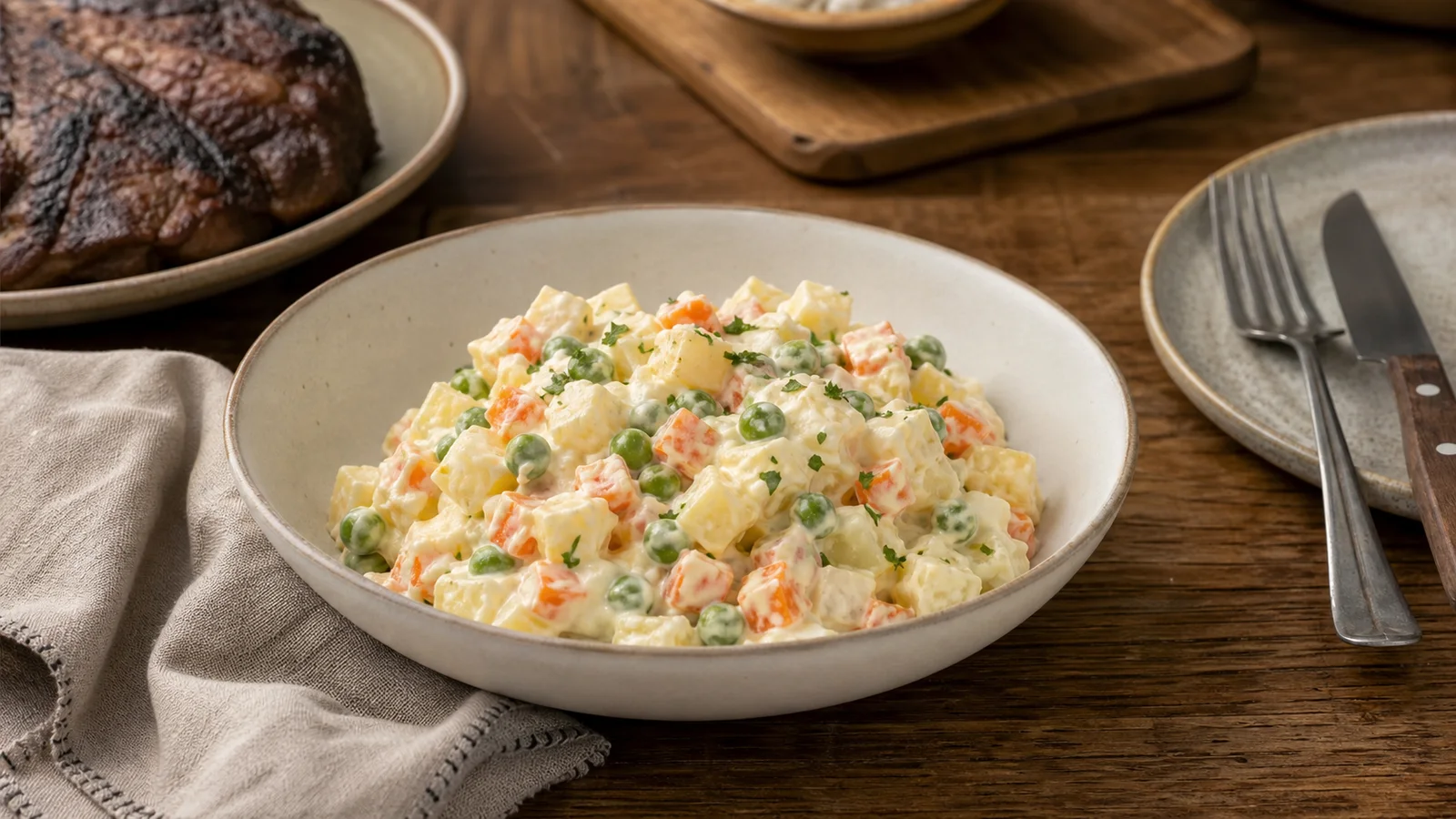
Ensalada Rusa Argentina: Potato, Carrot, and Pea Salad
Answer first: Argentine ensalada rusa is a cold salad of diced potatoes, carrots, and peas lightly bound with mayonnaise. This version stages the vegetables in one pot so each stays distinct, then cools them to 40°F (4.4°C) before dressing. It makes six side-dish portions.
Visit Argentina presents that potato-carrot-pea-mayonnaise combination as a summer dish and a familiar Christmas-table preparation. It is a recognizable Argentine version, not a single universal formula. Families may add hard-cooked egg, olives, tuna, apple, beet, or nothing beyond the core four ingredients.
The name reflects a dish with European roots that Argentina adopted and simplified through its own home and holiday tables. This page does not claim Argentina invented the salad or that every province prepares it the same way.
The ratio and texture
Two pounds of potato form the base. Carrot is present but does not turn the bowl sweet, and one cup of peas gives color without dominating every bite. Three-quarters of a cup of mayonnaise lightly binds roughly eight cups of cooked vegetables.
Use a waxy or all-purpose potato such as Yukon Gold. A very floury baking potato can break at the edges and turn the dressing pasty. The 1/2-inch dice is large enough to keep shape but small enough to share a fork with carrot and peas.
Staging all three vegetables in one pot saves equipment while respecting their different cooking speeds. Potatoes receive eleven minutes, carrots seven, and frozen peas two. Those are checkpoints, not a substitute for testing a cube. Drain when the potatoes are tender with slight resistance; carryover heat finishes the center.
Why cooling comes before mayonnaise
Warm potatoes absorb dressing, but this is a cold mayonnaise-bound salad intended for make-ahead service. Spreading the cooked vegetables into one layer releases steam and lowers their temperature faster than leaving them in a deep colander. Refrigeration finishes the cooling before mayonnaise is folded in.
The recipe specifies chilled commercial mayonnaise because FDA guidance notes that commercial products contain pasteurized eggs. If you make mayonnaise at home, use pasteurized eggs or egg product and a tested recipe; this page does not provide a raw-egg mayonnaise method.
Pasteurized mayonnaise does not make the finished bowl shelf-stable. Cooked vegetables, handling, and the full mixture still require refrigeration. Keep the salad at 40°F or below, serve a smaller bowl over ice, and replace it from the refrigerator instead of repeatedly topping up a warm bowl.
What to serve with ensalada rusa
The salad’s mild, creamy texture works beside browned, salty food. Serve it with tira de asado, choripán, or another grilled cut. Add salsa criolla separately when the table needs raw vegetables and vinegar; do not stir it through the mayonnaise bowl in advance.
At a long asado, portion only part of the salad for service and keep the reserve cold. The Argentine asado wine-pairing guide helps sequence cold sides, hot courses, water, and wine.
What to drink
Ensalada rusa is a side, so the meat or main dish should usually choose the bottle. Visit Argentina lists fresh Bonarda as a holiday-table option with ensalada rusa. That is a useful suggestion, not a required match. A dry rosé, crisp white, or water can be easier when mayonnaise is the strongest flavor on the plate.
Let the complete plate choose the bottle rather than assigning one from the side dish alone.
Sources and methodology
The ingredient boundary comes from Argentina’s official tourism material. Exact quantities, staged timing, fast cooling, and the three-day home storage choice are our recipe-development decisions informed by current federal safety guidance.
- Visit Argentina, Delicias estivales: 6 platos auténticos de Argentina para disfrutar del verano, for the potato, carrot, pea, and mayonnaise formulation and its summer-table context.
- Visit Argentina, Cocina navideña a la argentina, for ensalada rusa’s role on Argentine Christmas tables and the same core ingredient pattern.
- Visit Argentina, Cepas de vinos y espumantes argentinos ideales para brindar, for Bonarda as one official holiday pairing suggestion with ensalada rusa.
- FDA, Dairy and Eggs: Food Safety for Moms-to-Be, for the distinction between commercial mayonnaise made with pasteurized eggs and raw-egg homemade sauces.
- FDA, What You Need to Know About Egg Safety, for pasteurized eggs in uncooked egg preparations and 40°F refrigeration.
- FoodSafety.gov, 4 Steps to Food Safety, for 40°F cold holding and the two-hour/one-hour rule.
Ingredients
- 2 pounds (900 g) Yukon Gold or other waxy potatoes, peeled and cut into 1/2-inch dice
- 3 medium carrots (about 10 ounces / 285 g), peeled and cut into 1/2-inch dice
- 1 cup (145 g) frozen green peas
- 1 tablespoon kosher salt, for the cooking water
- 3/4 cup (170 g) chilled commercial mayonnaise made with pasteurized eggs
- 1 tablespoon (15 ml) fresh lemon juice or white-wine vinegar
- 3/4 teaspoon fine salt, plus more only after chilling and tasting
- 1/4 teaspoon black pepper, optional
- 2 tablespoons finely chopped flat-leaf parsley, optional, for garnish
Directions
- Set up cold storage first. Clear refrigerator space for a rimmed sheet pan or shallow container. Keep the commercial mayonnaise at 40°F (4.4°C) or below. Wash hands, the potatoes, and the carrots before peeling and cutting.
- Cut evenly. Make uniform 1/2-inch dice so the vegetables cook at a similar pace. Put the potatoes in cold water while finishing the carrots, then drain; do not leave cut potatoes at room temperature.
- Stage the vegetables. Bring 3 quarts (2.8 L) water and the 1 tablespoon kosher salt to a boil in a 5- to 6-quart pot. Add potatoes and simmer 4 minutes. Add carrots and simmer 5 minutes. Add frozen peas and simmer 2 minutes more.
- Test and drain. After about 11 minutes total for the potatoes, a small knife should enter a cube with light resistance; the pieces should not collapse. Drain immediately in a large colander and shake gently to remove trapped water.
- Cool quickly. Spread the vegetables in one layer on a clean rimmed sheet pan for 10 minutes so surface steam escapes. Transfer to a clean shallow container, cover loosely, and refrigerate until the center reaches 40°F (4.4°C) or below, about 30-45 minutes.
- Dress only when cold. Stir the mayonnaise, lemon juice or vinegar, 3/4 teaspoon fine salt, and optional pepper together. Fold through the cold vegetables without crushing them. Cover and chill for at least 30 minutes.
- Taste and finish. Stir once, taste with a clean spoon, and adjust salt only now. Garnish with optional parsley. The salad should be lightly bound, not floating in mayonnaise.
- Serve cold. Put out only what will be eaten promptly and keep a larger bowl nested over ice. Return leftovers to refrigeration within 2 hours, shortened to 1 hour when the air temperature is above 90°F (32.2°C).
Serving Ideas
Serve about three-quarters of a cup per person beside tira de asado, choripán, milanesa, roast chicken, or a cold holiday spread. Keep the bowl off the grill station and away from raw-meat utensils. Optional additions such as chopped hard-cooked egg, olives, tuna, or beet belong to other household versions; add them deliberately rather than calling one formula universal.
Storage
Keep ensalada rusa covered at 40°F (4.4°C) or below and use within 3 days for a conservative home window and better texture. Refrigerate within 2 hours, or within 1 hour above 90°F (32.2°C). Do not freeze; potatoes and mayonnaise separate and become watery. Discard salad that contacted raw-meat juice or sat out beyond the applicable limit.
The useful version is restrained: evenly cooked vegetables, enough mayonnaise to bind them, and a cold chain that lasts through service. Pair the side with tira de asado, then use the asado guide to plan the whole table.
Editorial image created for this recipe; it illustrates the restrained potato-carrot-pea version described below.