El Cuaderno · Oak-cue lab
Best Unoaked Chardonnay: Our $20 Argentine Pick
2024 Nine Queens Chardonnay, listed at $20 a bottle, with citrus, white stone fruit and floral notes. Check the style and delivered total before buying.
Research note: These are Familia Morgan's recommendations about wines Familia Morgan makes. This is not an independent blind tasting, a paid review, or a global ranking. Bottle price, public availability and the stated vessel and flavor profile were checked October 13, 2026; checkout terms and conflicting alcohol figures remain unverified.
Looking for the best unoaked Chardonnay for your table? Our producer pick is 2024 Nine Queens Chardonnay, an Argentine wine listed at $20 USD per 750 mL bottle on October 13, 2026. Its winemaker’s notes describe citrus, white stone fruit and floral aromas, with fermentation in stainless steel; the product page also explicitly lists it as unoaked. Consider it when that fresh-fruit profile fits the wine you want.
The $20 is the bottle price, before shipping and tax. The public catalog showed the single-bottle variant as available when checked; confirm current availability, shipping eligibility and the final total at checkout. The listing contains conflicting alcohol figures, so confirm the current bottle label if ABV matters to your choice.
A useful no-oak recommendation needs both an explicit unoaked statement and a style you enjoy. The guide below shows how to check those facts, keep oak separate from malolactic conversion, and match the wine to your food.
What “unoaked Chardonnay” does and does not prove
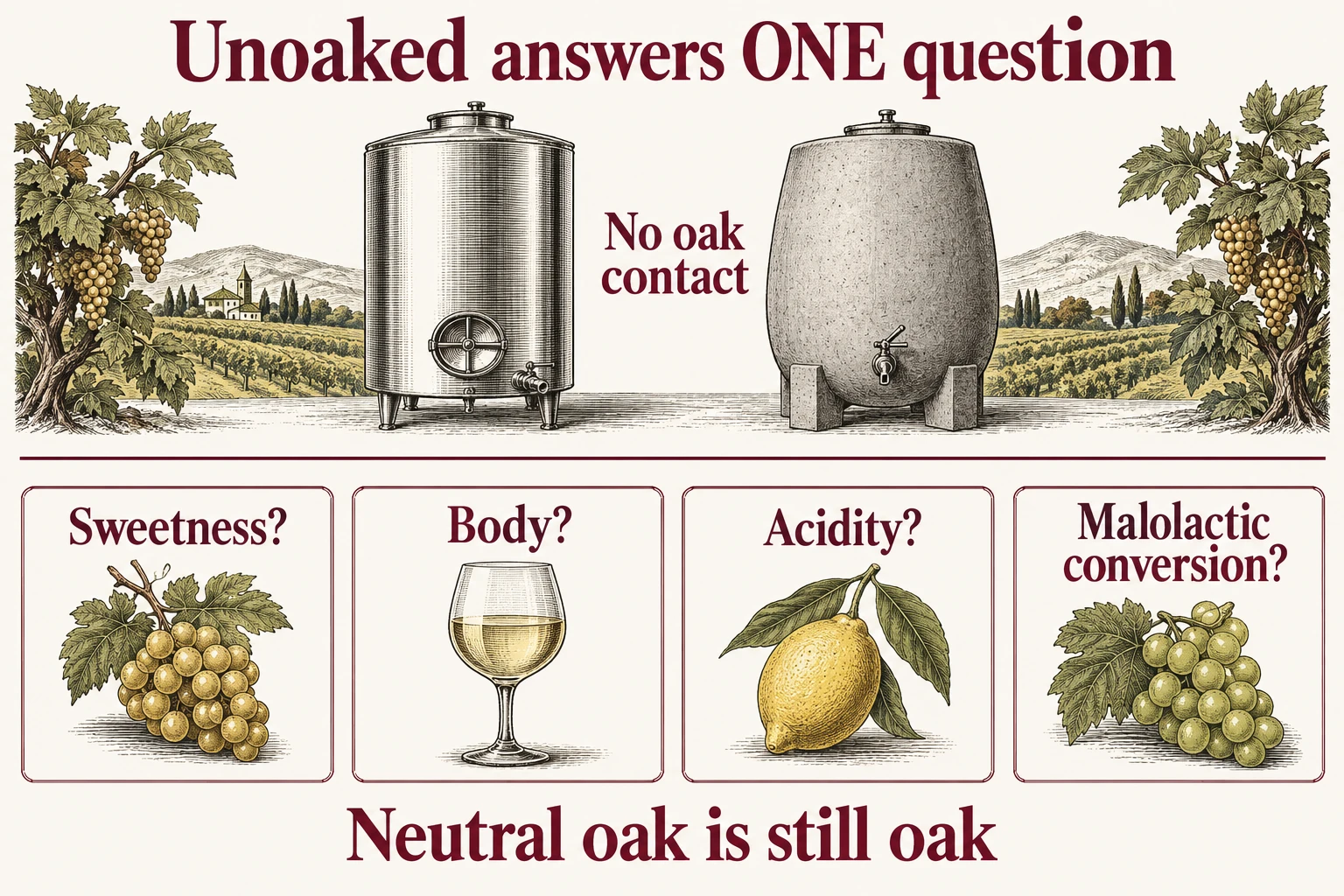
Read the illustration
Unoaked describes the absence of oak contact. It does not by itself establish sweetness, body, acidity or malolactic conversion. Neutral oak is still oak.
At its strictest, unoaked answers one production question: the wine did not have contact with an oak vessel. Stainless steel, concrete, and amphora are all non-oak vessels, although each can be used in different ways and should not be treated as sensorially identical. A neutral or old barrel may contribute less obvious oak character than a new barrel, but it is still an oak vessel; “neutral oak” is not the same claim as “unoaked.”
That narrow definition is useful precisely because it refuses to carry conclusions the evidence cannot support. Unoaked does not automatically mean:
- no malolactic conversion;
- no lees contact;
- high acidity, low alcohol, or light body;
- dry rather than sweet;
- citrus rather than ripe fruit;
- less expensive;
- natural, organic, low-intervention, or sulfite-free;
- younger, simpler, healthier, or higher quality.
Those are separate questions. A serious recommendation either supplies evidence for each one or leaves it unclaimed.
If you are still deciding between broad Chardonnay styles, start with the recommended Chardonnay wine compass. This page takes over once “no oak” is already the search job.
Build an evidence ladder before buying
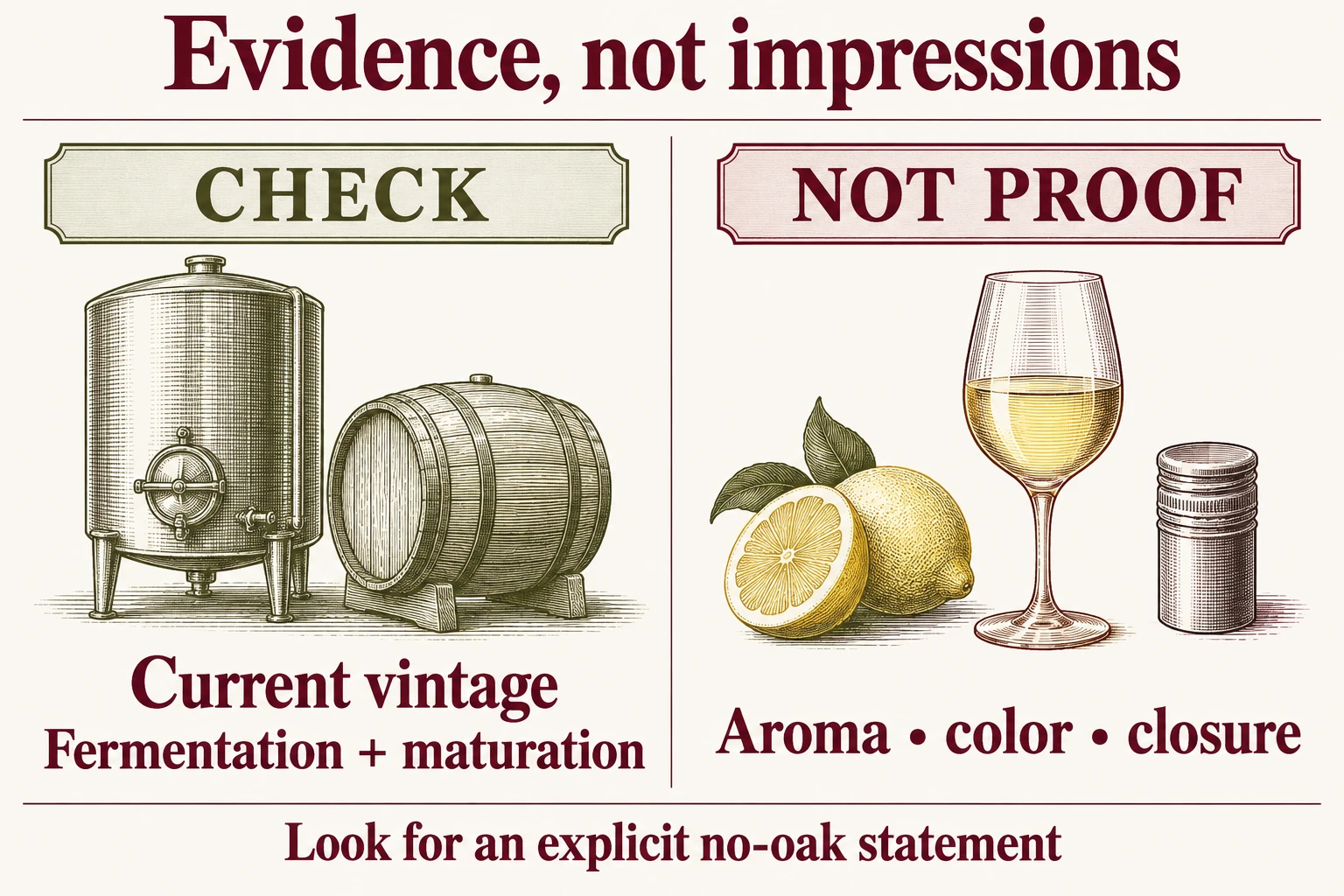
Read the illustration
Check the current vintage technical sheet and explicit producer statements about fermentation and maturation. Citrus aromas, pale color and a screw cap do not prove no oak.
Not every product description offers the same quality of evidence. Use this ladder from strongest to weakest:
- A producer technical sheet names the fermentation and maturation vessels. This is the clearest basis for a no-oak claim.
- The producer’s current product page explicitly says stainless steel, concrete, amphora, no oak, or unoaked. Check that the statement applies to the vintage being sold.
- A retailer reproduces a current producer statement. Useful, but verify the vintage and source when possible.
- A reviewer calls the wine crisp, mineral, citrusy, or clean. Those are sensory impressions, not vessel records.
- The label looks modern, pale, inexpensive, or sealed with a screw cap. None of those visual cues establishes the vessel.
The general oak glossary explains the vessel category. For where maturation sits among fermentation, stabilization, and bottling, use the how wine is made guide.
Run the oak-cue lab
The oak-cue lab separates five variables that shoppers often collapse into one. Move across the row before you decide that an aroma answers a production question.
| Variable | Best evidence | What it can tell you | What it cannot prove |
|---|---|---|---|
| Vessel | Producer names stainless, inox, concrete, amphora, or oak | Whether an oak vessel was used | Malolactic conversion, sweetness, acidity, or quality |
| Malolactic conversion | Technical note states full, partial, or blocked conversion | How that cellar step was managed | Whether oak was used |
| Lees | Producer states contact, stirring, or time | One possible source of texture and savory complexity | Oak contact or malolactic status |
| Fruit profile | Current vintage tasting description | The aromas the producer reports | Residual sugar, vessel, or measured acidity |
| Sensory oak cues | Taster reports toast, vanilla, coconut, or spice | A reason to investigate the cellar record | The exact vessel, barrel share, or duration |
Keep oak and malolactic conversion separate
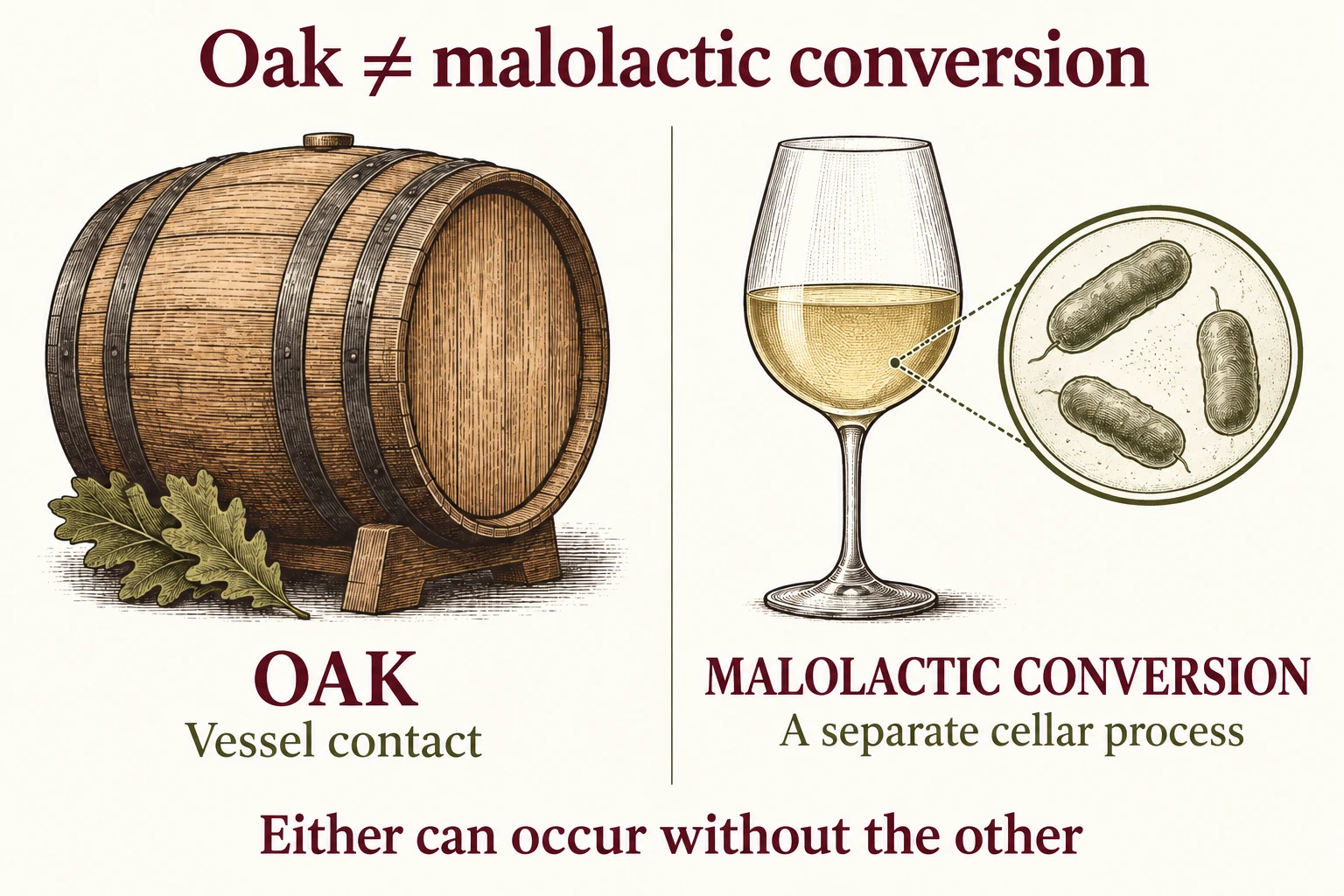
Read the illustration
Oak contact is a vessel choice; malolactic conversion is a separate cellar process. Either may occur without the other. Buttery aroma alone does not prove oak contact.
Malolactic conversion and oak can appear together, which is why they are often confused, but one does not establish the other. The Australian Wine Research Institute describes malolactic fermentation as the conversion of malic acid to lactic acid by lactic acid bacteria. Diacetyl associated with the process can contribute buttery aroma, with the final impact depending on winemaking conditions and management.
Oak is a vessel and maturation choice. Depending on barrel species, age, size, toast, and time, it can contribute or support aromas commonly described as vanilla, toast, coconut, or spice. A producer may combine both tools, use one without the other, or use neither.
That distinction changes what you ask:
- If your requirement is no barrel-derived character, verify the vessel.
- If your requirement is no malolactic conversion, verify that process directly.
- If your requirement is no buttery aroma, ask about both MLF management and the finished sensory profile.
- If your requirement is a lean or high-acid wine, seek an actual style statement or analysis; “unoaked” does not supply it.
Familia Morgan does not publish the malolactic status of the 2024 Nine Queens Chardonnay in the evidence used for this page. We will not guess. The malolactic fermentation glossary offers more context without turning “yes” or “no” into a quality grade.
Read the label, listing, and technical sheet in order
On a shelf, start with the back label, but do not expect every vessel detail to appear there. Then check the current producer page and technical sheet. Search for phrases such as unoaked, no oak, stainless steel, or inox. Concrete and amphora are also non-oak, but a thoughtful producer should still identify the actual vessel instead of relying on a generic “unoaked” halo.
Next, confirm that the evidence matches the vintage you are buying. A retailer may keep a description after inventory moves to the next harvest. Avoid copying an old technical note onto a new wine unless the producer confirms the method is unchanged.
Finally, separate the production record from the selling language. “Pure,” “clean,” “fresh,” “mineral,” and “modern” can express a writer’s impression, but they are not regulated substitutes for the vessel history. A bottle should not win this search merely because its copy sounds like no oak.
Match an unoaked style to the finished dish
No-oak Chardonnay can cover more than one sensory profile, so begin with preparation and sauce. The Wine Australia educator guide treats Chardonnay as a broad stylistic family and connects lighter examples with fish while fuller styles can suit richer dishes. WSET’s matching framework likewise asks readers to consider intensity, fat, salt, acidity, and sweetness.
| Dish | Ask first | When a fresh no-oak style can fit |
|---|---|---|
| Seafood | Raw, steamed, grilled, smoked, buttery, or spicy? | Simple preparations, citrus, herbs, and moderate intensity |
| Chicken | Poached, roasted, fried, or cream-sauced? | Lighter preparations and sauces that do not demand overt barrel character |
| Creamy pasta | How rich, browned, cheesy, or truffled is the sauce? | When freshness is welcome alongside the cream rather than more toast or vanilla |
| Vegetables | Are char, chile, sweetness, herbs, or cheese dominant? | Herb-led, grilled, or lightly creamy preparations of moderate intensity |
| Soft cheese | How salty, pungent, or washed is the rind? | Milder cheeses where fruit and floral character have room |
| Salmon | Raw, baked, grilled, smoked, glazed, or cream-sauced? | Several simple or herb-led versions; other preparations may call for another wine |
The more focused salmon pairing guide routes by preparation, while the pasta pairing guide routes by sauce. Those questions are more useful than treating any grape as an automatic match.
When unoaked Chardonnay is not the right answer
Choose an oak-influenced Chardonnay when barrel-derived toast, vanilla, coconut, or spice is part of the pleasure you are buying. Choose a wine with a published malolactic statement when that process is the deal-breaker; stainless steel alone cannot answer it. Choose an off-dry or lower-alcohol style when substantial sweetness or chile heat makes that the more comfortable pairing. Choose sparkling wine when bubbles and refreshment are the point. And choose a different grape when you simply do not enjoy Chardonnay—removing oak does not turn it into another variety.
Do not buy the Familia Morgan bottle solely because this is the producer’s page. Buy it only if a fresh citrus, white-stone-fruit, and floral description plus documented stainless-steel production fits what you want.
Questions shoppers ask about unoaked Chardonnay
Is unoaked Chardonnay always crisp and citrusy?
No. Those are possible sensory descriptions, not part of the definition. Fruit ripeness, site, harvest, fermentation, lees, malolactic conversion, and other decisions can change the result. Verify the vessel and read the individual wine description.
Does “stainless steel” mean no malolactic conversion?
No. Vessel and malolactic conversion are separate. A wine may be fermented or held in stainless steel and still undergo full or partial malolactic conversion.
Is Chablis the same as unoaked Chardonnay?
Chablis is a protected geographic name, while unoaked describes a production boundary. Do not substitute a region name for the individual producer’s vessel statement; production choices can vary.
Is unoaked Chardonnay cheaper or more natural?
Neither follows from the term. Price reflects many inputs and market choices. “Natural” has no single meaning supplied by a stainless-steel vessel, and this page makes no certification or additive claim.
Can unoaked Chardonnay pair with cream sauce?
It can. Freshness beside richness can be appealing, but sauce intensity, browning, cheese, mushrooms, truffle, spice, and the individual wine all affect the decision. Familia Morgan includes creamy pasta among its own suggestions for Nine Queens Chardonnay.
How is this different from a generic Chardonnay recommendation page?
This page owns one narrow question: how to verify and choose no-oak Chardonnay. The Chardonnay compass compares that branch with oak-influenced alternatives without duplicating this evidence lab.
Sources and methodology
This guide relies on primary education and technical sources for factual explanations. Third-party bottles are not ranked here. On October 13, 2026, Familia Morgan’s public product record listed 2024 Nine Queens Chardonnay at $20 USD per bottle and its single-bottle variant as available. The winemaker’s notes support the citrus, white-stone-fruit and floral profile and stainless-steel fermentation; the product page lists it as unoaked. Its conflicting alcohol figures remain unresolved, so this guide gives no ABV or malolactic claim. A dated check cannot promise future inventory, price, shipping eligibility or the delivered total.
- Familia Morgan, 2024 Nine Queens Chardonnay and its public product record, checked October 13, 2026, for the dated bottle price, public availability and stated production and flavor details.
- WSET, Behind the grape: Chardonnay in the US for Chardonnay’s range across climate and winemaking choices.
- AWRI, malolactic fermentation modulation fact sheet for malic-to-lactic conversion, diacetyl, and why buttery character is not an oak synonym.
- Wine Australia, Australian Wine Discovered: Chardonnay facilitator guide for its educator framework on leaner unoaked and richer oak-influenced Chardonnay styles and their food-pairing contexts.
- WSET, food-and-wine matching principles for conditional guidance about intensity, fat, salt, acidity, and sweetness.
No independent tasting panel, numerical scoring system, award comparison, or global bottle ranking was used. The recommendation is a disclosed producer judgment after the vessel and style lesson.
Price, availability, shipping eligibility, taxes, and final terms are confirmed at checkout.