El Cuaderno · Chardonnay compass
Recommended Chardonnay Wine: Pick the Style Before the Bottle
A palate-first way to choose Chardonnay without pretending that one bottle can be best for every table.
Research note: These are Familia Morgan's recommendations about wines Familia Morgan makes. This is not an independent blind tasting, a paid review, or a global ranking. Product facts were verified July 31, 2026.
The recommended Chardonnay wine for you is a style match, not the winner of a universal ranking. First decide whether you want a fresher or richer expression. Then decide whether oak character belongs in the glass. A fresh, stainless-steel Chardonnay can make sense with seafood, simply prepared chicken, vegetables, or soft cheese; a richer, oak-influenced bottle may be the better call when toast, vanilla, or a broader texture is part of what you want.

Start with the search job, not a bottle list
Many Chardonnay lists begin with scores, prices, or dozens of bottles. Those details can help after you know what you want, but they do not solve the first decision. Chardonnay can be shaped by growing conditions, harvest choices, fermentation, vessel, time on lees, malolactic conversion, and maturation. The grape name alone does not tell you which combination is in the bottle.
Use this order instead:
- Name the texture and aromatic direction you enjoy.
- Decide whether you want evidence of oak influence.
- Match the style to the dominant part of the dish, especially the sauce.
- Read the producer’s own technical description rather than inferring a method from one flavor word.
- Only then compare current bottles, price, and availability.
This guide owns the broad choice. If you already know that wood is not wanted, use the focused no-oak evidence guide for the next decision.
Use the Chardonnay compass
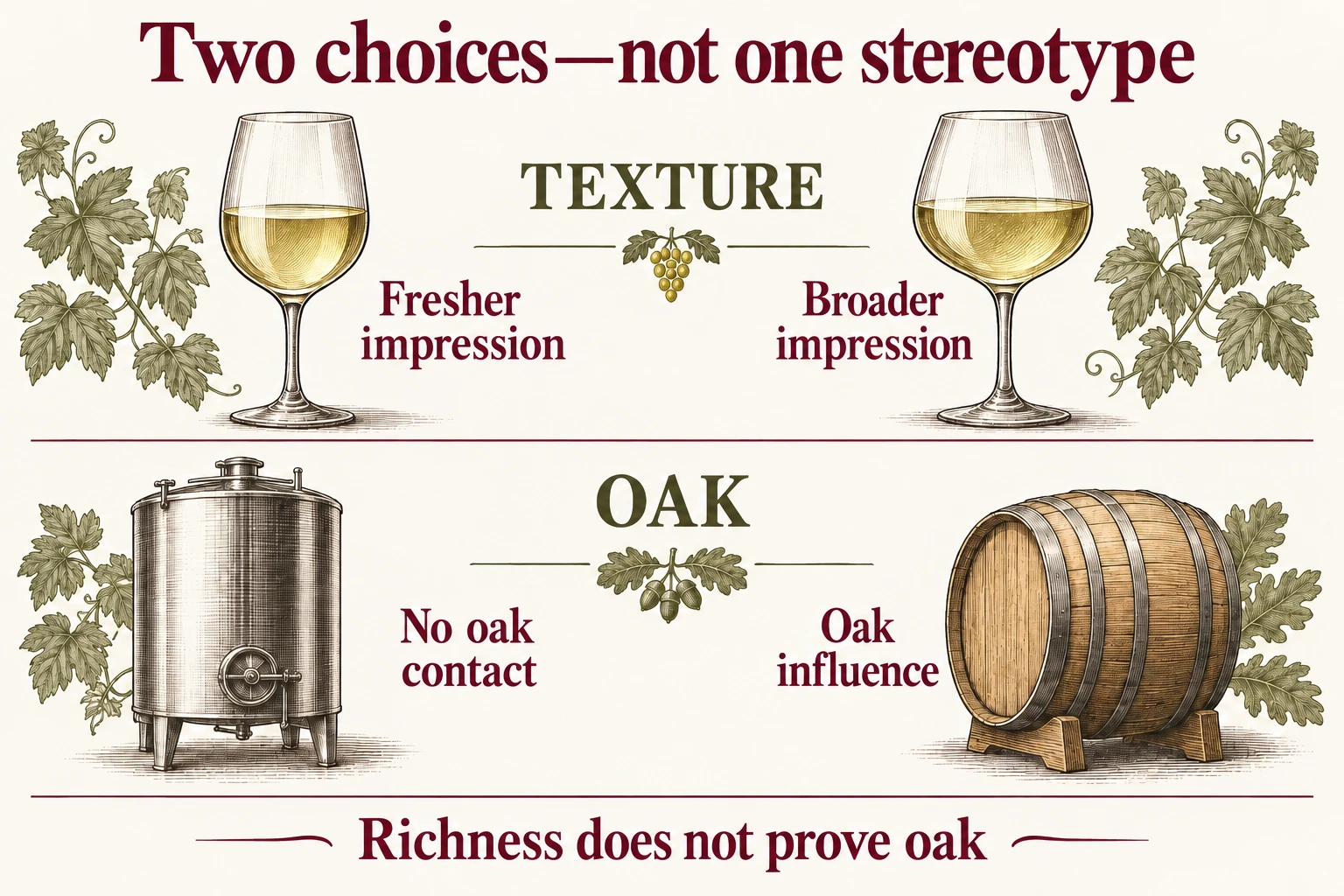
Read the illustration
First consider whether you prefer a fresher or broader impression. Separately consider whether you want oak-derived character. Verify the individual wine rather than assuming richness proves oak.
The Chardonnay compass has two useful axes: fresh to rich, and no oak vessel to evident oak influence. It resolves to a style, never directly to a product. The language in the middle is deliberately cautious because a producer’s decisions can move a wine away from a category stereotype.
| Compass point | What you may be seeking | Evidence to look for | Ask the retailer or producer for |
|---|---|---|---|
| Fresh · no oak vessel | Fruit and floral character without barrel-derived toast or vanilla | Stainless steel, concrete, or another clearly documented non-oak vessel | A documented unoaked Chardonnay |
| Fresh · subtle oak | Fruit first, with restrained wood influence | Specific barrel age, size, share, or maturation detail | A lightly oaked Chardonnay |
| Rich · restrained oak | A broader impression without making wood the main event | Vessel information plus lees and malolactic details when published | A rounded, moderately oak-influenced Chardonnay |
| Rich · evident oak | Toast, vanilla, or spice as an intentional part of the style | Barrel fermentation or maturation described by the producer | An oak-forward Chardonnay |
Separate oak from malolactic conversion
Oak describes contact with wood, while malolactic conversion is a separate microbial process that converts malic acid to lactic acid; diacetyl associated with that process can contribute buttery character. “Buttery” therefore does not prove an oak vessel, and “unoaked” does not prove that malolactic conversion was blocked. If either detail decides the purchase, use the dedicated best unoaked Chardonnay evidence guide and verify the producer’s current technical information.
Match the style to the plate and occasion
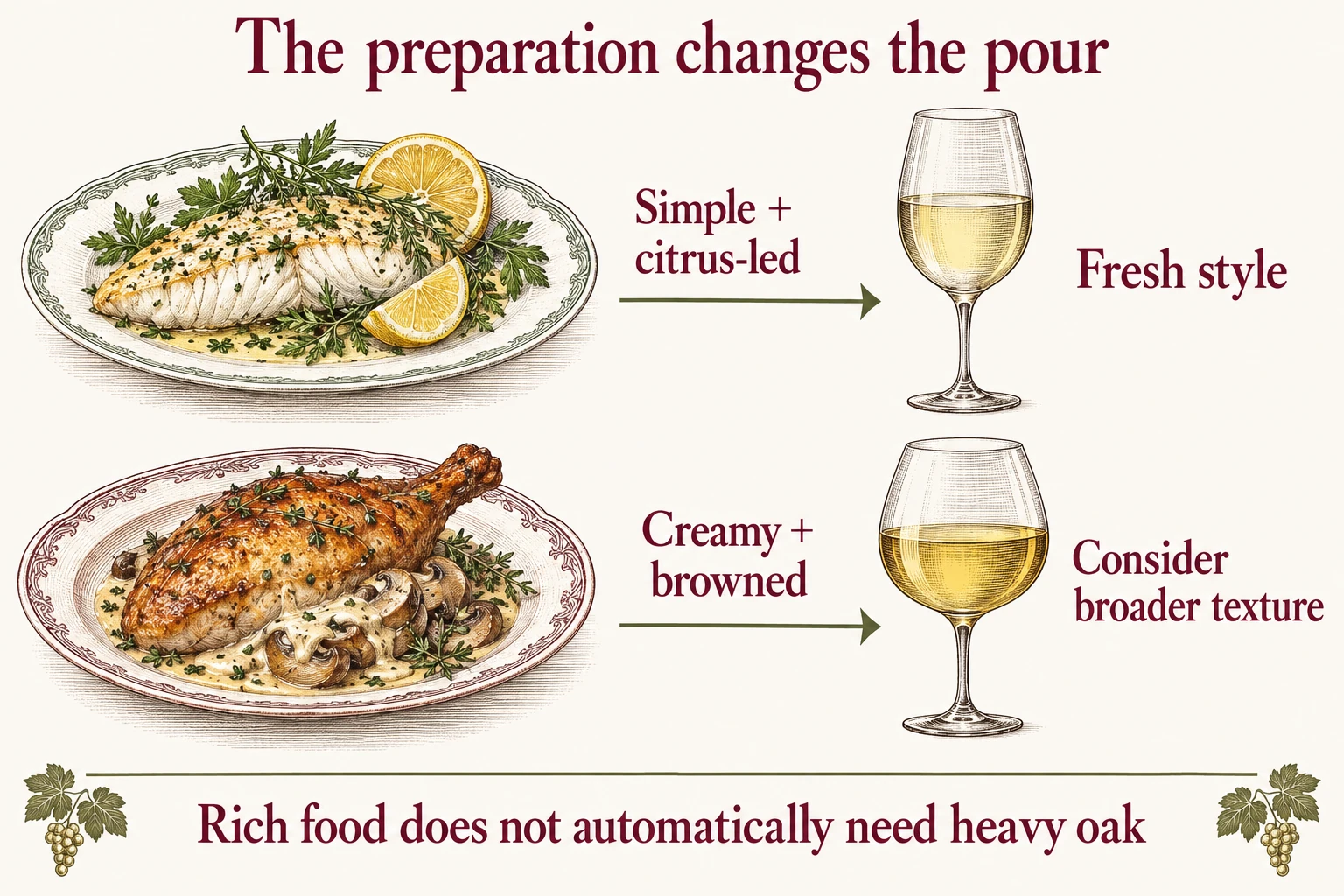
Read the illustration
Simple seafood and lemon-herb chicken can favor a fresh Chardonnay. Cream, browned flavors and richer preparations may call for a broader style. Rich food does not automatically require heavy oak.
Food matching is conditional. Preparation, sauce, seasoning, sweetness, and intensity can matter more than the name of the protein. The table below is a shortlist, not a promise that every wine in a category will behave identically.
| Table or occasion | What changes the decision | A sensible starting style |
|---|---|---|
| Seafood | Delicacy, smoke, butter, cream, citrus, and chile all pull differently | Fresh and no-oak for simple preparations; richer styles for buttery or creamy sauces |
| Chicken | Poached, grilled, fried, roasted, and cream-sauced chicken are different pairing jobs | Fresh for lighter preparations; restrained or evident oak when the dish is richer |
| Pasta | The sauce matters more than the noodle shape | Fresh for green or lighter cream sauces; richer for deeply roasted or fuller cream preparations |
| Vegetables | Char, sweetness, herbs, and dairy can outweigh the vegetable itself | Fresh to subtly oak-influenced, adjusted to seasoning |
| Soft cheese | Salt, richness, rind, and pungency vary widely | Fresh or rounded Chardonnay, tested against the particular cheese |
| Mixed gathering | One wine must avoid overwhelming lighter dishes | A fruit-led, restrained style is often the safer opening bottle |
Familia Morgan suggests seafood, chicken, creamy pasta, vegetables, and soft cheese with Nine Queens Chardonnay. That is a producer pairing opinion, not a scientific result. For a preparation-first decision, continue to wine with salmon or the sauce-first pasta guide.
What changes the answer at the shelf
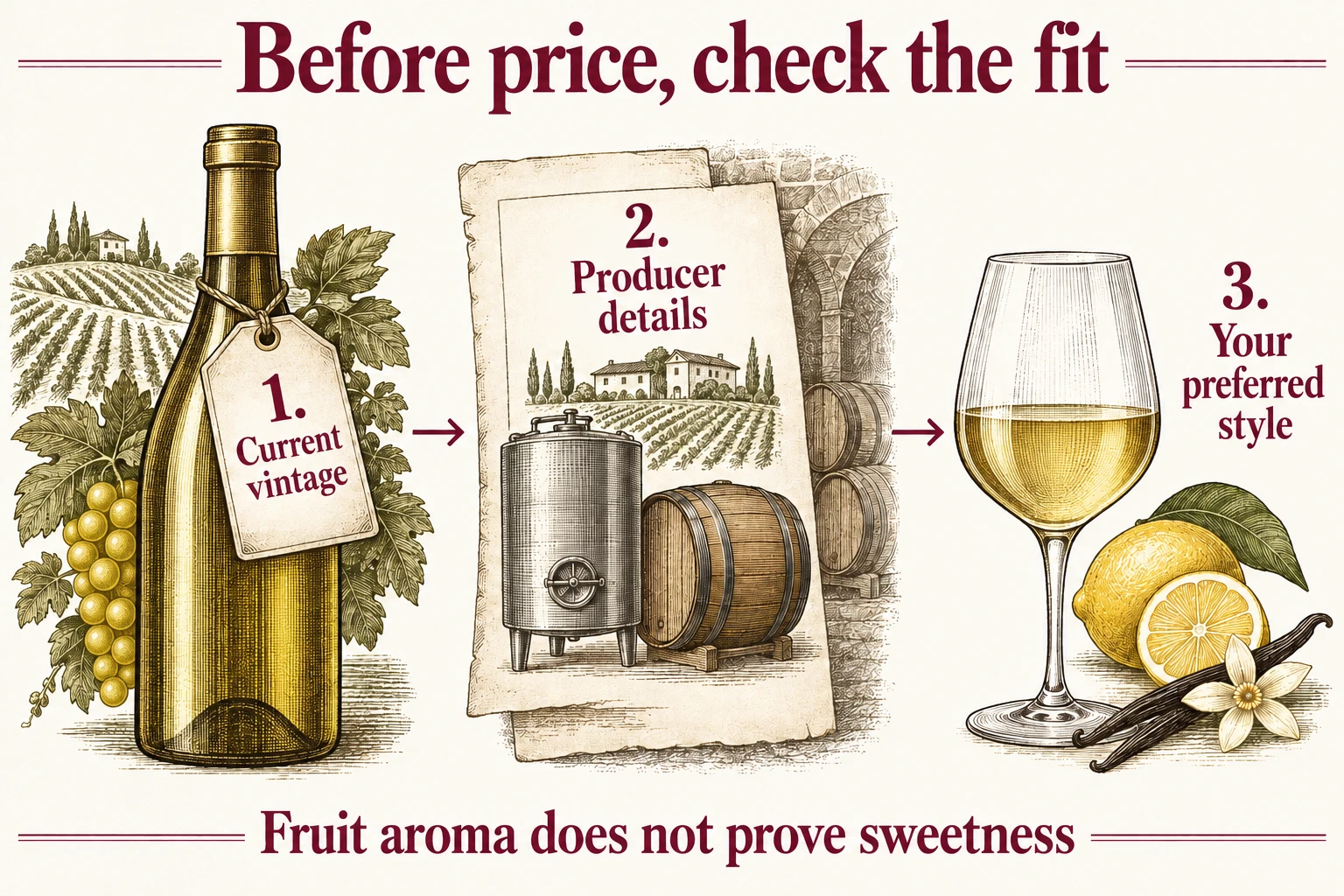
Read the illustration
Check the current vintage, producer vessel details and the style you actually enjoy before comparing price. Fruit aromas do not establish residual sugar.
The producer’s evidence. “Chardonnay” identifies the grape, not the vessel. A useful listing names the vintage, origin, and relevant cellar decisions. “Stainless steel” is stronger evidence than a retailer guessing “unoaked” from tasting language.
The current vintage. Do not silently transfer a note from one vintage to another. Weather, picking date, fermentation, and maturation choices can change.
The dominant flavor on the plate. Lemon and herbs, browned butter, cream, smoke, chile, and sweet glaze can each redirect the match. Choose for the finished dish rather than the uncooked ingredient.
Your own preference. If you routinely dislike vanilla or toast in white wine, popularity cannot turn an oak-forward bottle into the right purchase. If those characters are why you order Chardonnay, a stainless-steel bottle may disappoint.
Price and availability. Price can reflect farming, yield, maturation, packaging, scarcity, route to market, and positioning. It does not reveal the compass quadrant. Check the product evidence first and checkout terms last.
When to choose another Chardonnay style
Choose an oak-influenced Chardonnay from a producer that documents its cellar work if you specifically want toast, vanilla, baking spice, or barrel character. Choose a producer that publishes malolactic information if avoiding or seeking that process is non-negotiable. Choose a sweeter white style if the dish carries meaningful sweetness or chile heat and your usual dry wine feels harsher beside it. And choose sparkling, rosé, or red when the preparation points there; “Chardonnay night” is not a reason to force the grape onto an unsuitable plate.
That is the statement in this guide most likely to cost us a sale, and it belongs before the product recommendation.
Questions to ask before buying
Which Chardonnay style works for a mixed table?
A fruit-led, restrained Chardonnay is often a practical starting point when one bottle must sit beside several lighter dishes, but there is no universal mixed-table winner. If richer sauces, browned flavors, or a preference for toast and vanilla lead the meal, a broader, oak-influenced style may make more sense. Choose the style that creates the fewest conflicts across the actual menu.
Does fruit aroma mean a Chardonnay is sweet?
No. Citrus, stone-fruit, or tropical-fruit language describes aroma and flavor impressions, not residual sugar. Check an explicit sweetness statement when sweetness matters.
Is a higher price a better recommendation?
Not by itself. A costly oak-forward Chardonnay remains the wrong choice for someone seeking no barrel character. Style fit comes before the price comparison.
Can stainless-steel Chardonnay go with creamy food?
It can. The answer depends on the completed dish and the individual wine. Familia Morgan includes creamy pasta among its suggestions for Nine Queens Chardonnay, but a very rich, browned, or heavily seasoned sauce may point to a broader style.
Should I buy by region?
Region is useful context, not a complete flavor specification. Within one region, site and cellar choices can produce very different Chardonnay. Our Mendoza regions field guide explains why origin should begin better questions rather than end the decision.
Still deciding which white grape to buy?
Compare Chardonnay with Pinot Grigio when you want a lighter everyday white, Chardonnay with Sauvignon Blanc when aroma and freshness lead the choice, or Chardonnay with Riesling when sweetness and the food need closer attention. Each guide gives the other grape a genuine chance to be the better fit.
For two more directions, Chenin Blanc vs Chardonnay explains the sweetness and texture checks, while Viognier vs Chardonnay helps you choose between floral, stone-fruit perfume and the Chardonnay style you enjoy.
Sources and methodology
This guide separates verified Familia Morgan product facts, general wine principles, producer recommendations, and personal preference. We did not conduct a blind tasting, award scores, or rank third-party bottles.
- WSET, Behind the grape: Chardonnay in the US for Chardonnay’s stylistic range and the influence of climate and winemaking.
- WSET, winter food-and-wine matching principles for conditional guidance about intensity, fat, salt, acidity, and sweetness.
- AWRI, malolactic fermentation modulation fact sheet for the distinction between malolactic conversion, diacetyl, and oak.
- Wine Australia, Australian Wine Discovered: Chardonnay facilitator guide for its educator framework on leaner unoaked and richer oak-influenced Chardonnay styles and their food-pairing contexts.
Product facts were checked against Familia Morgan’s live product information on July 31, 2026. The check establishes a snapshot, not a promise of future inventory or terms.
Price, availability, shipping eligibility, taxes, and final terms are confirmed at checkout.