Buyer guide
The Best Wine With Salmon Follows the Preparation, Not the Fish
Salmon can be delicate, smoky, creamy, charred, or sweet-hot. The bottle should follow what happened in the pan and what is on the plate.
Research note: These are Familia Morgan's recommendations about wines Familia Morgan makes. This is not an independent blind tasting, a paid review, or a global ranking. Product facts were verified July 31, 2026.
The short answer: The best wine with salmon depends more on preparation and sauce than on the fish alone. A fresh, unoaked Chardonnay is a practical choice for baked, simply grilled, or citrus-herb salmon. Rich cream sauce can favor a fuller Chardonnay; smoke can favor sparkling or aromatic white wine; and a sweet-hot glaze can make an off-dry aromatic white the more forgiving choice.
Salmon has enough oil and flavor to work with more than one wine color. That is useful, but it also means that “white with fish” is not a complete buying rule. Browning adds intensity. Butter adds weight. Smoke changes the aroma. Soy contributes salt and umami. Sugar and chile can make the same bottle feel entirely different.
Use this guide in order: locate the preparation on the spectrum, check the sauce, then choose a wine style. The bottle recommendation comes later because a useful pairing answer should survive even if you buy from another producer.
Find your place on the salmon spectrum
The cuaderno-spectrum is a two-part check: first move from gentle cooking to smoke and char, then move from a light seasoning to a rich, sweet, or hot sauce. It resolves to a style of wine, not a brand.
Raw, gently baked, or lightly dressed poachedWith lemon, cucumber, herbs, and no rich sauce
Look for: fresh unoaked Chardonnay, dry sparkling wine, or a restrained dry rosé.
Roasted or pan-searedWith browned edges, herbs, or a savory glaze
Look for: a fuller white or a light, fresh red such as Pinot Noir.
Butter or cream sauceRichness is now the strongest part of the plate
Look for: fuller Chardonnay, often with some oak influence, or use a fresher white deliberately for contrast.
Smoked or heavily charredAroma and intensity move to the foreground
Look for: sparkling wine, an aromatic white, dry rosé, or light Pinot Noir rather than a delicate neutral white.
Sweet and spicy glazeHoney, maple, teriyaki, chile, or all four
Look for: an off-dry aromatic white when sweetness or heat is pronounced; a firm dry wine can feel harsher here.
This spectrum is intentionally not a scorecard. A diner who enjoys contrast may choose a brighter wine with a rich sauce; another may prefer to echo the sauce with a broader, creamier wine. Both can be sensible.
Why preparation changes the bottle
Salmon’s oiliness makes freshness useful because a lively-feeling sip can reset the palate. That does not prove that every salmon pairing needs the highest-acid wine available, nor does it support calling a particular bottle “high acid” without analysis. It is a general pairing principle, not a laboratory measurement of the wine in front of you.
Cooking method changes intensity. Poaching preserves a gentle texture and flavor. Roasting concentrates and browns. Grilling adds char. Hot smoking adds both smoke and a denser texture, while cold-smoked salmon brings salt and a pronounced cured character. The more intense the preparation becomes, the easier it is for a very delicate wine to disappear.
Sauce can matter even more. Salt often makes tannic dryness and bitterness feel softer, while umami can reduce the impression of fruit and make bitterness more noticeable. A sweet sauce can make a dry wine seem less fruity and more severe. Chile can emphasize alcohol and tannin. Those effects explain why a wine that works with lemon-herb salmon may struggle with sticky, hot teriyaki salmon.
If you want the grape background before choosing, read our guide to recommended Chardonnay by style and the focused guide to verifying an unoaked Chardonnay. For the red-wine branch, our Malbec and Pinot Noir comparison explains why Pinot is usually the lighter salmon option.
A preparation-by-preparation guide
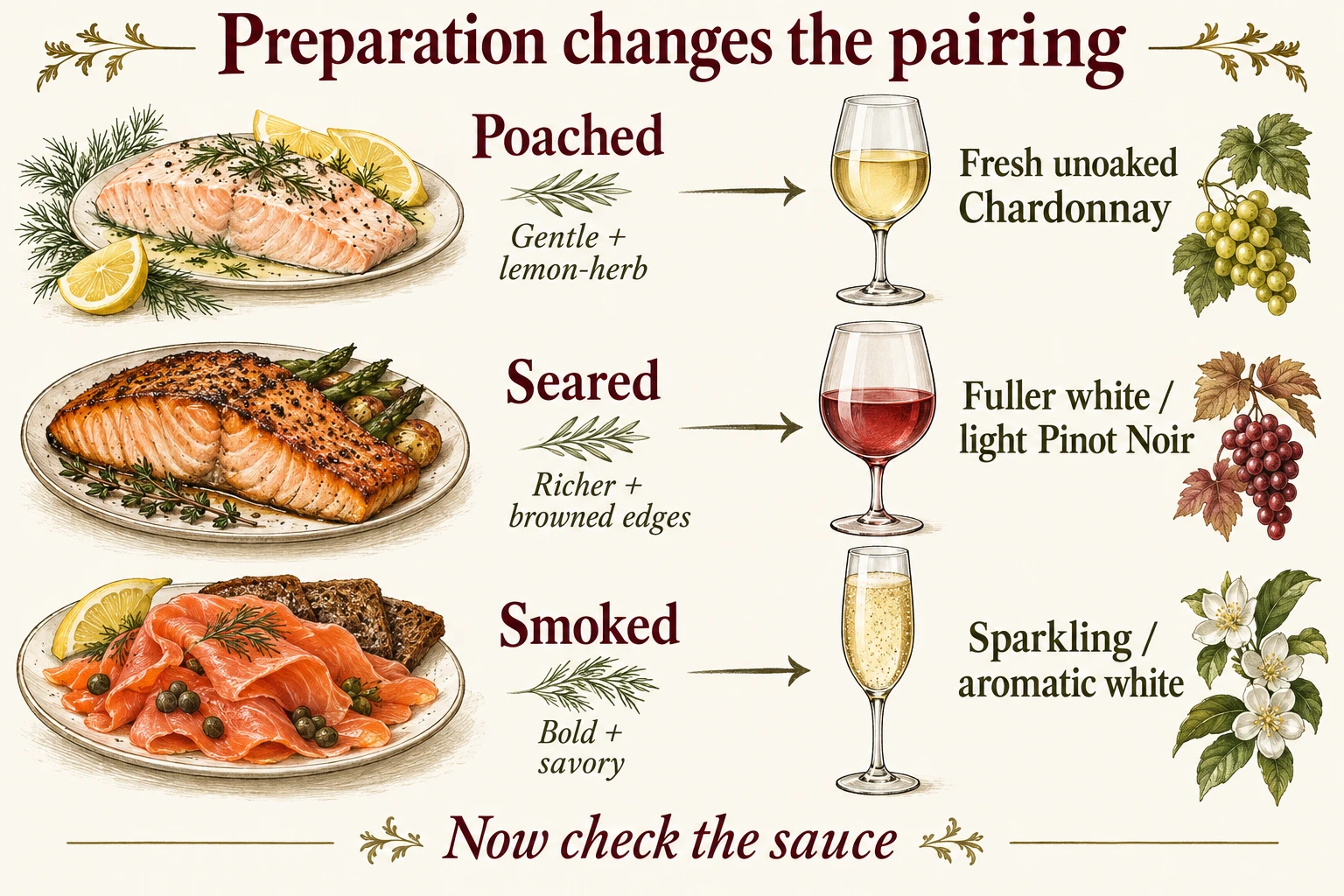
Read the illustration
Gentle lemon-herb salmon points to fresh unoaked Chardonnay; seared salmon to fuller white or light Pinot Noir; smoked salmon to sparkling wine or aromatic white. Sauce can override these starting choices.
Raw salmon, sashimi, and sushi
With plain sashimi, prioritize delicacy and freshness: dry sparkling wine, a restrained dry rosé, or a clean white can all work. Sushi is more complicated because rice seasoning, soy, wasabi, ginger, avocado, and spicy mayonnaise may be stronger than the fish. If the roll is sweet or hot, an off-dry aromatic white can be easier than a forceful dry red. Avoid using a tannic red as the automatic “serious” choice; soy and umami can make it taste more bitter.
Poached salmon
Poached salmon with lemon, dill, and no rich sauce can work with fresh unoaked Chardonnay. When beurre blanc or cream dominates, a broader or oak-influenced Chardonnay is often the better route. A fresh unoaked Chardonnay can still work as contrast in the second case, but it should be described as contrast rather than the only correct match.
Baked lemon-herb salmon
This is the clearest fit for a citrus- and fruit-led unoaked Chardonnay. Lemon, parsley, dill, tarragon, and a modest amount of olive oil leave room for a youthful white. Keep sweet glaze and aggressive chile out of this category: they change the sensory job. A simple sheet-pan salmon with vegetables is also a sound match, particularly when the vegetables are roasted rather than heavily caramelized with sugar.
Grilled or pan-seared salmon
Browning and char give the fish more intensity. A fuller white can meet that intensity, while a light Pinot Noir offers a red-wine route without making tannin the main event. For lightly grilled salmon with citrus and herbs, fresh unoaked Chardonnay remains reasonable. For deeply charred salmon with mushrooms or a dark savory glaze, move toward Pinot Noir or another light, fresh red.
Smoked salmon
Sparkling wine and aromatic white wine are often the more reliable choices because they can meet smoke, salt, and cured flavor without adding heavy tannin. A dry rosé can also work. We would not make a fresh unoaked Chardonnay our universal first recommendation here, especially for intensely smoked fish. If the smoking is light and the garnish is lemon-led, it may still be enjoyable, but that is a narrower case.
Sweet, soy-based, or spicy glaze
Treat sweetness, umami, and heat as three separate controls. Mild soy and ginger with no added sugar can work with a fresh white. A sticky maple, honey, or teriyaki glaze often favors a wine with some sweetness of its own. Add chile and the case for an off-dry Riesling or another aromatic off-dry white becomes stronger. Familia Morgan does not currently make that style, and recommending it may be more useful than forcing our Chardonnay into the wrong dinner.
What changes the answer
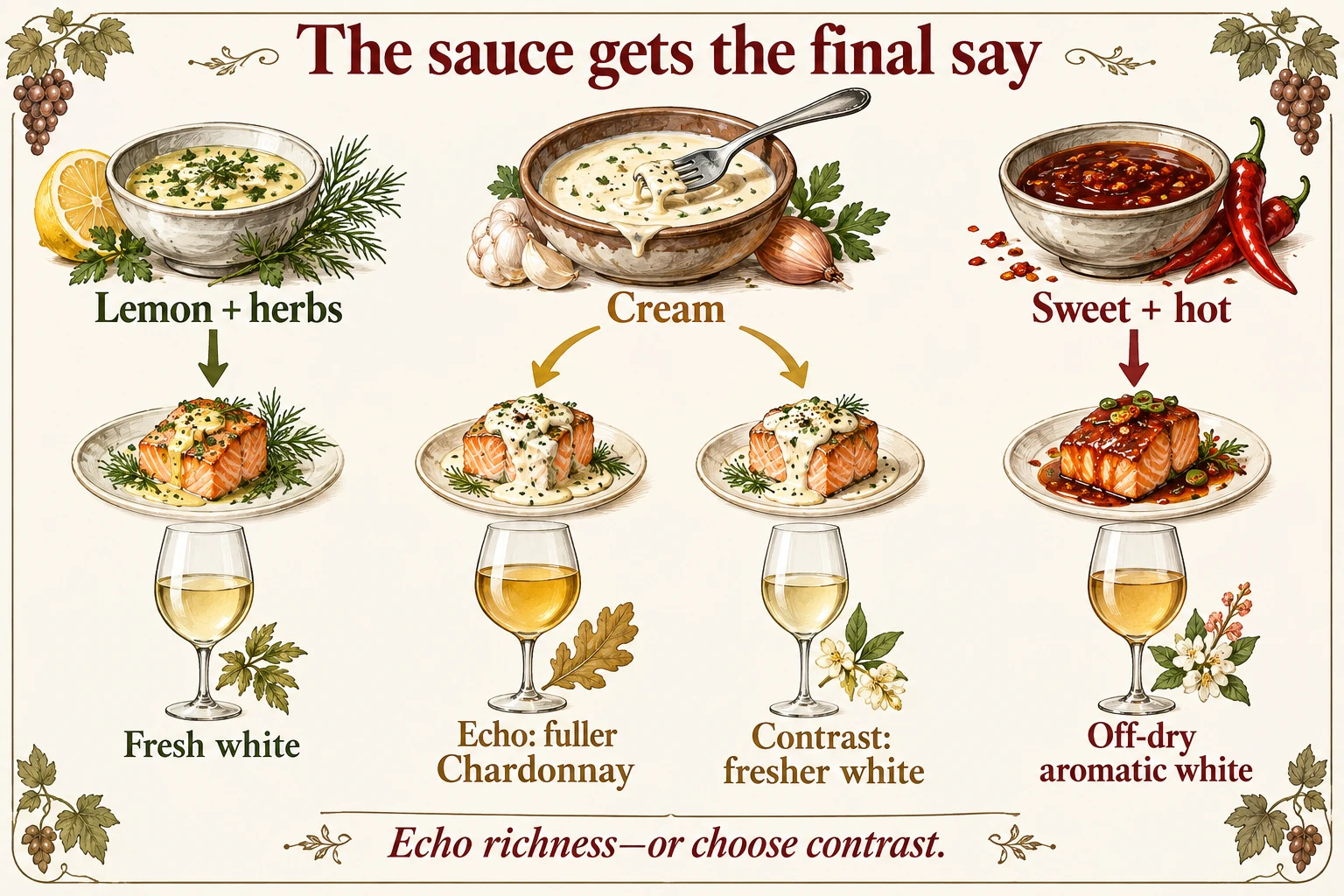
Read the illustration
Lemon and herbs favor freshness; cream can be echoed with fuller Chardonnay or contrasted with a fresh white; sweet-hot glaze favors off-dry aromatic white. There is no single best wine for every salmon dish.
Before buying, ask these four questions:
- What is the strongest flavor? It may be smoke, cream, soy, chile, or sugar rather than salmon.
- Is the wine meant to echo or contrast? A fuller Chardonnay can echo cream; a fresher white can cut across it.
- How intense is the browning? A pale poach and a hard sear are not the same pairing problem.
- What does the diner enjoy? A person who dislikes oak should not be pushed toward an oaked Chardonnay simply because it is conventional with cream sauce.
Serving temperature matters too. A white served painfully cold can hide aroma and texture; a light red served warm can feel heavier. Chill the wine, but allow it to show its character. Pairing is not a test with one correct paper—it is a controlled way to improve the odds of a satisfying glass.
When a fresh unoaked Chardonnay fits
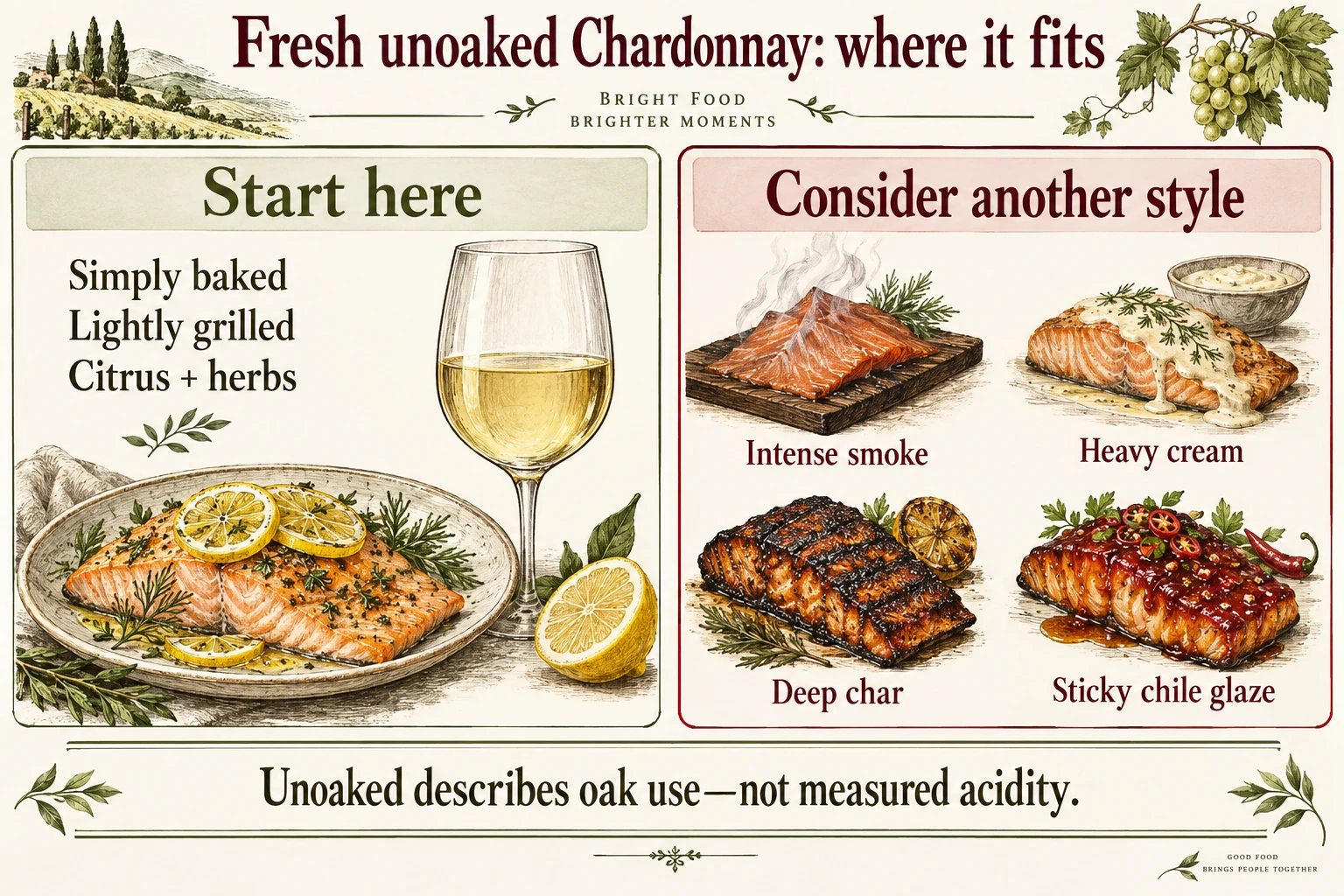
Read the illustration
Fresh unoaked Chardonnay is a starting point for simply baked, lightly grilled, or citrus-herb salmon. Intense smoke, heavy cream, deep char or sticky chile glaze may call for a different style. Unoaked describes oak use, not measured acidity.
Choose this route for simply baked, lightly grilled, poached lemon-herb, or vegetable-accompanied salmon without a very sweet, smoky, creamy, or hot sauce. The verified reason is stylistic: the producer says the 2024 Nine Queens Chardonnay was fermented in stainless steel and lists it as unoaked, with fresh citrus, white stone fruit, and floral notes. We do not turn those facts into an unsupported claim about measured acidity or universal superiority.
These are Familia Morgan’s recommendations about wines Familia Morgan makes. This is not an independent blind tasting, a paid review, or a global ranking.
Price, availability, shipping eligibility, taxes, and final terms are confirmed at checkout.
When this is not your bottle
Do not choose the Nine Queens Chardonnay merely because the main ingredient is fish. It is not our first call for intensely smoked salmon, a heavy cream sauce when you want a matching rich texture, deeply charred salmon with earthy accompaniments, or a sticky chile glaze. Sparkling wine, fuller oaked Chardonnay, light Pinot Noir, or off-dry Riesling may serve those plates better. We do not currently make several of those styles.
That boundary is part of the recommendation. A useful producer guide should help a reader leave without buying when the product does not fit.
Related decisions
- Choosing Chardonnay for other meals? Start with the style-first Chardonnay buyer guide.
- Want to distinguish cellar technique from flavor assumptions? Read how wine is made.
- Considering red wine with salmon? Compare Malbec with Pinot Noir before reaching for a structured red.
- Planning the whole table? The Argentine wine guide provides broader varietal and region context.
Questions buyers ask
Is Chardonnay always the best wine with salmon?
No. Chardonnay is versatile, but sparkling wine, dry rosé, aromatic white wine, and light Pinot Noir can all be better depending on smoke, sauce, sweetness, heat, and personal taste.
Can red wine work with salmon?
Yes. A light, fresh red with modest tannic impact—Pinot Noir is the common example—can suit grilled or seared salmon. A forceful tannic red is harder with delicate fish and umami-rich sauces.
Does unoaked Chardonnay mean high acidity?
No. “Unoaked” describes the absence of oak influence; it does not by itself prove acidity, dryness, alcohol, or malolactic-conversion choices. Check the producer’s technical information rather than inferring all of those traits from the vessel.
Should I cook with the same wine?
Only if the recipe calls for wine and the style makes sense. Use a sound wine you would be willing to drink, but there is no requirement to pour an expensive bottle into the pan. The drinking wine can be chosen after the finished sauce is tasted.
Sources and methodology
This guide was checked against primary wine-education and industry material, then narrowed to the live product facts Familia Morgan can verify. Pairing statements are principles and informed recommendations, not chemical guarantees or universal rankings.
- WSET, guide to Easter food and wine pairings, for preparation, richness, and fish-pairing context.
- WSET, pairing wine with takeaway meals, for umami and its possible effect on fruit, bitterness, and tannic sensations.
- WSET, food and wine matching principles, for salt, fat, sweetness, acidity, and balance.
- Wine Australia, Chardonnay facilitator guide, for lean unoaked and richer oak-influenced Chardonnay styles, including fish and cream pairing guidance.
- Familia Morgan’s live Shopify product information for the 2024 Nine Queens Chardonnay, verified July 31, 2026. Product details and final checkout terms can change.