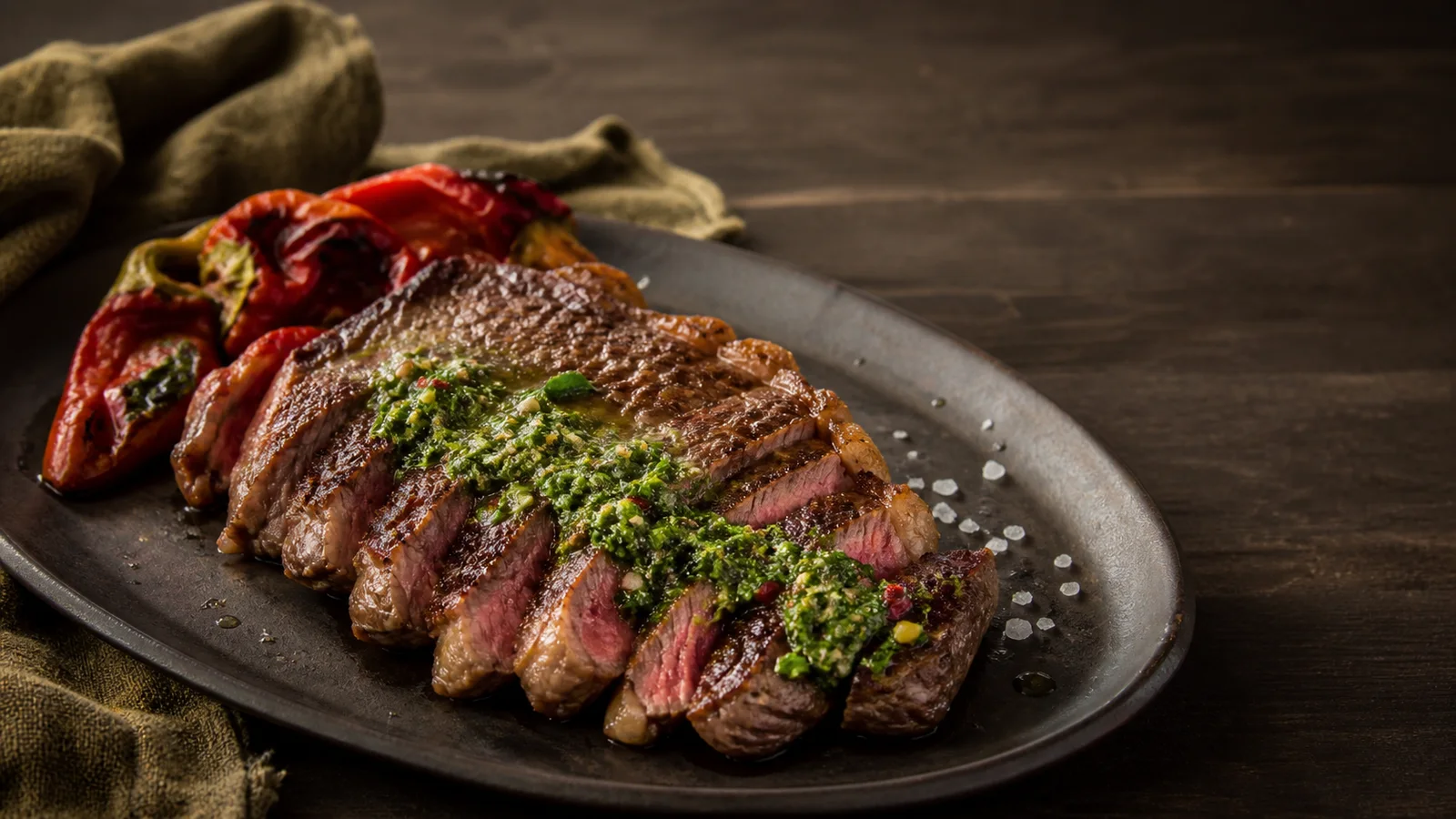
Argentine Steak with Chimichurri (Grill or Pan)
Answer first: this plated recipe uses two intact, boneless New York strip steaks, each 12 ounces and 1¼ inches thick. Cook them over a two-zone grill or one at a time in cast iron, verify 145°F (62.8°C) before removing them from the heat, rest at least three minutes, slice across the grain, and add clean chimichurri only after cooking.
This page owns the complete plate. The sauce page owns the chimichurri formula, so it is not recopied here. The steak pairing guide owns the broad wine logic, while the pairing tool returns a starting point based on a single steak setup. This recipe owns cut, thickness, heat, sauce separation, slicing, and storage.
Why this cut and thickness
Argentina’s tourism authority uses bife de chorizo for a strip-loin steak, and Argentina’s beef-cut institute documents the cut within its own national system. A U.S. New York strip is a useful, widely sold home starting point, but it is not a one-to-one translation of every steak sold under the Argentine name. Butchery specifications, exterior fat, aging, and steak shape vary.
This recipe does not silently change cuts or thickness. A one-inch sirloin, a two-inch ribeye, and a 1¼-inch strip do not share a reliable clock. If your steak differs from the stated specification, use the same heat logic but expect the timing to change.
Grill or cast iron at a glance
Live fire · two zones
Grill
Build a hot side for crust and a cooler side for control. Brown both faces first, then move the steak when the exterior is ready before the center is.
Planning range: 10-16 minutesIndoor · heavy pan
Cast iron
Use one dry steak at a time so the pan stays hot. Sear, reduce the heat if the fond blackens, and turn more frequently as the center approaches its endpoint.
Planning range: 8-12 minutes eachFuel, pan, steak shape, and starting temperature all change the clock. The ranges organize dinner; they do not certify doneness. USDA notes that appliances and outdoor grills vary, and its own time charts are approximate. The thermometer reading in the geometric center is the decision.
Thermometer placement and carryover
For a steak this size, insert the probe sideways so the sensing area reaches the center. Avoid the exterior fat cap, pan, bone, and very edge. If the strip is tapered, check the thick and thin sections rather than trusting one convenient spot.
Carryover is variable. Steak mass, crust temperature, grill intensity, pan material, and rest conditions affect what happens after cooking. Carryover may hold or raise the center temperature, but it is not a fixed five-degree coupon. Because USDA specifies the minimum before removal, do not subtract a fixed number of degrees from 145°F.
Keep the chimichurri clean and cold
Reserve the table portion first. Measure sauce into a clean bowl before raw beef leaves the refrigerator. Keep it covered and cold.
Use separate utensils. A spoon or brush that touches raw steak cannot return to the clean sauce.
Store conservatively. Refrigerate at 40°F or below and use within four days; do not treat an untested home sauce as shelf-stable.
The linked chimichurri recipe supplies the measured sauce. This plate adds a stricter service rule because raw meat and ready-to-eat sauce occupy the same workspace. The National Center for Home Food Preservation advises that homemade garlic-in-oil mixtures be refrigerated at 40°F or below and used within four days. Chimichurri includes vinegar, but this home batch has not been laboratory-tested to prove a shelf-stable pH.
How to serve the plate
Slice only after the three-minute minimum rest, and cut across the visible grain. Lay the pieces on a warm—not raw-meat—platter, add peppers, and spoon sauce over only the portion that will be eaten. Put the remaining clean sauce on the table so each diner controls the amount.
For a sharper second condiment, add salsa criolla. For a larger menu, the Argentine asado wine-pairing guide handles the progression from first bites to main cuts, while the asado glossary entry keeps the concise cultural definition.
A restrained wine starting point
Malbec can be a useful start because the steak has enough weight for a structured red, while chimichurri’s herbs and vinegar often favor freshness over heavy oak. It is not the only answer. The exact cut, char, sauce amount, producer style, and your sensitivity to tannin all matter.
Use the best wine with steak guide for the decision logic or the steak pairing tool for a starting point you can compare against the finished plate. The Malbec guide and Argentine wine guide explain how region and producer choices can change the glass.
Sources and methodology
This is a fixed-specification home recipe assembled from current food-safety guidance, official Argentine cut and food context, and method-specific planning ranges. Timing is deliberately subordinate to measured center temperature.
- USDA FSIS, Safe Minimum Internal Temperature Chart, for 145°F before removal and the three-minute whole-steak rest.
- USDA FSIS, Grilling Food Safely, for raw/cooked separation, thermometer use, approximate timing limits, hot-weather holding, and leftovers.
- USDA FSIS, Food Thermometers, for center placement, sideways insertion in thinner foods, probe care, and accuracy limits.
- USDA FSIS, Beef From Farm to Table, for whole-steak safety, approximate beef timing, refrigerated storage, and 165°F reheating.
- Beef Checkoff, Skillet Cooking Time Guidelines, for a published strip-steak skillet range used only as a planning cross-check, never as the doneness decision.
- National Center for Home Food Preservation, Freezing Garlic-in-Oil, for the conservative four-day refrigerated limit applied to the fresh garlic-and-oil sauce.
- Visit Argentina, Asado: A Guide to Experience the Most Delicious Ritual, for bife de chorizo, chimichurri, and Argentine grill context.
- IPCVA / Argentine Beef, cut nomenclature and bife de chorizo grill context, for Argentine cut naming without claiming a universal U.S. equivalent.
Ingredients
- 2 boneless New York strip steaks, 12 ounces (340 g) each and 1 1/4 inches (3.2 cm) thick, intact rather than mechanically tenderized
- 2 teaspoons (6 g) Diamond Crystal kosher salt, or 1 teaspoon (6 g) fine salt, for the steaks
- 1 teaspoon (2 g) freshly ground black pepper
- 2 teaspoons (10 ml) neutral high-heat oil, such as avocado, grapeseed, or canola, for the steaks
- 2 large red bell peppers (about 12 ounces / 340 g total), cored and quartered lengthwise
- 2 teaspoons (10 ml) olive or neutral oil, for the peppers
- 1/2 teaspoon (1.5 g) Diamond Crystal kosher salt, or 1/4 teaspoon fine salt, for the peppers
- 1/2 cup (120 ml) prepared chimichurri, made from the separate chimichurri recipe, kept refrigerated until plating
Directions
- Stage the clean sauce. Make the chimichurri from its linked recipe. Measure 1/2 cup into a clean serving bowl, cover, and refrigerate it. This bowl never touches raw beef, a raw-meat brush, or raw-meat utensils. Keep the source batch refrigerated too.
- Prepare the fixed-size plate. Keep the steaks refrigerated until the grill or skillet is nearly ready. Do not rinse them. Pat them dry with paper towels, then season both sides with the 2 teaspoons steak salt and black pepper. Toss the pepper quarters in their 2 teaspoons oil and 1/2 teaspoon salt on a separate clean tray.
- Grill method. Prepare a two-zone grill: preheat one side of a covered gas grill to about 425-450°F (218-232°C) on its gauge, or bank hot coals to make direct and cooler zones. Clean and oil the grate. Grill the peppers, turning, until browned and tender, about 8-12 minutes. Put the steaks over direct heat for 3-4 minutes, turn with clean tongs, and cook 3-4 minutes more. Move them to the cooler zone when the crust is dark enough, then turn every 1-2 minutes until a food thermometer reaches 145°F (62.8°C) before removing. For the stated steaks, 10-16 minutes total is an approximate range, not a doneness test.
- Cast-iron method. Broil the oiled peppers on a rimmed sheet pan 4-6 inches from the element, turning once, until browned and tender, about 8-12 minutes. Meanwhile, heat a 12-inch cast-iron skillet over medium-high for 3-5 minutes. Rub each steak with 1 teaspoon high-heat oil. Sear one steak at a time so the pan is not crowded, 3-4 minutes on the first side and 3 minutes on the second; reduce to medium if the fond blackens, then turn every minute until the center reaches 145°F (62.8°C) before removing. Eight to 12 minutes per steak is an approximate range; thermometer temperature decides.
- Check the actual center. Move the steak to a clean spatula or plate, then insert an instant-read thermometer sideways into the center of the thickest section, avoiding the exterior fat strip. Check more than one place. Wash the probe with hot, soapy water after every use. Color, crust, and elapsed time cannot verify safety.
- Rest before slicing. Transfer safely cooked steaks to a clean platter and give them at least a three-minute rest before carving. Carryover heat may hold or raise the temperature, but USDA guidance requires 145°F before removing the steaks from heat, so do not subtract a fixed number of degrees or pull them early.
- Slice and finish the complete plate. Slice the steaks across the visible grain into 1/2-inch pieces. Arrange with the peppers, then spoon some of the refrigerated clean chimichurri over the sliced beef and pass the rest at the table. Discard any sauce that contacted raw beef, its tray, brush, or utensils.
Wine Pairing
A fresh, moderately structured Malbec is one starting point rather than a universal answer: strip steak supplies weight, while chimichurri favors freshness over heavy oak. Availability and shipping eligibility are confirmed at checkout.
Serving Ideas
Serve one-half steak per person with the blistered peppers and sauce passed separately. Add salsa criolla, a crisp green salad, or simple potatoes when the table needs more acidity or starch. For a longer gathering, use the asado wine and service guide rather than treating this single plate as the whole asado.
Storage
Move steak and peppers into separate shallow containers and refrigerate within 2 hours, or within 1 hour above 90°F (32.2°C). Keep them at 40°F (4.4°C) or below and use within 3-4 days; reheat leftovers to 165°F (73.9°C). Store clean chimichurri separately at 40°F or below and use it within 4 days. A home mixture containing fresh garlic and herbs in oil is not shelf-stable or a canning recipe. Discard any sauce exposed to raw-meat juices.
The repeatable result comes from fixing the cut and thickness, giving the steak enough dry heat for a crust, and letting a thermometer—not the hero photo—decide when it leaves the heat. For the bottle decision, continue to the steak pairing guide or compare your variables in the steak pairing tool.
Editorial image created for this recipe; it shows the intended sliced steak, chimichurri, and pepper plating, not a doneness reference.