Buyer guide
Best Red Wine for Beef Stew: Cooking & Pairing
The bottle that seasons a long braise and the bottle you want to drink with dinner have different jobs. Solve them separately.
Research note: These are Familia Morgan's recommendations about wines Familia Morgan makes. This is not an independent blind tasting, a paid review, or a global ranking. Product facts were verified July 31, 2026.
For cooking beef stew, start with a sound, inexpensive dry red: Merlot for a round, fruit-led gravy, Pinot Noir for a Bourguignon-style recipe, or Sangiovese for tomato and herbs. These are starting points, not requirements; follow the recipe and avoid a heavily oaked or very tannic bottle that overwhelms the sauce.
The best red wine with beef stew in the glass depends on the finished sauce, including its richness, mushrooms, smoke, sweetness, and chile. You do not need the same bottle for both jobs. Our 2020 Unoaked Malbec is a drinking recommendation for the finished dish, not a cooking ingredient.
Separate the wine for the pot from the wine for the glass
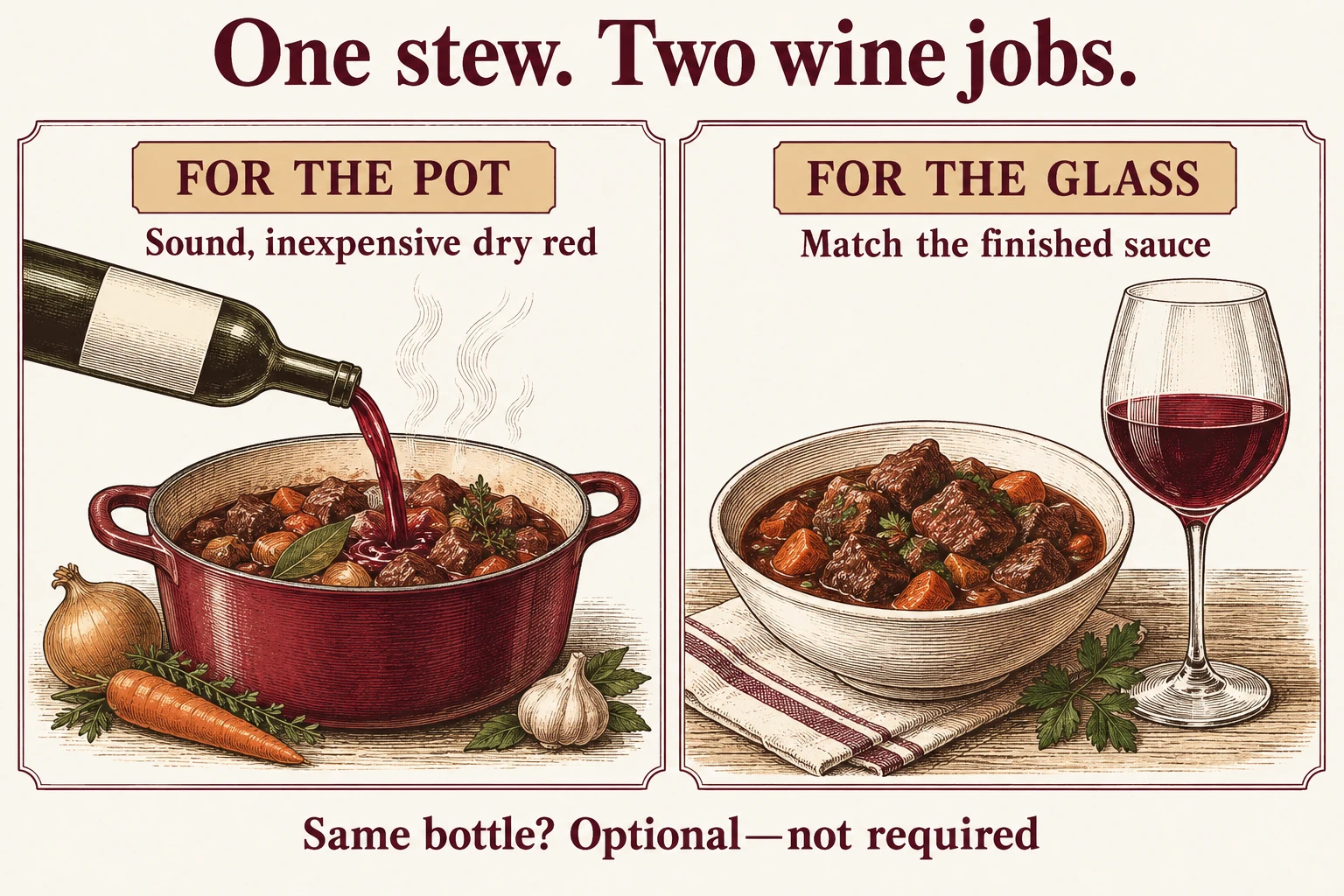
Read the illustration
For the pot, choose a sound inexpensive dry red suited to the recipe. For the glass, match the finished sauce. The same bottle is optional, not required.
The common search question hides two decisions. Cooking wine becomes one ingredient among stock, aromatics, vegetables, and meat. Drinking wine must remain enjoyable after a bite of the completed stew. Buying one bottle for both jobs is convenient, but it is not a quality requirement.
| Decision | Job | Buy for | Avoid | Practical answer |
|---|---|---|---|---|
| For the pot | Season and deepen the braising liquid | A sound, inexpensive dry red with enough fruit and freshness for the recipe | Faulted wine, accidental sweetness, or a style that overwhelms the sauce | Use a modest bottle you would accept in a simple glass; there is no need to sacrifice a special bottle. |
| For the glass | Refresh the palate and stay expressive beside the finished stew | A style matched to gravy, tomato, mushroom, smoke, sweetness, and chile | Choosing from the word beef alone | Taste the completed sauce, then choose the bottle you actually want to drink. |
“Cook only with wine you would drink” is useful if it means do not cook with spoiled or faulted wine. It becomes wasteful when interpreted as “buy the same premium bottle for the pot.” A clean, straightforward dry red can perform the cooking job. Save the bottle chosen for aroma, texture, and pleasure for the table.
Choose a sound, inexpensive dry red for the pot
A practical cooking red should be dry, clean-smelling, and compatible with the recipe. Merlot, Malbec, Sangiovese, Côtes-du-Rhône-style blends, or another straightforward red can work. Grape name is less important than condition and balance. Avoid a bottle with cork-taint aromas, stale oxidation, or an unpleasant volatile character; long cooking may concentrate rather than repair faults.
Think about the sauce before pouring
For a classic brown gravy, a round, fruit-present dry red is a forgiving choice. A tomato-and-herb stew can welcome a fresher-feeling red that does not disappear beside the tomato. A mushroom-heavy version benefits from savory compatibility, while a smoky or chile-led stew needs restraint: reducing a hot, heavily oaked, or very tannic wine may intensify qualities you did not want.
Add wine after browning the meat and aromatics, use it to loosen the flavorful browned layer, and let harsh raw-wine aromas settle before adding the rest of the liquid. Exact quantity and reduction time belong to the recipe; more wine does not automatically produce more complexity.
Cooking reduces alcohol, but does not promise zero
Heat and time can reduce the alcohol retained in a dish, but method, duration, vessel, and when wine is added all matter. Cooking does not guarantee that all alcohol disappears. The USDA’s retention tables report retention factors for different cooking methods and times, which is why a universal “it all cooks off” statement is inaccurate.
If a diner needs to avoid alcohol, do not rely on simmering as a guarantee. Replace the wine with unsalted stock or water, then rebuild brightness carefully with tomato, verjus, or a small amount of suitable vinegar according to the recipe. That substitute will not taste identical, but it makes the boundary explicit.
Match the glass to the finished stew
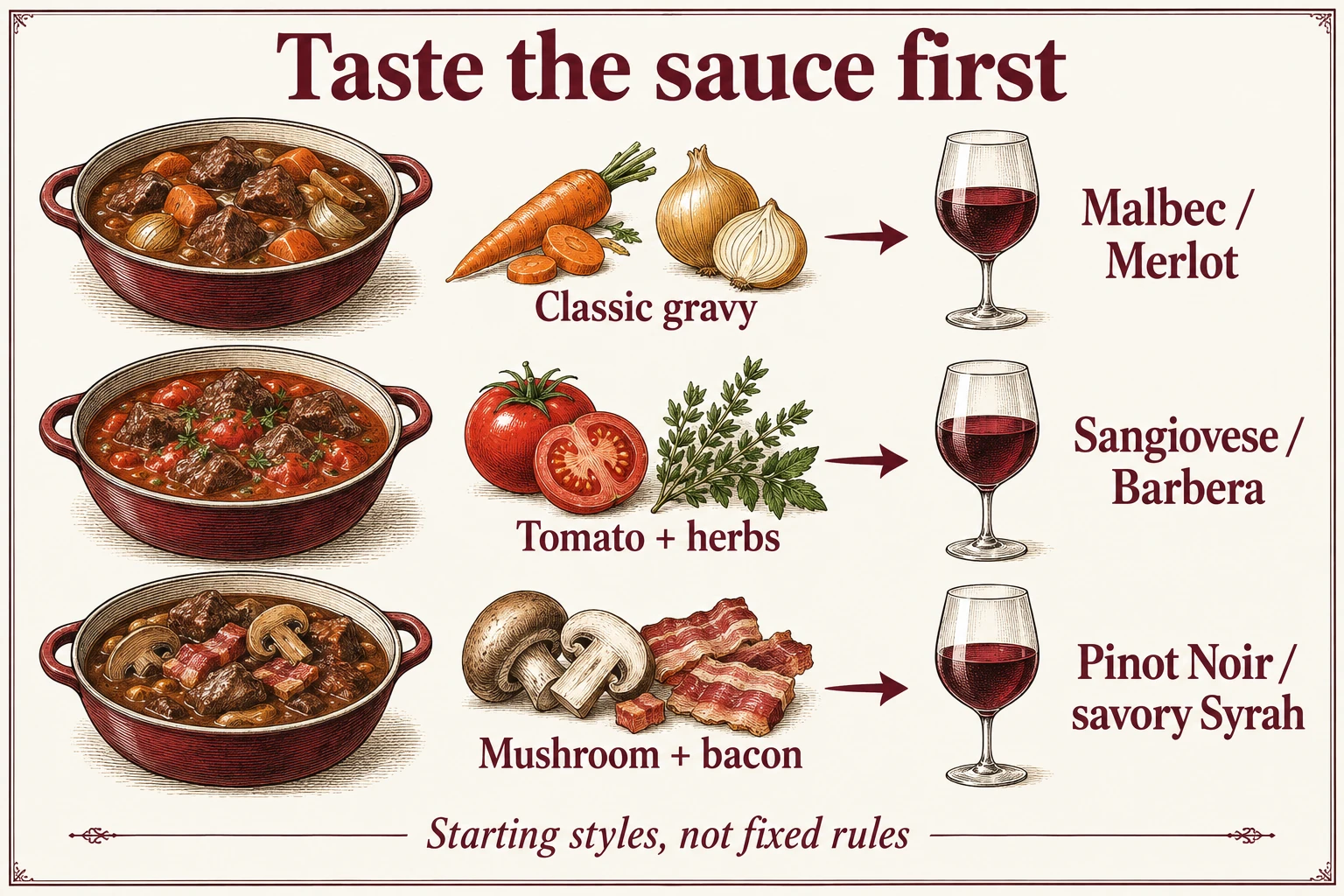
Read the illustration
Classic gravy can suit Malbec or Merlot; tomato and herbs can suit Sangiovese or Barbera; mushroom and bacon can suit Pinot Noir or savory Syrah. These are style starting points.
The final sauce is better evidence than the raw ingredient list. Taste it when it is close to finished, then use these style routes.
| Finished stew | What the dish emphasizes | Red-wine starting point | When another direction may be better |
|---|---|---|---|
| Classic brown gravy | Beef, stock, onion, root vegetables | Fruit-present Malbec, Merlot, or balanced red blend | A very delicate stew may favor a lighter red |
| Tomato and herbs | Acidity, oregano, thyme, or rosemary | Sangiovese, Barbera, fresh Malbec, or another lively dry red | Avoid a wine that seems flat after tasting the tomato-rich sauce |
| Mushroom and bacon | Umami, smoke, salt | Pinot Noir, savory Syrah, fresh Malbec, or restrained blend | Strong umami can reduce perceived fruit and emphasize drying sensations |
| Smoky or chile-spiced | Smoke, warmth, possible sweetness | Juicy, lower-tannin red; serve slightly cool | If chile dominates, rosé or an off-dry aromatic white can be more comfortable than red |
| Bourguignon-style | Wine-rich gravy, mushrooms, bacon, herbs | Pinot Noir is traditional; supple Malbec or another balanced red can work | Tradition does not require an expensive Burgundy or the same wine in pot and glass |
Classic gravy
Beef, stock, onion, and root vegetables create depth without necessarily adding much sweetness or acidity. A fruit-present red with moderate structural impact is usually easier than an austere bottle. Malbec can work well, but so can Merlot or a balanced blend. Use the Malbec guide to separate fresh, unoaked expressions from darker, oak-shaped versions.
Tomato and herb
Tomato can make a wine with insufficient freshness seem flat. Look for a dry red that remains lively beside the sauce rather than simply choosing the biggest body. Sangiovese and Barbera are classic style directions; fresh Malbec can also make sense. This is a sensory starting point, not a measured acidity claim about every bottle.
Mushroom and bacon
Mushrooms, slow-cooked stock, and bacon add umami, salt, and sometimes smoke. Umami can reduce perceived fruit and increase perceived bitterness or tannic dryness. A savory Pinot Noir or Syrah can be compelling. A fresh-fruited Malbec can retain contrast, especially if the stew is not heavily smoked.
Smoky or spicy stew
Chile heat can increase the impression of alcohol and tannic harshness. If the dish is fiery, a powerful dry red may make both the food and wine feel hotter. Choose a juicier, less tannic red, or leave the red-wine category altogether for an off-dry aromatic white or rosé. That is an honest answer even on a page about red wine.
Bourguignon-style stew
Pinot Noir is the historical reference, but the dish does not require a prestigious bottle. Mushrooms, bacon, onions, and a wine-rich sauce can also work with supple Malbec or another balanced red. Use one modest dry red for cooking and, if desired, a different bottle for drinking. “Same grape” is an option, not a rule.
What changes the answer
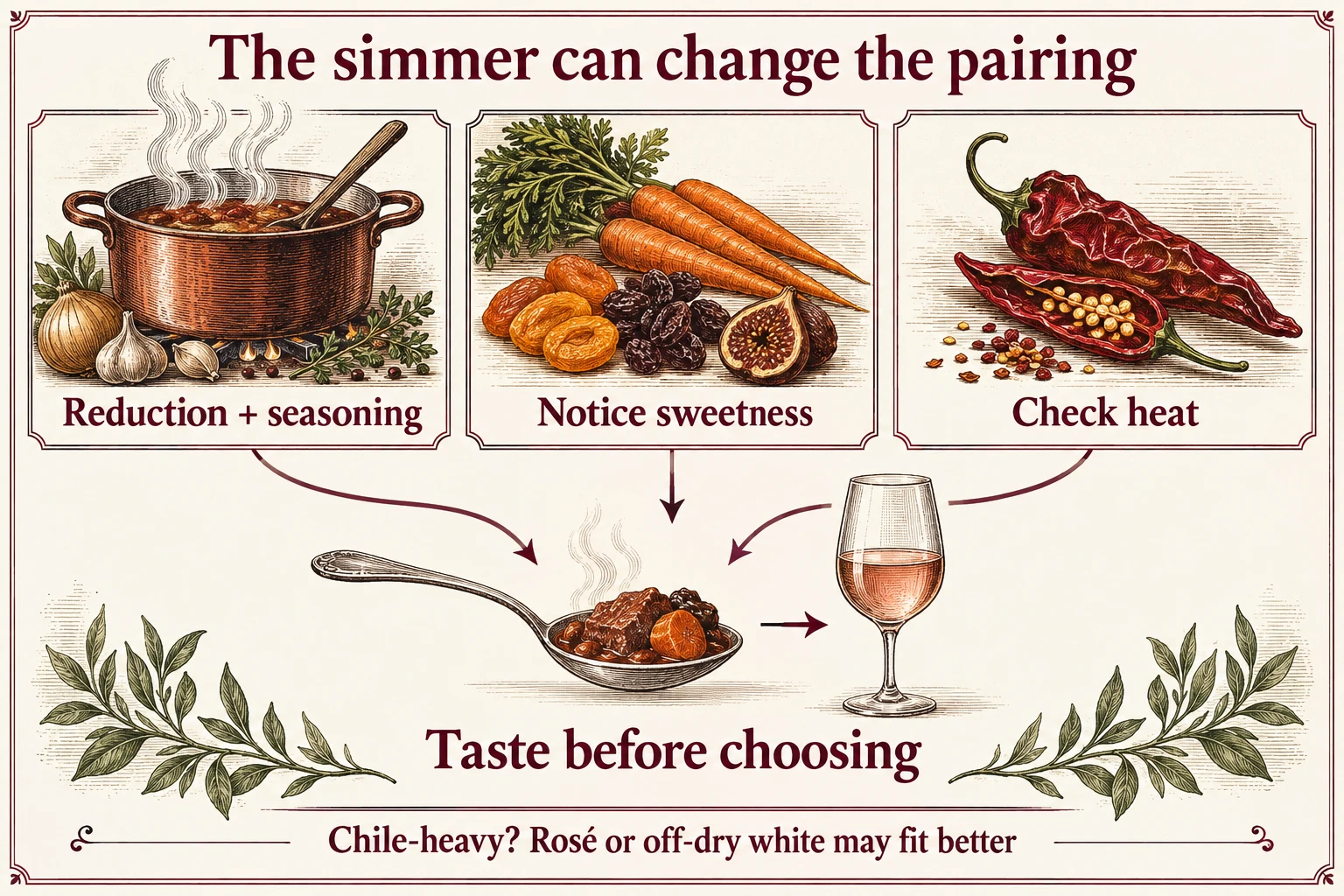
Read the illustration
Reduction, final seasoning, sweetness and chile can change the pairing. Taste the finished stew before choosing the wine; a chile-hot stew need not be paired with red.
Four final details can move the recommendation:
- Salt and reduction. A stew becomes more concentrated as it cooks. Make the final wine decision after adjusting seasoning, not at the beginning.
- Sweet vegetables or glaze. Carrots, caramelized onions, dried fruit, or sweet sauce can make a dry wine seem less fruity and more severe.
- Umami. Mushrooms, long-cooked stock, and cured meat can make bitterness and drying sensations more noticeable in some pairings.
- Chile and serving temperature. High heat can emphasize alcohol. A slightly cool, fruit-present red can feel more comfortable, but an off-dry white may still be the better answer.
When the Unoaked Malbec is not your bottle
Choose something else when heat or sweetness leads. A chile-heavy stew can make a dry red’s alcohol and tannic sensations feel more forceful. A tagine-like beef stew with dried fruit may make a dry red seem less fruity. In either case, a supple low-tannin red, dry rosé, or off-dry aromatic white may work better. We would rather identify that mismatch than turn every stew into a reason to buy our Malbec.
The Unoaked Malbec is also not a claim that oak is wrong with stew. A darker, oak-matured red can suit a deeply browned, smoky, or reduced preparation. “Unoaked” tells you about maturation, not automatic lightness, acidity, quality, sweetness, or alcohol. Choose the bottle whose verified style fits the sauce you made.
Related decisions
- Read the Malbec guide for the grape’s range beyond one cellar method.
- When value is the buying constraint, use the affordable Malbec guide to compare disclosed style and evidence rather than price alone.
- Use the Malbec comparison guide to consider Merlot, Cabernet, Pinot Noir, and Syrah without forcing a winner.
- For another slow-cooked pairing problem, start with the wine pairing with lamb guide.
- For grilled rather than braised beef, use the Argentine steak with chimichurri recipe.
- Understand the producer’s regional context through the Mendoza wine-regions guide and high-altitude wine guide.
Questions shoppers ask
Can I cook with the same wine I serve?
Yes, if it is sound, dry, suited to the recipe, and you are happy with the cost. It is a convenience, not a requirement. A modest clean red can go into the pot while a different bottle is reserved for drinking.
Is cooking wine safe for someone avoiding alcohol?
Do not assume so. Retention varies with method and time, and cooking does not guarantee removal of all alcohol. If avoidance matters, use a nonalcoholic substitute and follow relevant medical, recovery, religious, or household guidance rather than relying on a simmer.
Does stew need a full-bodied red?
Not automatically. A dense, reduced stew can welcome a substantial wine, but tomato, mushrooms, chile, salt, and sweetness all change the interaction. A lighter, fresher red may remain more enjoyable beside a delicate or spicy version.
Does unoaked mean light or high-acid?
No. Unoaked describes the absence of oak maturation, not body, acidity, alcohol, sweetness, quality, or whether malolactic conversion occurred. Those traits require their own evidence.
Sources and methodology
This guide treats cooking wine and drinking wine as two separate decisions. Cooking-safety and sensory statements come from primary or established educational sources; bottle statements come from the live producer listing.
- USDA, Table of Nutrient Retention Factors, Release 6, for evidence that alcohol retention varies by cooking method and time rather than following one universal rule.
- WSET, how to pair wine with your favourite takeaway meals, for umami and its possible effect on fruit, bitterness, and tannic sensations.
- WSET, winter wine and food matching, for the conditional effects of salt, fat, acidity, and sweetness.
- WSET, how to pair drinks with spice, for the ways chile heat can affect perceived alcohol and tannin.
- Wines of Argentina, Malbec pairing, for Argentine industry guidance on matching Malbec styles to food.
- Familia Morgan, 2020 Unoaked Malbec, checked July 31, 2026 for the product and pairing details stated here.
Price, availability, shipping eligibility, taxes, and final terms are confirmed at checkout.