Malbec vs Tempranillo: Choose by Fruit, Oak, and Style
Quick Takeaways
- Malbec: start with a fruit-led Argentine bottle for generous dark plum and blackberry; look for a fresher, floral expression if you want less weight
- Tempranillo: start with a young bottle for plum and strawberry, or a matured Rioja for oak and developed savory character
- Choose Argentine Malbec for a generous dark-fruit starting point; choose young Tempranillo for red fruit, or matured Rioja for a more developed style.
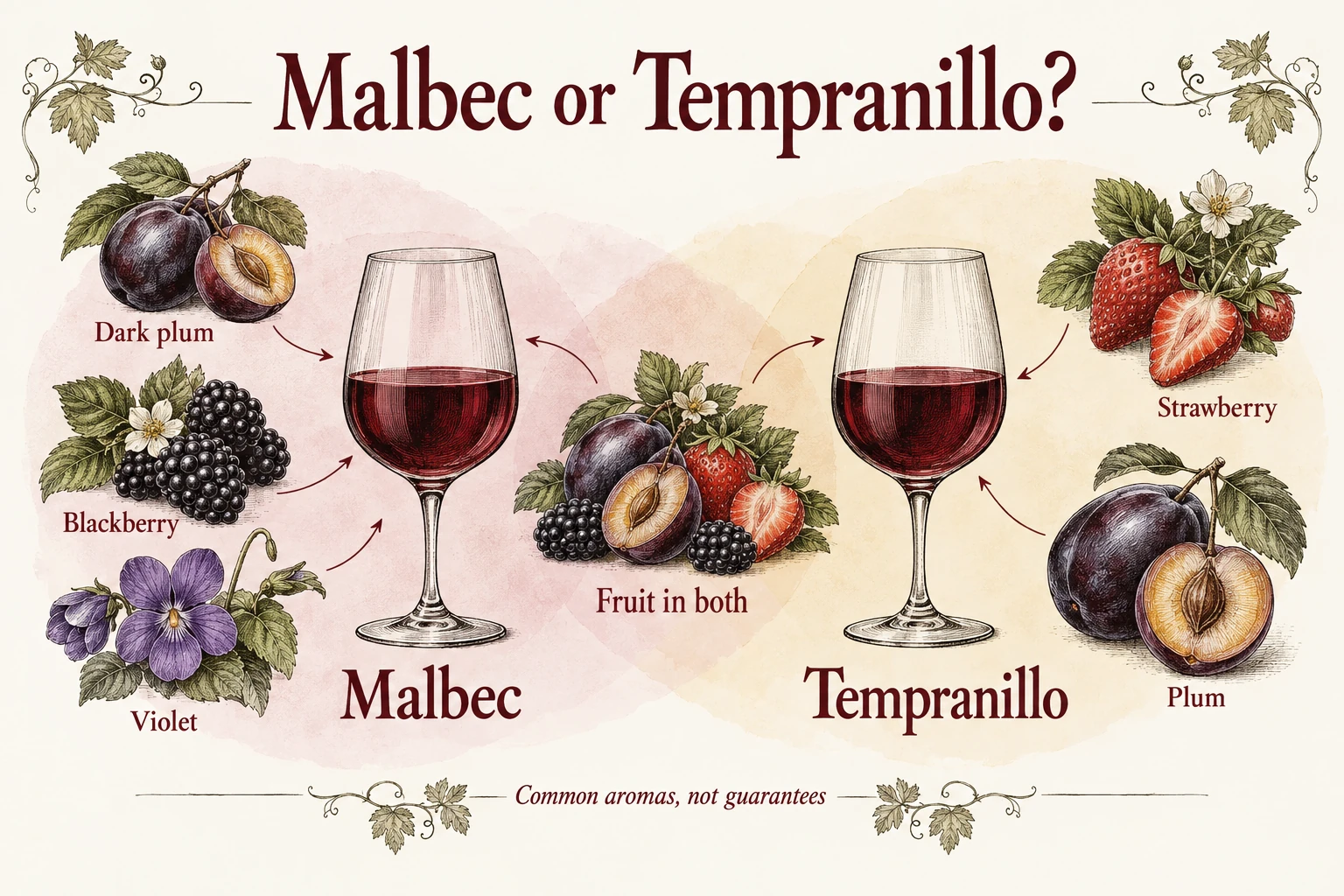
For Malbec vs Tempranillo, our first buying distinction is generous dark fruit versus a choice of youthful red fruit or developed savory character. Start with a fruit-led Argentine Malbec if blackberry and dark plum appeal. Try a young Tempranillo for a plum-and-strawberry direction, or a bottle-matured Rioja if you want fruit alongside oak spice and more developed aromas.
Searching Tempranillo vs Malbec leads to the same choices. These are useful reference styles, not a permanent “fruity versus earthy” divide. A young Tempranillo can be all about fruit; a matured Malbec can be savory. Ribera del Duero can also make substantial, dark-fruited Tempranillo, so it is a different starting point from a light young Spanish red.
Use the profiles to narrow the choice, then compare two bottles with similar price and maturation ambitions. That makes the difference you actually care about easier to find.
Malbec vs Tempranillo: At a Glance
Malbec: dark-fruit possibilities, several textures
Malbec has French roots and a particularly strong modern identity in Argentina. Mendoza examples span generous, rounded reds and fresher, floral expressions; Cahors offers another important reference. Vineyard and cellar choices matter as much as the name on the front label. WSET’s Malbec guide describes that range.
What to look for:
- Flavor Profile: dark plum, blackberry, and floral notes are useful starting associations; red-fruit styles also exist
- Body: Argentine examples often give a generous, substantial impression; fresher and more restrained expressions offer an alternative
- Tannins: rounded Argentine styles are a useful starting point for a plush feel; firmer examples, including many Cahors wines, also exist
- Acidity: depends on site and winemaking; compare freshness rather than assigning a grape score
- ABV: check the current bottle’s label; no single strength describes the grape
- Color: commonly deep, with variation from extraction and age
- Style Advantage: a direct starting point for generous dark fruit, with a choice of freshness or oak influence
Tempranillo: a choice between youthful fruit and maturation
Tempranillo is closely associated with Spain, especially Rioja and Ribera del Duero. It also appears under other names, including Portugal’s Aragonez and Tinta Roriz. Rioja’s regulatory council describes both youthful and age-worthy interpretations, with red and black fruit rather than an exclusively savory profile. Its Tempranillo overview explains the variety’s versatility.
What to look for:
- Flavor Profile: plum and strawberry are useful starting associations; dark fruit and flowers can also appear
- Body: youthful Spanish examples can feel lighter; oak-matured Rioja and concentrated Ribera del Duero can offer more weight
- Tannins: supple young examples and structured, age-worthy wines offer different choices; a Reserva label alone does not promise softness
- Acidity: depends on site and winemaking; the grape name cannot rank two bottles reliably
- ABV: check the current bottle’s label; a Spanish origin does not guarantee lower alcohol
- Color: red through purple in young examples, changing with age and style
- Style Advantage: a clear shopping route from youthful red fruit to the savory detail of a more developed Rioja
Fruit character gives you a starting point.
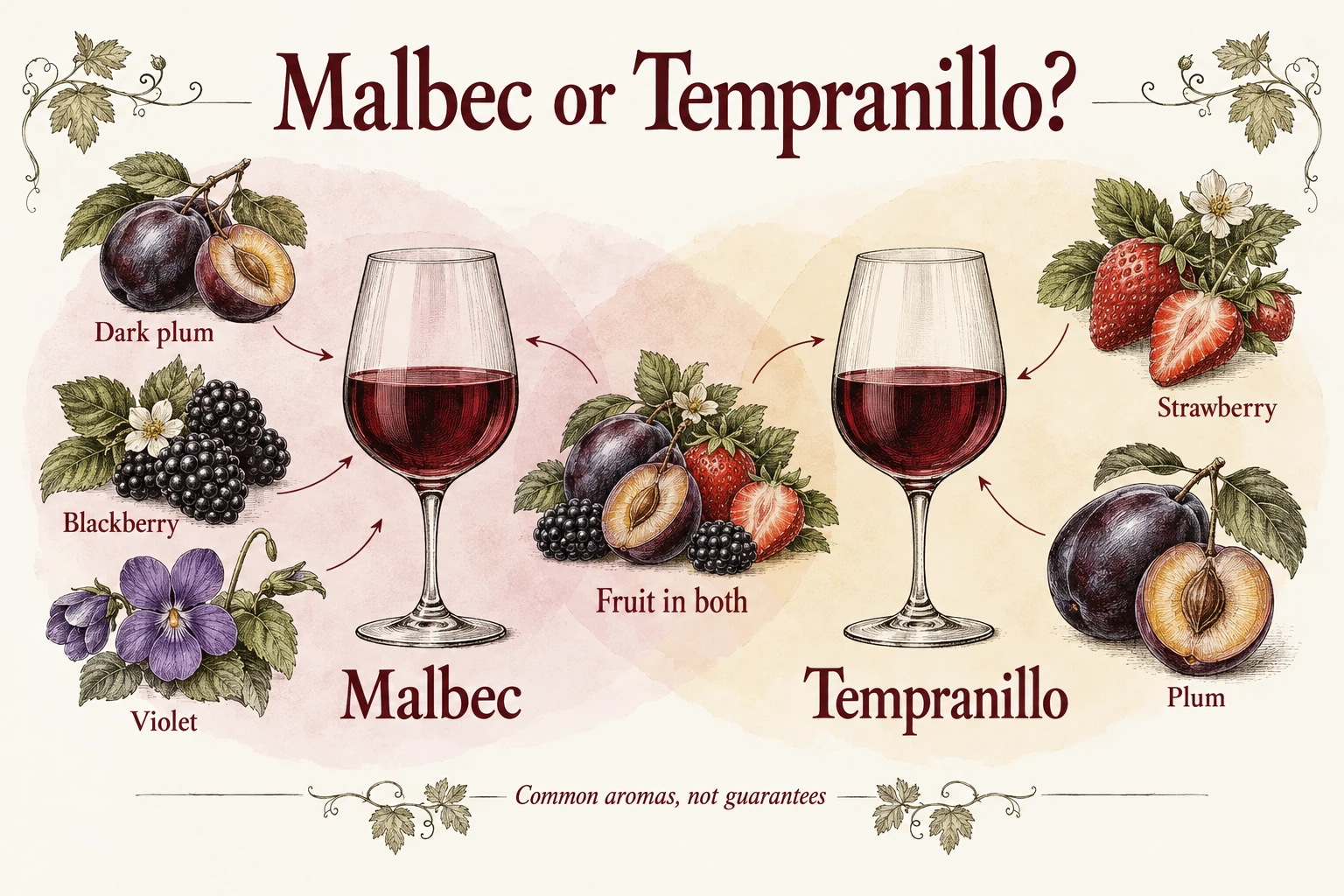
Read the illustration
Malbec: dark plum, blackberry, violet. Tempranillo: strawberry, plum. Fruit belongs in both groups. These are common associations, not exclusive traits or measurements.
Key Differences: Compare Origin, Fruit, and Maturation
These rows compare useful reference styles rather than claiming a fixed chemical difference between every bottle.
| Attribute | Malbec | Tempranillo |
|---|---|---|
| Origins | France; now strongly tied to Argentina | Spain; also important in Portugal |
| Fruit starting point | Dark plum and blackberry | Plum and strawberry; dark fruit too |
| Youthful route | Fruit-led Argentine; often generous | Young Spanish; can be lighter and fresh |
| Fuller reference | Concentrated Mendoza Malbec | Concentrated Ribera del Duero |
| Matured route | Oak-matured Argentine or mature Cahors | Oak-and-bottle-matured Rioja |
| Developed notes | Oak spice; earth with bottle development | Oak spice; dried fruit, mushroom, leather |
| Names to recognize | Malbec; Côt | Tinto Fino; Aragonez; Tinta Roriz |
| Blend check | Varietal wines and Bordeaux-style blends | Rioja and Portuguese blends are common |
| Reserva context | Read Argentine rules and actual oak notes | Read the named Spanish region's category |
Fruit is a better clue than “bold versus elegant”
For a reader who says “I want ripe black fruit and a generous mouthful,” fruit-led Argentine Malbec is our first suggestion. For “I want a fresher-feeling red-fruit style,” a young Tempranillo is worth trying. For “I want less emphasis on fresh fruit and more developed savory detail,” look at a matured Rioja.
Those suggestions describe different shopping routes. Plum and floral notes overlap, and a dark-fruited Ribera del Duero may sit closer to your preferred Malbec than to the young Tempranillo beside it. Rioja’s red-variety guide explicitly describes both delicate and powerful Tempranillo expressions.
If what you really want is a gentler finish, ask for that directly. The words “supple” and “rounded” are more useful buying clues than assuming every Malbec is soft or every Tempranillo is restrained. Our smooth-red guide explains how texture differs from sweetness.
Youthful versus matured can outweigh the grape difference
Put a fresh, little-oaked Malbec beside a young fruit-led Tempranillo and you can concentrate on fruit and texture. Put an oak-matured Malbec beside a similarly matured Tempranillo and you can compare how fruit, spice, and structure fit together.
As WSET’s teaching guide explains, Tempranillo spans simple fruit-led and more developed dry reds. An inexpensive young wine beside a long-matured bottle answers a different question: which of those two styles do you prefer? That is a worthwhile tasting, but it does not prove that the entire grape behaves like either example.
Both grapes can take either route.
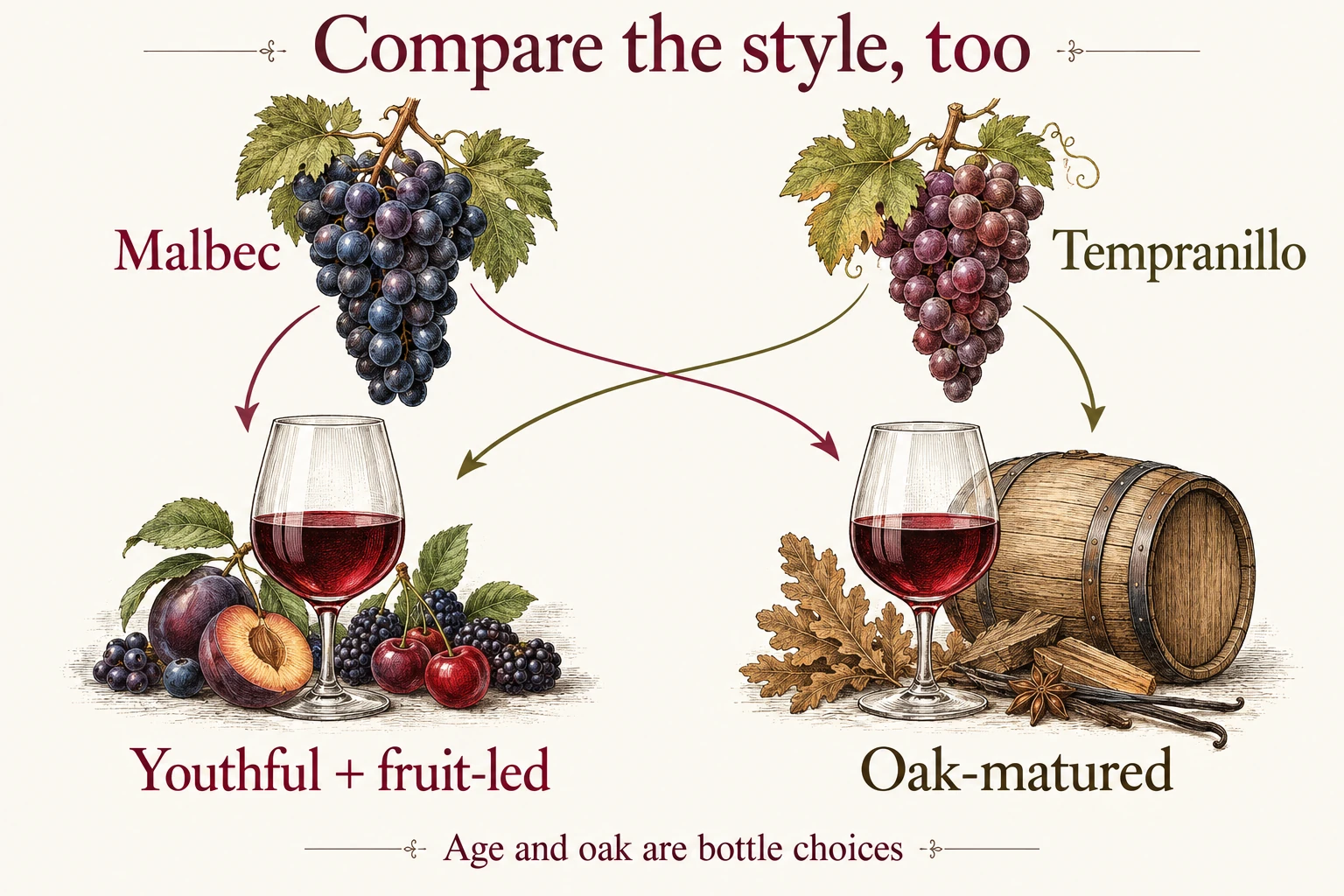
Read the illustration
Both Malbec and Tempranillo can be youthful and fruit-led or oak-matured. Check the particular wine's maturation rather than assigning one path to each grape.
Read Reserva in its own jurisdiction
Rioja and Ribera del Duero have their own controlled wine categories. Rioja red Reserva has a minimum total maturation period of 36 months, including at least 12 months in oak and at least six in bottle. The Rioja council’s category guide sets out those requirements. Ribera del Duero also distinguishes young, Roble, Crianza, Reserva, and Gran Reserva styles.
An Argentine Malbec marked Reserva should not inherit those Spanish requirements in your comparison. For a Familia Morgan bottle, use its disclosed maturation. Our 2020 Malbec Reserva documents 12 months in French and American oak, with 15% new oak. That is useful bottle evidence; it is not a claim that it follows Rioja’s complete Reserva timetable.
An older vintage also does not prove that a bottle was stored well or that you will enjoy its current condition. Ask for current drinking advice when buying a mature wine.
Read beyond Reserva.
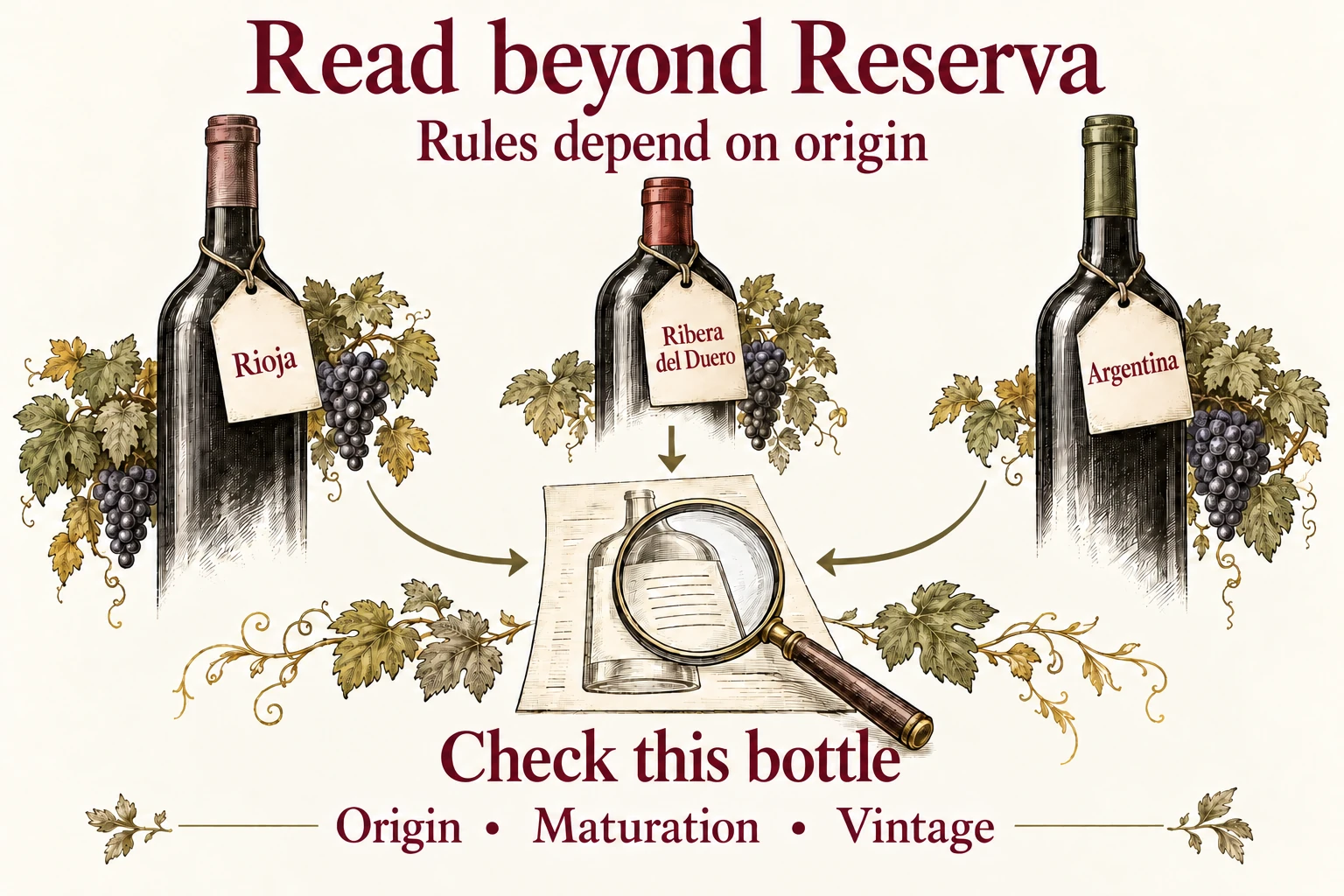
Read the illustration
Rioja, Ribera del Duero, and Argentina are different label contexts. Read origin, maturation, and vintage together; the shared word Reserva does not make the bottles equivalent.
Where Malbec and Tempranillo Grow
These are useful shopping reference points, not a ranking of origins.
Malbec: Where It Grows
- Mendoza, Argentina: a broad range of Malbec styles. Use the Mendoza regions guide when a subregion matters to your choice
- Cahors, France: a distinct Malbec reference, often associated with firmer structure. The local name Côt refers to Malbec. Check the individual wine rather than expecting an Argentine profile
- Patagonia, Argentina: another place to explore Malbec beyond Mendoza. Wines of Argentina’s regional overview shows why the country needs more than one style description
Tempranillo: Where It Grows
- Rioja, Spain: compare the actual blend and maturation category. Rioja is a region, not a synonym for a bottle containing only Tempranillo
- Ribera del Duero, Spain: Tempranillo is also called Tinto Fino or Tinta del País. The regional council identifies it as the principal variety; young wines and matured wines offer different starting points
- Portugal: the grape is known as Aragonez or Tinta Roriz and is often used in blends. Wines of Portugal explains the names; check the whole blend before treating it as a direct varietal comparison
Malbec vs Tempranillo Food Pairings
Malbec Food Pairings
Our starting choices emphasize fruit alongside savory food, with the wine’s texture matched to the bite.
Good Matches:
- Grilled beef with a fruit-present Malbec whose grip you enjoy
- Beef empanadas with a fresh, less oak-dominant style
- A rich rib roast with an oak-matured Malbec when jus and herbs lead the plate
Why It Works: these are opportunities to keep recognizable fruit beside browned meat and seasoning. Move toward a gentler bottle for leaner meat or a delicate filling; a substantial meal does not automatically require maximum tannin.
Tempranillo Food Pairings
Our starting choices emphasize the same balance, with an additional choice between youthful fruit and a more developed style.
Good Matches:
- Herb-roasted lamb with a savory, oak-influenced Tempranillo
- Roast pork with a youthful, fruit-led Tempranillo
- A savory bean-and-mushroom dish with a supple example rather than the firmest bottle
Why It Works: fruit and savory character can complement the plate in different proportions. Choose the wine’s weight for the dish, and taste before assuming maturation makes it a better match.
Pro Tip: Either grape can work with either set of foods. We use these as practical starting choices, not exclusive pairings. Sweet glaze, strong chile, or a very drying finish can change the answer; choose a different wine when it tastes better with the meal.
For the full plate decision, use wine with steak, wine with lamb, or wine with prime rib. WSET’s pairing principles support tasting food and wine together rather than treating a chart as a verdict.
A Malbec example from our range
We make the wines mentioned here. This is a producer explanation, not an independent tasting or ranking. Our 2024 Nine Queens Malbec offers a disclosed fresh red-fruit and subtle-smoke profile with stainless-steel fermentation and an unoaked product record. Our 2020 Malbec Reserva provides a documented oak-matured alternative with plum, dark fruit, and vanilla.
The public catalog checked October 13, 2026 listed them at $20 and $55 respectively; those dated prices illustrate two options within Malbec, not a quality ranking against Tempranillo. Product style and oak records were verified July 31, 2026. Current price and availability need checking on the product page.
If you want Rioja, Ribera del Duero, or Tempranillo’s particular expression, buy that wine. A Malbec should not be offered as an identical substitute. For a budget-led purchase, the affordable Malbec guide owns that decision; for the grape’s full background, use our Malbec guide.
FAQ: Malbec vs Tempranillo
Is Tempranillo sweeter than Malbec?
Neither grape name establishes a sugar level. Both offer dry red-wine styles, and ripe fruit aromas can occur in dry wine. If sweetness matters to you, ask for the producer’s sweetness description or residual-sugar information for that bottle. Plum or strawberry notes are not measurements.
Tempranillo vs Malbec: which is smoother?
Compare the actual bottles. A youthful, supple Tempranillo can feel gentler than a firm Malbec, and a rounded Malbec can feel gentler than a structured Tempranillo. Look at maturation and tasting descriptions, then notice the drying grip rather than equating “dry” with rough texture.
Is Tempranillo a cheap wine, and is Malbec a high-end wine?
Neither is a price category. Both grapes appear in everyday and ambitious wines. Region, producer, vintage, maturation, and market all affect the offer. Compare bottles at a budget you are comfortable with rather than paying for a grape’s reputation.
Is Tempranillo similar to Malbec?
It can be a useful next grape if you enjoy fruit-present red wines and want to explore another range of styles. Start with comparable oak influence and texture. A mature Rioja may be a bigger departure from a young Malbec than a young Tempranillo is.
Does Reserva mean the same thing on both bottles?
No. Read the origin and applicable category together. A Rioja label, a Ribera del Duero label, and an Argentine label do not provide interchangeable maturation guarantees. The producer’s disclosed barrel and bottle history is more informative than comparing the word alone.
Which should I choose for dinner?
Choose the bottle whose fruit, texture, and maturation suit both the dish and your preferences. For a savory roast, either may work. For a very sweet or hot preparation, reconsider the dry-red choice rather than making either grape win by default.
The Final Word: How to Choose
Choose Malbec when:
- You want a generous dark-plum and blackberry starting point: try a fruit-led Argentine example
- You like that fruit direction but want oak spice: compare a documented oak-matured bottle
- Beef or empanadas are on the table and fruit contrast is your preference
Choose Tempranillo when:
- You want a youthful plum-and-strawberry direction: try a young, less oak-dominant Spanish bottle
- You want oak and developed savory aromas: explore a bottle-matured Rioja
- You want a substantial Spanish red: compare a concentrated Ribera del Duero rather than assuming Tempranillo is always lighter
The honest answer: choose a style within the grape before declaring a winner between grapes. Similar price, serving conditions, and maturation make a side-by-side comparison more useful.
Keep comparing with Malbec vs Merlot and Malbec vs Cabernet Sauvignon, or return to the Malbec comparison guide.
This guide covers the Malbec–Tempranillo choice. The linked grape, region, value, and food guides handle those more specific decisions.