At the table · bottle field guide no. 05
Wine Bottle Sizes Chart: A Volume-First Guide
A bottle name can change when the wine or region changes. The milliliters do not. Start with the printed volume, then translate the tradition.
Research note: Current U.S. and Argentine label rules establish how net contents are stated; Comité Champagne supplies its own bottle-name sequence; NIST and NIAAA support the unit and serving calculations.
The rule that survives every chart
The printed volume wins
A standard comparison bottle contains 750 mL. A magnum contains 1.5 L, exactly two of those bottles; 3 L is four; 6 L is eight. But names beyond magnum can change with wine tradition and market. Treat the label’s mL, cL, or L as the fact and the traditional name as context.
The table calculates U.S. 5-fluid-ounce servings from the nominal volume. Those are inventory units, not instructions to drink, and real pours, residue, and service loss can differ.
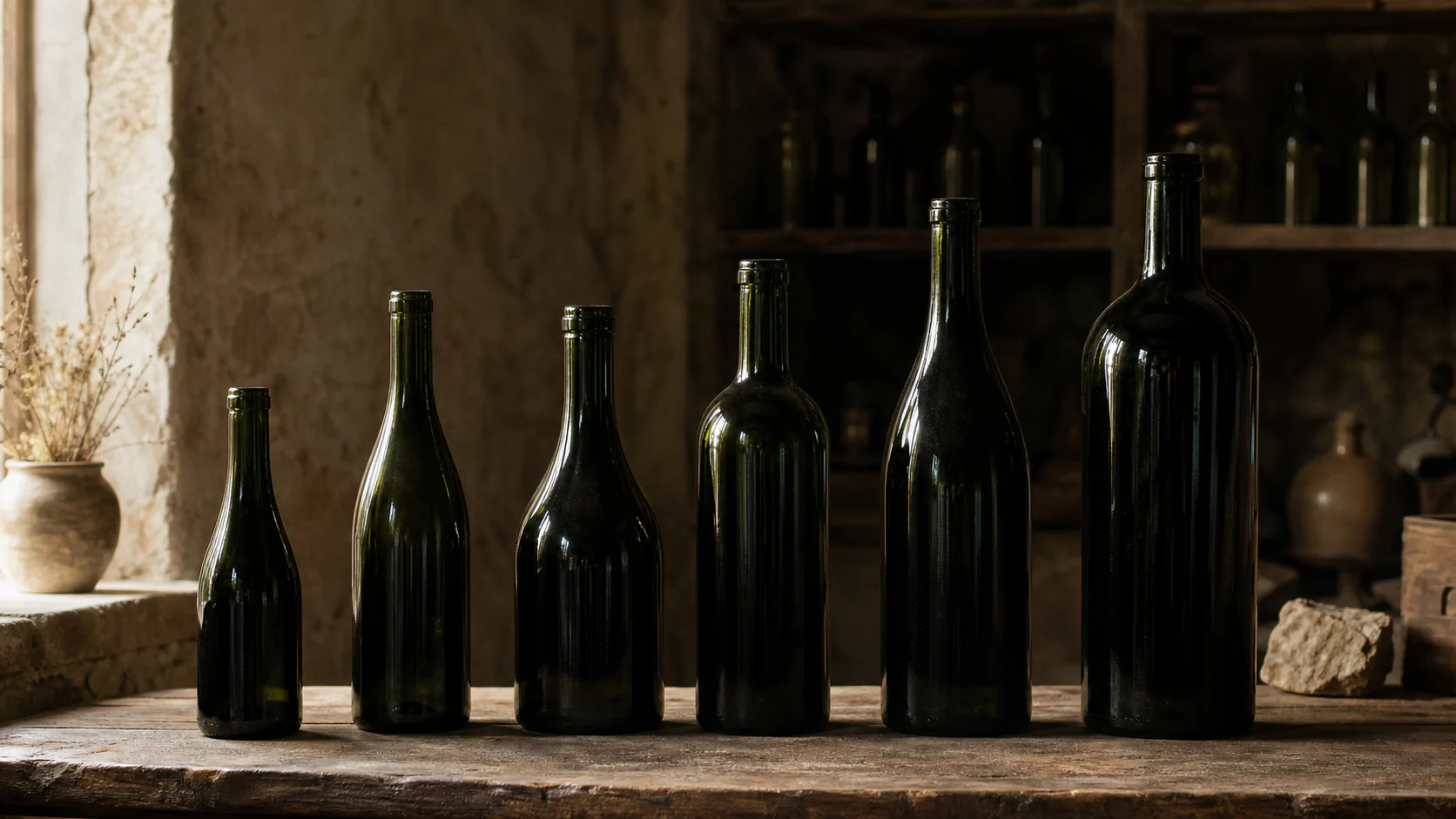
The glossary owns each concise bottle-name definition; this guide owns the comparison. Use the linked entries for the meaning of split, standard bottle, double magnum, Jeroboam, Rehoboam, Methuselah, Imperial, Salmanazar, Balthazar, Nebuchadnezzar, and Solomon. Use this page when you need them on one evidence-bounded scale.
From reference to purchase plan
Do not force every party into 750 mL math
The standalone calculator accepts the exact bottle volume—including a custom size—plus adult guests, expected wine drinkers, pour size, an optional visible buffer, bottles already on hand, ABV, and a separate alcohol-free inventory line.
01 · Volume before folklore
Eight reference points on one axis
The rail uses a logarithmic volume axis so a 187 mL package remains readable beside 30 L. Point position encodes nominal liquid volume. It is not physical bottle height or width: glass shape, wall thickness, punt, neck, and closure vary.
Nominal capacity · logarithmic
From 187 mL to 30 L
160× more volume from end to end
- 187 mL Split / mini
- 375 mL Half-bottle
- 750 mL Standard bottle
- 1.5 L Magnum
- 3 L Double magnum / Jeroboam
- 6 L Methuselah / Imperial
- 15 L Nebuchadnezzar
- 30 L Melchizedek or Midas
02 · The full reference
Wine bottle sizes, equivalents, and 5 oz servings
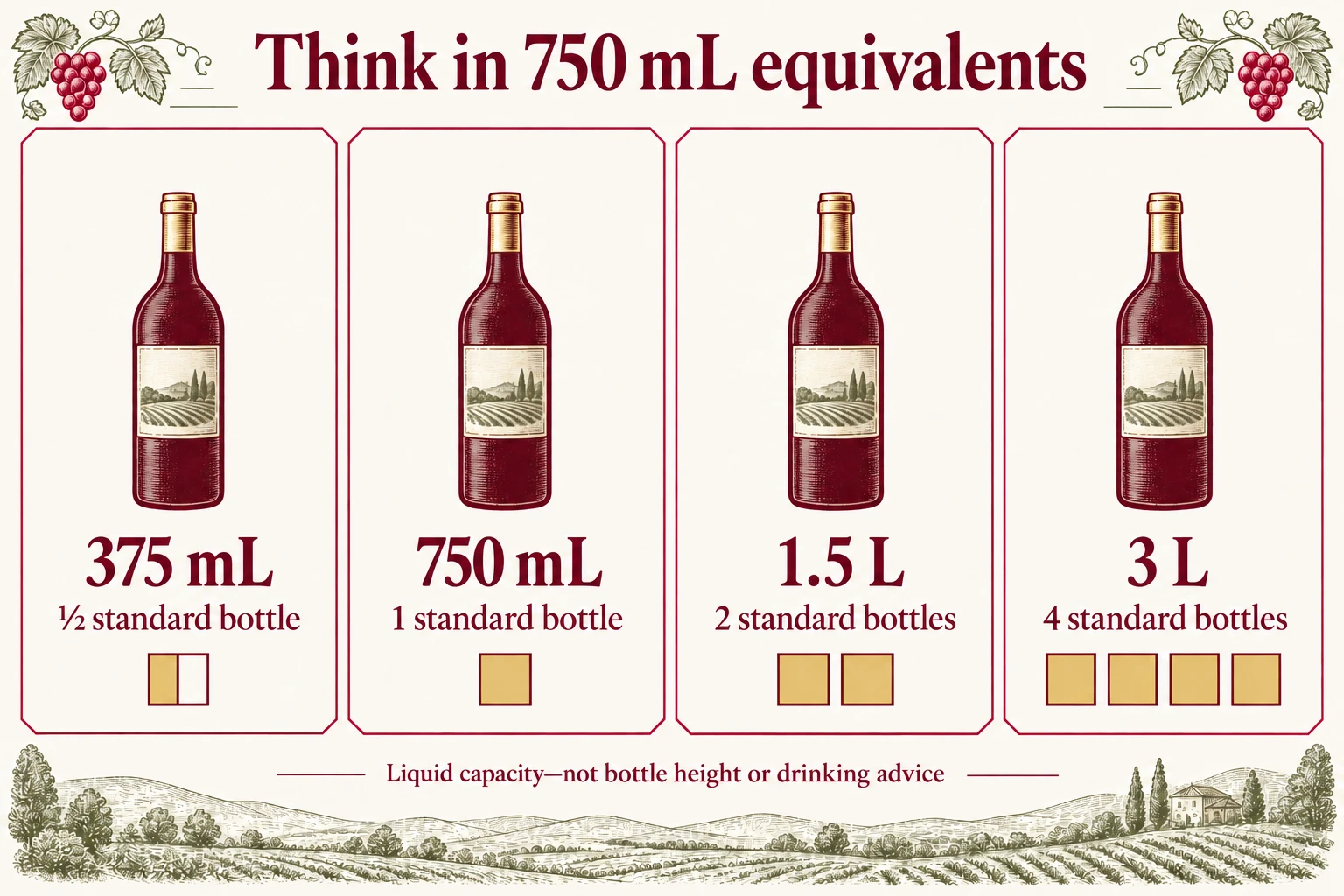
Read the illustration
375 mL is half of a 750 mL bottle; 750 mL is one; 1.5 L is two; 3 L is four. These are liquid-capacity equivalents, not physical bottle dimensions or suggested consumption.
The serving column uses Volume ÷ 147.87 mL, because NIST gives one U.S. fluid ounce as 29.57353 mL and five fluid ounces are 147.86765 mL. The bottle-equivalent column uses Volume ÷ 750 mL. Values are nominal and rounded for display.
| Name | Volume | 750 mL equivalents | Approx. 5 oz servings | Naming context | Practical use / handling |
|---|---|---|---|---|---|
| Split / mini | 187 mL | 0.249 | 1.3 | A current U.S. authorized fill. “Split” is market shorthand; Comité Champagne’s quarter is 200 mL. | A small package, often seen in hospitality or sparkling wine. Read the number on the label. |
| Quarter | 200 mL | 0.267 | 1.4 | The official Comité Champagne size list calls 20 cL a quarter. | A small Champagne format; not numerically identical to a 187 mL U.S. split. |
| Half-bottle | 375 mL | 0.5 | 2.5 | Demi or half-bottle in many markets; the number remains the reliable conversion. | Useful when a full 750 mL package would exceed the planned volume. |
| Medium / pinte | 500 mL | 0.667 | 3.4 | Comité Champagne lists 50 cL as medium or pinte. Elsewhere, 500 mL may have no special name. | A label-specific intermediate format; common uses vary by wine style and market. |
| Standard bottle | 750 mL | 1 | 5.1 | The comparison baseline used on this page, not the only legal or commercial fill. | The familiar reference package for bottle equivalents and event inventory. |
| Liter bottle | 1 L | 1.333 | 6.8 | An authorized U.S. fill without one universal traditional bottle name. | Use 1,000 mL in the calculation instead of rounding it to a “bottle and a third.” |
| Magnum | 1.5 L | 2 | 10.1 | Magnum is stable across the official Champagne list and widespread still-wine usage. | A manageable large format for group service; check the actual bottle and closure before opening. |
| Double magnum / Jeroboam | 3 L | 4 | 20.3 | Common still-wine shorthand says double magnum; Comité Champagne calls 3 L Jeroboam. | Plan a stable service position and enough glassware before opening. |
| Rehoboam | 4.5 L | 6 | 30.4 | The official Champagne list calls 4.5 L Rehoboam. Still-wine charts may use other names. | A heavy event format. Confirm availability, opening, support, and service with the seller or producer. |
| Methuselah / Imperial | 6 L | 8 | 40.6 | Comité Champagne uses Methuselah; many Bordeaux-context charts use Imperial. Verify the label. | Special handling is prudent; the filled package is much heavier than the wine volume alone. |
| Salmanazar | 9 L | 12 | 60.9 | A named size on the official Champagne list. | Ceremonial event scale; coordinate safe transport, chilling, opening, and pouring. |
| Balthazar | 12 L | 16 | 81.2 | A named size on the official Champagne list. | Professional or producer guidance is sensible before moving or serving the filled bottle. |
| Nebuchadnezzar | 15 L | 20 | 101.4 | A named size on the official Champagne list. | A display and service project, not merely “twenty normal bottles” from a handling standpoint. |
| Salomon / Solomon | 18 L | 24 | 121.7 | Comité Champagne spells the 18 L format Salomon; English-language charts may say Solomon. | Rare ceremonial scale. Establish equipment, people, and a controlled pour plan in advance. |
| Souverain | 26.25 L | 35 | 177.5 | A 26.25 L named format on the official Champagne list. | Specialized producer-led handling and service. |
| Primat | 27 L | 36 | 182.6 | A 27 L named format on the official Champagne list. | Specialized producer-led handling and service. |
| Melchizedek or Midas | 30 L | 40 | 202.9 | The official Champagne list gives both names for 30 L. | The largest format in that published sequence; plan with the producer or experienced service team. |
03 · Three naming lanes
Bottle names are regional conventions, not a worldwide standard
A traditional name can be useful shorthand within a defined context. It becomes misleading when a chart moves the name into another region without saying so. When the name and number disagree, read the label before using a traditional name as a conversion.
United States · current fill rules
The regulator authorizes numbers, not biblical names
TTB’s May 2026 guidance lists authorized fills through 3 L—including 187 mL—not 187.5 mL—then permits wine containers from 4 through 17 liters in whole-liter quantities. Containers of 18 L or more are exempt from the general standards-of-fill rule but still need their net contents stated as required.
A casual “quarter bottle” calculation may produce 187.5 mL; that does not change the current 187 mL U.S. listed fill.
France · Comité Champagne
Champagne naming lane
The Comité’s published sequence includes a 200 mL quarter, 375 mL half-bottle, 500 mL medium or pinte, 750 mL bottle, 1.5 L magnum, 3 L Jeroboam, 4.5 L Rehoboam, 6 L Methuselah, 9 L Salmanazar, 12 L Balthazar, 15 L Nebuchadnezzar, 18 L Salomon, 26.25 L Souverain, 27 L Primat, and 30 L Melchizedek or Midas.
That is a Champagne-specific official list, not a license to rename every still-wine bottle.
Argentina · current label rule
The net contents must stay visible and metric
The INV’s current labeling guidance requires net contents to be stated in milliliters, centiliters, or liters. It places the legal product name, alcohol, net contents, and country in the same visual field, with current size and legibility requirements.
For an Argentine bottle, the declared metric contents are the planning input. The silhouette is not.
04 · Transparent arithmetic
How every number in the table is calculated
750 mL equivalents
labeled volume in mL ÷ 750 mL
Example: 4,500 ÷ 750 = 6 standard-bottle equivalents.
Five-ounce volume units
labeled volume in mL ÷ (5 × 29.57353 mL)
Example: 750 ÷ 147.86765 = about 5.1 five-ounce units.
Bottles to buy
round up (planned volume ÷ labeled bottle volume)
Do not round to the nearest bottle. A fraction means the plan needs the next full package.
Nominal is not measured service. The label describes packaged volume. A host’s glass markings, foam, sediment, spills, tasting discards, and unfinished wine can change what reaches glasses. The calculator exposes a user-selected buffer instead of hiding one.
05 · Size without mythology
Large format changes logistics before it changes meaning
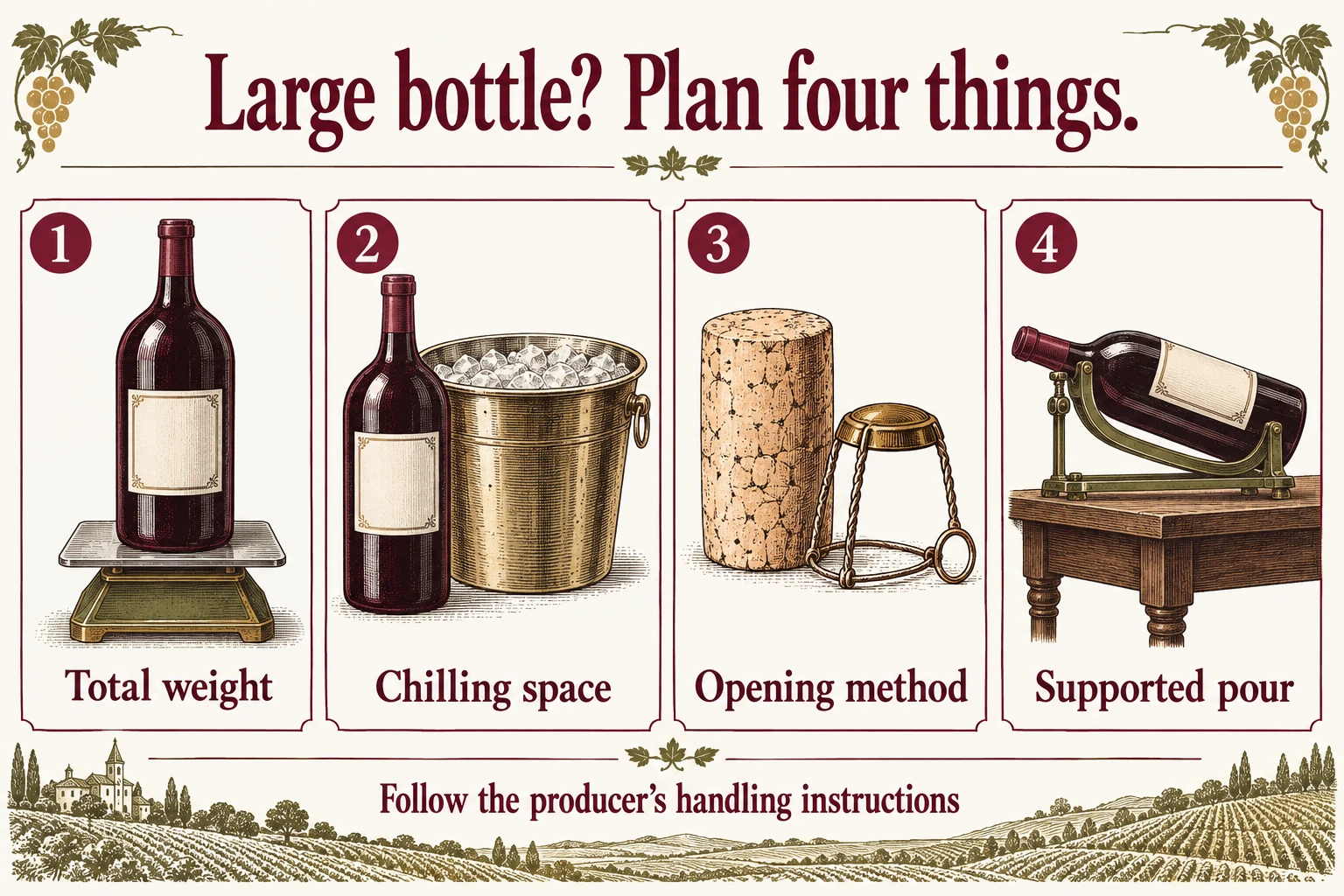
Read the illustration
For a large bottle, check total package weight, storage and chilling space, the specific closure, and a stable supported pour. Capacity alone does not tell you how to lift, open or serve the bottle.
Weight is not just liquid
One liter of wine is roughly one kilogram before the glass is counted, but bottle glass mass and geometry vary. Do not estimate a safe lift from liquid volume alone. Use the producer’s handling instructions and more than one trained person when appropriate.
Opening is package-specific
Closure dimensions, pressure, disgorgement history, and service hardware can change with format. A familiar name does not guarantee a familiar cork or opening method.
Aging is not guaranteed by size
Comité Champagne explains a lower air-to-wine ratio for some larger formats when the neck and closure are comparable. That mechanism does not make every large bottle better. Wine, oxygen at bottling, closure, storage, pressure, and production method still matter.
Chill and serve deliberately
A large package may not fit ordinary refrigeration or buckets. Confirm temperature control, a stable surface, opening space, pour support, glasses, and a plan for remaining wine before the event begins.
06 · Put the chart to work
Choose the event question before the bottle count
A comparative wine tasting flight may use several small samples of different wines; an Argentine asado may open styles in stages; a sobremesa table should ask who actually wants wine and keep reserve bottles sealed. Those are different inventory problems even when the guest count matches.
Set wine drinkers, pours, exact bottle volume, visible buffer, on-hand bottles, ABV, and alcohol-free inventory.
Need the comparison Tasting flight guidePlan equal samples across several wines without confusing tasting volume with a standard drink.
Need the evening Sobremesa hosting guidePlan pacing, inclusive drinks, the table transition, and a clear ride home.
Sources and methodology
Facts checked July 11, 2026. Regulatory sources control labeling statements; Comité Champagne controls the Champagne naming lane; NIST controls the unit conversion; NIAAA controls the U.S. standard-drink reference. Editorial handling notes are deliberately cautious because glass, closures, and producers vary.
- TTB: Wine labeling—net contents — current authorized U.S. fills, metric display, large-container treatment, and exact-content guidance; updated May 21, 2026.
- Comité Champagne: bottle-size FAQ — the official quarter-to-Melchizedek/Midas sequence used in the Champagne naming lane.
- Instituto Nacional de Vitivinicultura: current wine-product labeling — net contents in metric units and placement/legibility under Resolution 37/2025.
- OIV: presentation of nominal volume — liters, centiliters, and milliliters as the core wine-label units.
- NIST: U.S. customary-to-metric volume conversion and NIST SP 1020 — 1 U.S. fluid ounce = 29.57353 mL for the table’s arithmetic.
- NIAAA: What is a standard drink? — 0.6 U.S. fluid ounces or 14 grams of pure alcohol, with 5 fl oz at 12% ABV as a familiar wine example.
- CDC: Prevent impaired driving — plan a trusted designated driver, alternative transport, and alcohol-free beverages before an event.